
A facilities manager stands in a half-lit company lobby at eight in the morning, looking at the corner where a rented photo station will sit for the afternoon recruiting open house. The line item was $1,800. By the time the equipment leaves that evening, the company will have a few hundred photos, a stack of branded prints, and no clear answer to whether the spend earned anything back.
The best photo booth for that situation, and for corporate settings in general, is not a format. It is the booth that matches two things: how often the company will deploy it, and what it needs the booth to produce. A single external event points toward renting. An office program plus a yearly calendar of events usually points toward owning. Format, the question every rental listicle answers first, is actually the last decision.
This page is written for the people who make that call: HR directors, facilities managers, field marketers, multi-location operators, and procurement. It lays out a decision framework, a rent-versus-own break-even keyed to a company’s own internal touchpoints, and an honest method for calculating return.
Start With the Two Questions That Decide This
A marketing coordinator opens the first vendor page in the search results and meets a wall of formats: open-air, enclosed, 360, glam, green screen, AI. Each one has a photo gallery and a “perfect for corporate” caption. The page assumes the buyer’s first job is to pick a silhouette. That is the wrong first move, and it is why corporate photo-booth purchases so often end up either over-built or under-equipped.
Two questions decide the purchase, and format sits downstream of both.
Deployment frequency
The first is deployment frequency. Is this one event, or a recurring need? Frequency decides whether to rent or own, and that single choice governs most of the budget. A company renting once a year and a company running a standing program are not buying the same thing, even when the equipment on the floor looks identical.
Required output
The second is required output. Does the booth need to produce entertainment, branded content, or opt-in contact data? Output decides the software and the form factor, because the capture flow, the consent step, the delivery method, and the data export all live in software, not in the hardware shell.
Answer those two and the format mostly chooses itself. A recurring office program that needs reliable participation and a small footprint narrows to a short list before anyone opens a photo gallery. A one-off trade-show activation built to capture leads narrows to a different list. The spectacle formats, the 360 rig and the glam setup, are situational add-ons, not defaults.
Office vs. Event: Two Different Buying Problems
An HR director and a marketing director walk into the same budget meeting, both asking for “a photo booth.” They are not asking for the same thing, and funding it as one line item is how companies end up with the wrong equipment in both places.
When renting makes sense
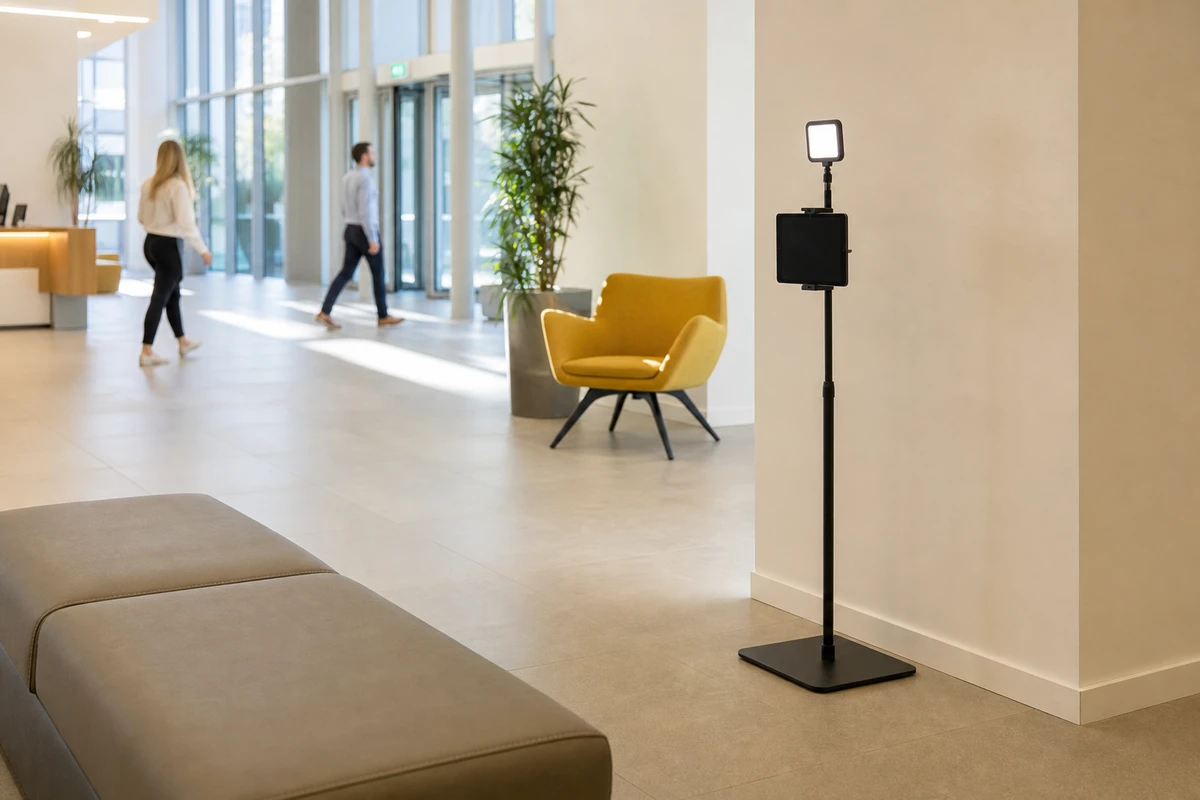
A corporate office is a recurring, internal, employee-facing environment. The relevant moments are a lobby or break-room installation, onboarding days, quarterly all-hands meetings, employee-appreciation afternoons, and recruiting open houses. The need is continuous and low-drama. The output skews toward culture, morale, and employer-brand content, the photos that end up on a careers page or an internal channel. The owner is usually HR or facilities. This use case rewards owning equipment that is simple, reliable, and always available, because paying a specialist to set up and tear down for each session would swamp the value of any one of them.
A corporate event is a one-off, external, marketing-facing activation: a trade show, a product launch, a conference, a sponsorship, a client-appreciation night. The need is episodic and high-stakes. The output skews toward branded social content and lead capture. The owner is usually marketing or events. This use case can justify renting a premium, staffed, format-specific activation, the kind of setup that would sit idle and depreciate for eleven months if owned. It can also justify owning, once the event calendar is full enough.
The point the rental search results miss is that one company usually has both needs at once, and the mistake is to fund one and forget the other. Buy into a premium rental habit and the office gets nothing between events. Equip the office with a basic setup and the flagship trade show gets a booth that underrepresents the brand. The fix is an inventory, done before any format or vendor enters the conversation: every office touchpoint and every event for the next twelve months on one sheet, each marked internal or external, recurring or one-off. That sheet, not a vendor gallery, is what the purchase should be built from.
What the Booth Must Produce: Entertainment, Branded Content, or Opt-In Data
At a holiday party, a booth succeeds if the line stays busy and people laugh. At a trade show three weeks later, the same booth can run flawlessly, photograph beautifully, and still fail, because the marketing team needed 400 consented contacts in a CRM and got a folder of nice images instead. Same hardware, opposite outcomes. The difference is the job.
A corporate photo booth does one of three jobs as its primary work, and usually a second as backup.
Entertainment and culture
The first is entertainment and culture: the work at office parties, all-hands meetings, and employee-appreciation events. Success is participation rate and morale, not polish. It calls for simplicity, instant prints or digital copies, props, and low enough operating friction that the booth runs without a hired specialist. The fanciest format is close to irrelevant here. Freeman’s Q1 2024 Trends Report, a survey of 2,002 B2B event attendees, found that 56% want hands-on, participatory experiences while only 31% of organizers treat hands-on as a top priority. Attendees ask to take part, and a simple, fast booth lets more of them do it than an elaborate rig would.
Branded content and social reach
The second is branded content and social reach: the work at product launches, brand activations, and sponsorships. Success is shares, impressions, and the volume of on-brand content produced. The requirements live in software: custom overlays and templates, instant delivery by text or email so guests share from their own phones, and full brand control of the output. EventTrack 2025, the experiential benchmark published by Event Marketer, reports that 72% of attendees actively capture and share event content online. A booth that fails to hand them clean, branded material leaves that reach unclaimed.
Opt-in data and lead capture
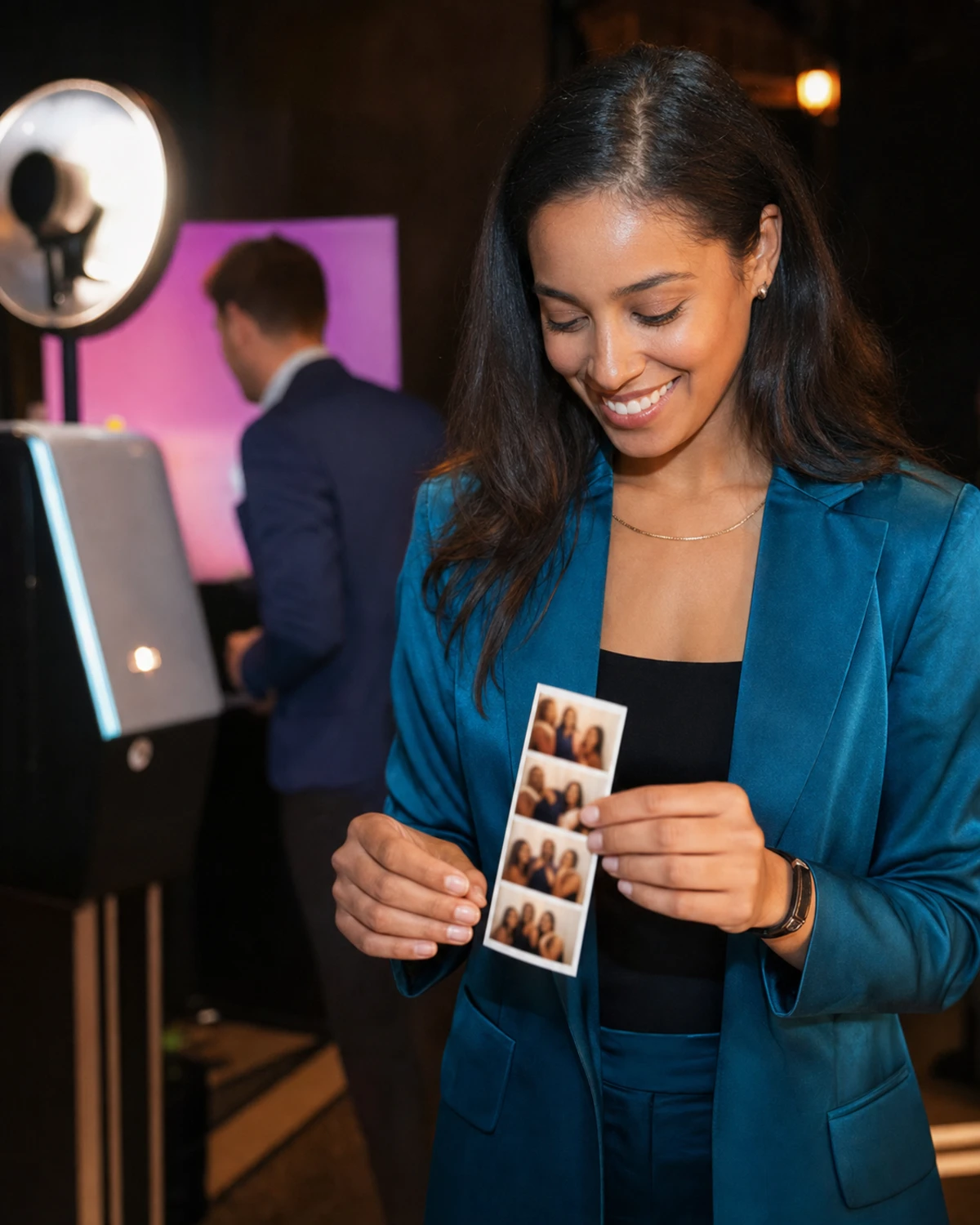
The third is opt-in data and lead capture: the work at trade shows and recruiting events. Success is qualified, consented contacts exported to a CRM. It requires a consent-based form that gates photo delivery, clean data validation, CRM-ready export, and a defensible privacy posture.
The misconception worth correcting: “best” is not the most spectacular format; it is the configuration that does the buyer’s primary job. A 360 booth with no data-capture flow is the wrong tool for a trade show no matter how good its footage looks. The output requirement dictates the software far more than it dictates the hardware silhouette, which is why the format question, when it finally arrives, deserves less space than the search results give it.
The Format Question, Settled Quickly
Walk a trade-show floor and the formats announce themselves: a 360 rig with a guest spinning on a platform, an enclosed booth behind a curtain, an open-air station that is mostly a tablet on a stand. The visual variety is real, and it is where most buyers spend their first and longest decision. It deserves a fraction of that attention.
Throughput separates the formats
Throughput is what separates these formats in practice. Video Activations, an activation vendor that serves Fortune 500 brands, publishes a format comparison drawn from its own operations. The numeric throughput figures below are vendor-operational data rather than independent research, but they are the most granular numbers available publicly and they line up with general event-production experience.
| Format | Best job | Throughput/hour | Footprint and staffing |
|---|---|---|---|
| Open-air (tablet/app) | Recurring office program, most events | High | Small; can run self-serve |
| Enclosed | Casual office parties, classic prints | Lower, bottlenecks at volume | Larger; usually attended |
| 360 video | Social spectacle, floor traffic | 40 to 80 | About 15 by 15 feet; staffed |
| Glam / portrait | Upscale galas, VIP nights | Low, slow by design | Moderate; staffed |
| Green screen / AI | Campaign-specific branded content | 40 to 80 | Moderate; needs creative lead time |
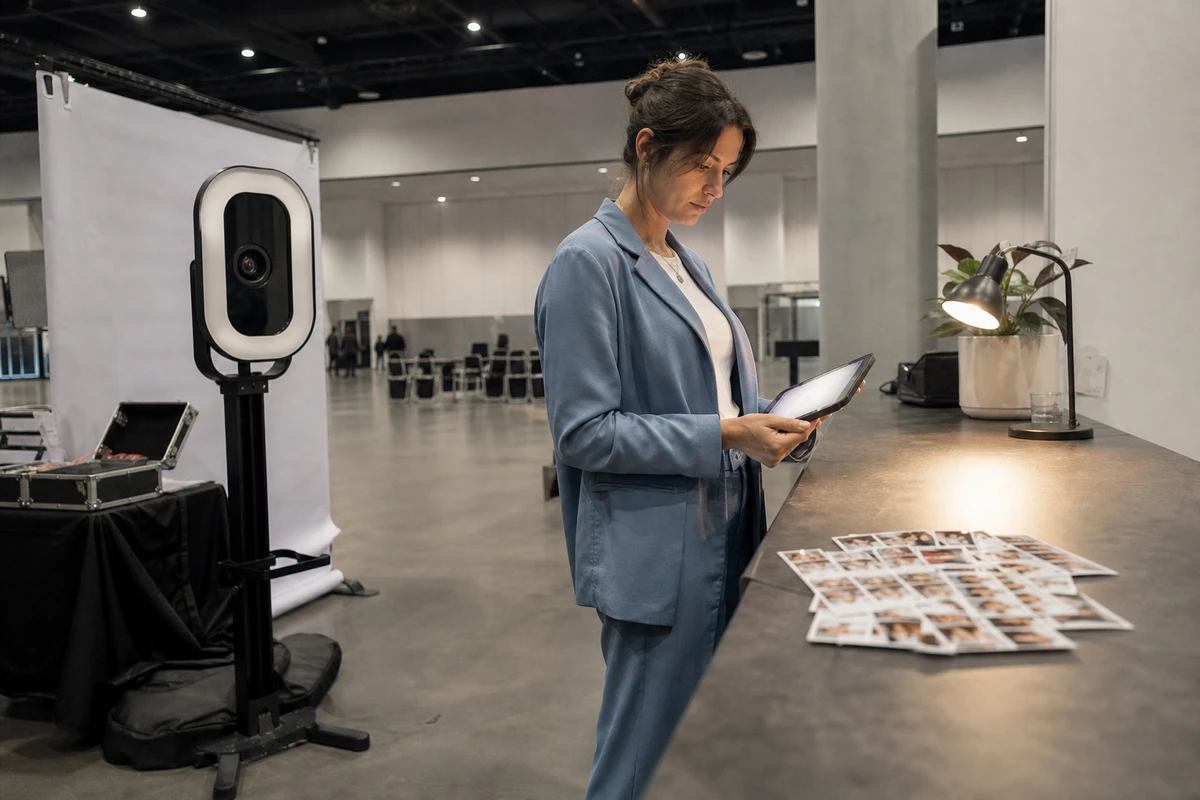
The open-air booth, a camera or tablet on a stand running brandable software, is the versatile default: high throughput, fully controllable output, a small footprint, and the option to run unattended. It fits the recurring office program and most events. The enclosed booth gives privacy and classic printed strips and suits a casual office party, but it bottlenecks once a crowd forms. The 360 booth is a real traffic magnet and a real constraint at once; at 40 to 80 guests an hour it is a situational moment, not the backbone of a program. Glam and portrait formats are staffed, slow, and premium, which fits an executive gala and little else. Green screen and AI formats produce strong campaign content but need creative production time booked well ahead.
Most corporate jobs, office and event alike, are best served by a software-driven open-air booth. Clear Choice Photo Booth, a rental vendor, reaches the same verdict from the rental side, calling open-air the best all-around choice for corporate use for its throughput and group-friendliness. The spectacle formats are add-ons for specific moments. A buyer who starts the decision there is optimizing the smallest variable.
Rent or Own: The Break-Even Math for a Corporate Buyer
A marketing director with one trade show a year and a facilities manager with a lobby, a quarterly all-hands, and a recruiting calendar can look at the identical booth and should reach opposite decisions. The deciding number is not the price of the equipment. It is how many times the equipment gets used.
Rental cost first
Rental cost first. Across vendor marketplaces and market surveys, a single corporate rental runs roughly $400 to $1,500 for a standard open-air booth, with branded, staffed setups landing higher. Video Activations puts basic rentals at $1,200 to $2,000 and professional branded activations, with trained staff and custom creative, at $2,500 to $12,000 or more per event. A branded, staffed corporate booth in a major market is reasonably budgeted around $2,000 to $3,000.
Ownership next
Ownership next. A complete software-driven open-air system is a stack of parts: a tablet or camera, a stand or shell, lighting, a software license, and an optional dye-sublimation printer. Independent operator guides and Clear Choice Photo Booth’s market analysis put a complete tablet-based system with a printer at roughly $3,500 to $6,000, a professional open-air booth at $6,000 to $12,000, and a full operator-ready setup with backup equipment at $7,000 to $15,000. Software is separate, either a monthly subscription (roughly $20 to $150) or a one-time license.
The break-even
The break-even. Clear Choice Photo Booth, working the math from the rental side, concludes that renting costs less for any company hosting fewer than 15 to 20 events a year, with a worked example showing 21 events a year over three years to recover a $10,000 purchase at $900 per rental. That is vendor analysis, not independent research, and it shifts with purchase price and rental rate, but it is consistent across multiple vendor sources.
The reframe no rental page makes: a corporate buyer should not count “events,” it should count internal touchpoints. A company with a lobby installation (effectively continuous), a quarterly all-hands, a holiday party, a summer outing, two or three recruiting events, and four to six trade shows or activations is already past 15 deployments a year. For that company, owning crosses break-even inside the first year or two, and every deployment after sits near marginal cost. Renting still wins for a company with one flagship event and nothing else. Cost is not the only factor either: owning needs an internal owner for the gear, storage space, and a tolerance for handling staffing and reliability. A buyer who wants a different premium format each time, or who would rather offload that operational risk, can rationally keep renting past break-even. The honest rule is procedural: inventory the annual touchpoints first, then let the count decide.
Two Worked ROI Examples
A finance partner reviewing the events budget does not want a vendor’s “$3.50 return per dollar” headline. They want the arithmetic. Measuring that arithmetic has gotten easier: Bizzabo’s 2025 State of Events benchmark found the share of organizers reporting difficulty proving event ROI fell to 40%, down from 70% a year earlier. Two worked scenarios show how a company runs its own version.
Take a three-day trade show
Take a three-day trade show. The booth runs 600 guest sessions across the show. At a 70% opt-in rate, that is 420 consented contacts exported to the CRM. If 4% of those contacts convert and the average deal is worth $1,200, the booth produced 420 × 4% × $1,200, or $20,160 in closed business against a roughly $2,500 booth cost. The conversion rate and the deal value are the swing variables, and they are company-specific; the structure of the calculation is what transfers, not the example’s inputs.
At that $2,500 cost, the booth captured leads at about $5.95 per consented contact. For comparison, the HubSpot and FirstPageSage 2025–2026 benchmark puts the average LinkedIn B2B cost-per-lead near $110, and WordStream’s 2024 data puts the cross-industry Facebook average near $22. A booth capturing consented contacts at single-digit cost competes well with paid social, with the added difference that the contact also had a live brand interaction.
Now an internal event
Now an internal event. A company runs an employee-appreciation afternoon with 100 attendees. If 40% opt in to receive company communications and each contact is conservatively worth $50 in downstream pipeline or referral value, that is 100 × 40% × $50, or $2,000 of pipeline from one afternoon. The morale side is real but belongs in directional terms, not a precise figure. Gallup’s workforce research puts the cost of replacing an employee at one-half to two times annual salary, $25,000 to $100,000 on a $50,000 wage. A single photo activation does not move that number alone, but it contributes to the event satisfaction and engagement Gallup links to lower turnover, and the scale of that turnover cost is why even a directional improvement is worth tracking.
One caution on numbers borrowed from competitor content. A cluster of statistics circulates across rental-vendor pages: a 68% satisfaction lift, seven-times engagement versus email, 94% brand recall, a $3.50 return per dollar, 92% lead-capture accuracy. None traces to a primary source, and the “industry average” return figure is, on inspection, a rounding of one vendor’s own worked example. They should carry no weight in a procurement decision. The arithmetic above, run on a company’s real opt-in rate, conversion rate, and contact value, is worth more than any borrowed benchmark.
Throughput, Lead Time, and the Mistakes That Waste the Budget
Anyone who has watched a 45-minute line form at an activation that looked flawless in the proposal knows the most expensive photo-booth mistakes are operational, not format choices.
Throughput is the common miss
Throughput is the variable buyers underestimate most. The math is simple: divide the guest count by the activation window in hours, check that against the format’s per-hour capacity, and add a 20% buffer for slow periods and technical hiccups. Video Activations frames the failure plainly: a 400-person conference dinner with a three-hour window and a single green-screen video studio maxes out near 180 guests served, so more than half the room never participates. A booth that photographs beautifully and serves a quarter of the attendees has failed at the one job an event booth has.
Creative lead time is the second trap. Custom overlays, branded backgrounds, and branded delivery pages are design work, and design work has a queue. Vendor sources consistently cite a four to six week minimum, stretching to eight to twelve weeks in the busy fourth-quarter season. Book late and the output is templated and off-brand at exactly the event where the brand mattered most. This is a quiet advantage of owning: branded creative is a one-time setup on an owned booth, adjusted per event rather than rebuilt and re-paid for every deployment.
Placement decides whether the booth earns its corner. A booth tucked into a dead hallway underperforms regardless of format; a booth set where guests already gather, near registration, the bar, or the path between sessions, generates its own line.
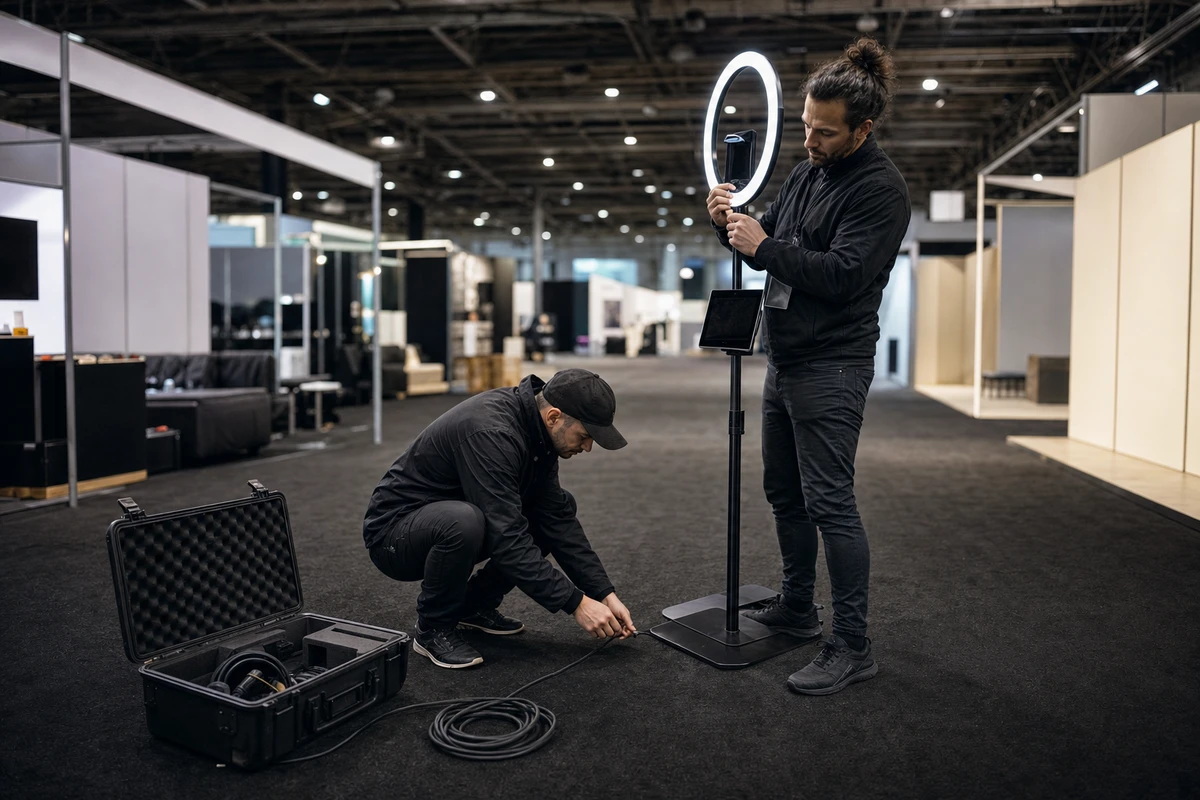
Staffing is a real cost, not a rounding error. A professional activation is often two people, a host who runs the guest experience and a technician who watches output quality, not a single attendant. That two-person crew belongs in the rent-versus-own comparison. A well-configured self-serve open-air booth removes the line item entirely for simple office flows.
Finally, there are conditions under which a booth is not worth buying at all. Several vendors, against their own commercial interest, name the same three: very low guest dwell time, a setting too formal for participation to feel natural, and the absence of any consent-and-sharing workflow. A booth that cannot be configured for the job in the room should not be bought for that room.
Data Capture, Consent, and Compliance
A marketing manager exports 600 contacts from a trade-show booth and is about to load them into the email platform. The question that should stop them first: did each of those contacts actually agree to receive marketing, and is there a record of it?
The opt-in sequence
Opt-in capture works as a sequence. A consent-based form gates photo delivery, so the guest enters a name and email and ticks a box to receive the photo and any marketing the company has named. The contact is validated, then the list exports to a CRM. Simple Booth’s HALO app runs that sequence on an iPad: an operator sets the consent checkbox and the custom data fields once, each guest fills them in to receive the photo, and the contacts export ready for a CRM. The entertainment venue chain Treetop Golf used that lead-capture flow to build a list of 150,000 unique email addresses across its locations. The consent step is not paperwork added after the fact; it is what makes the rest of the data usable.
The compliance check
The rules differ by jurisdiction. Under UK and EU GDPR, the UK Information Commissioner’s Office is explicit that consent must be freely given, specific, informed, and an unambiguous affirmative act. A pre-ticked box does not qualify, and registering for an event is not consent to receive marketing; a separate, explicit opt-in is required. If the captured data will be shared with sponsors, each named sponsor has to be disclosed at the point of collection. In the United States, the California Attorney General’s CCPA guidance is opt-out based for email but requires a Notice at Collection, given at or before the point of capture, disclosing what categories of data are collected and why. If that data is sold or shared with sponsors or advertisers, CCPA also calls for a “Do Not Sell or Share My Personal Information” option.
This ties back to the office-versus-event split. A rented one-off event captures a single batch of contacts. An owned office program accumulates first-party data across many touchpoints over a year, which raises both the value of that data and the compliance stakes. The consent and export workflow should be built and tested before the first deployment, not improvised at the second.
The Decision Path
The page reduces to a short, ordered process a buyer can run this week.
- Inventory every office and event touchpoint for the next twelve months on one sheet. Mark each internal or external, recurring or one-off.
- For each touchpoint, name the primary output: entertainment, branded content, or opt-in data.
- Total the deployments. If the count reaches 15 or more, price owning a software-driven open-air system against a year of rentals. Below that, renting is likely correct.
- Match the form factor to the dominant job, not to the most striking gallery photo. For most corporate programs that means an open-air booth, with a spectacle format added only for the specific moment that needs it.
- Confirm throughput against the largest expected guest count, and budget creative lead time at six weeks or more before the first branded deployment.
- Build and test the consent and CRM-export workflow before the first session, not after.
The best photo booth for corporate offices and events is the one sized to a company’s real cadence and pointed at its real output goal, not the one that photographs best in a rental catalog.
Frequently Asked Questions
Is a photo booth worth it for a corporate event?
Yes, when success is defined and measurable: participation at an internal event, on-brand social content at an activation, or consented leads at a trade show. It is not worth it at events with very low guest dwell time, in settings too formal for participation to feel natural, or without a consent-and-sharing workflow. Decide what the booth must produce before deciding whether to buy it.
Should a company rent or buy a photo booth?
Rent for a single or rare event. Buy once your annual deployments, counting office touchpoints such as a lobby installation, all-hands meetings, and recruiting days alongside external events, reach roughly 15 to 20. Vendor break-even analysis lands consistently in that range, though the exact figure depends on purchase price, operating costs, and rental rates. Most companies undercount because they tally “events” and forget the office.
What type of photo booth is best for a trade show versus an office party?
For a trade show, use a software-driven booth configured for opt-in lead capture, with a consent form gating photo delivery and CRM export. For an office party, use a simple, reliable, high-throughput booth focused on participation, ideally one that runs self-serve so no specialist is needed. The hardware can be the same open-air booth; the software configuration is what changes.
How much does a corporate photo booth cost?
Renting a standard open-air booth runs roughly $400 to $1,500 per event, with branded, staffed activations reaching $2,500 to $12,000 or more. Owning a complete software-driven open-air system runs roughly $3,500 to $6,000 for a tablet-based setup with a printer, and $7,000 to $15,000 for a full operator-ready rig with backup equipment. Software is a separate monthly or one-time license.
How do photo booths capture leads, and is it compliant?
A consent-based form gates photo delivery: the guest enters contact details and ticks an opt-in box before receiving the photo, and the list then exports to a CRM. Compliance depends on jurisdiction. GDPR requires explicit, affirmative opt-in consent and treats event registration as separate from marketing consent. CCPA in California is opt-out based but requires a Notice at Collection. Any event with European attendees falls fully under GDPR, so build for the stricter standard.
How many people can one photo booth serve per hour?
It depends on the format. Vendor-operational figures put 360 booths and green-screen or AI experiences in the range of 40 to 80 guests per hour, while a high-throughput open-air booth serves considerably more. To size a booth for an event, divide the guest count by the activation window in hours, compare the result to the format’s capacity, and add a 20% buffer for slow periods and technical issues.
Sources
- Gallup (2021). “The ‘Great Resignation’ Is Really the ‘Great Discontent.‘” https://www.gallup.com/workplace/351545/great-resignation-really-great-discontent.aspx
- Freeman (2024). “Freeman Trends Report Q1 2024: Attendee Motivators.” https://www.freeman.com/resources/freeman-trends-report-q1-2024/
- Bizzabo (2025). “2025 State of Events: B2B Insights & Industry Benchmarks.” https://www.bizzabo.com/blog/get-2025-events-benchmark-report
- Event Marketer (2025). “EventTrack 2025.” https://www.eventmarketer.com/article/eventtrack25/
- UK Information Commissioner’s Office (2025). “What Is Valid Consent?” https://ico.org.uk/for-organisations/uk-gdpr-guidance-and-resources/lawful-basis/consent/what-is-valid-consent/
- Office of the California Attorney General (2025). “California Consumer Privacy Act (CCPA).” https://oag.ca.gov/privacy/ccpa
- WordStream / LocaliQ (2024). “Facebook Ads Benchmarks for Your Industry 2024.” https://www.wordstream.com/blog/facebook-ads-benchmarks-2024
- HubSpot / FirstPageSage (2026). “2025–2026 CPL and CAC Benchmarks.” https://blog.hubspot.com/marketing/2022-cpl-and-cac-benchmarks
- Video Activations (2026). “Best Photo Booth for Corporate Events: A Side-by-Side Comparison of Every Format.” Vendor-published. https://www.videoactivations.com/blog/best-photo-booth-corporate-events
- Clear Choice Photo Booth (2026). “Is It Cheaper to Rent or Buy a Photo Booth? Cost Breakdown.” Vendor-published. https://clearchoicephotobooth.com/blog/rent-vs-buy-photo-booth-cost/
- Clear Choice Photo Booth (2026). “Is a Photo Booth Worth It for a Corporate Event?” Vendor-published. https://clearchoicephotobooth.com/blog/is-a-photo-booth-worth-it-for-a-corporate-event/