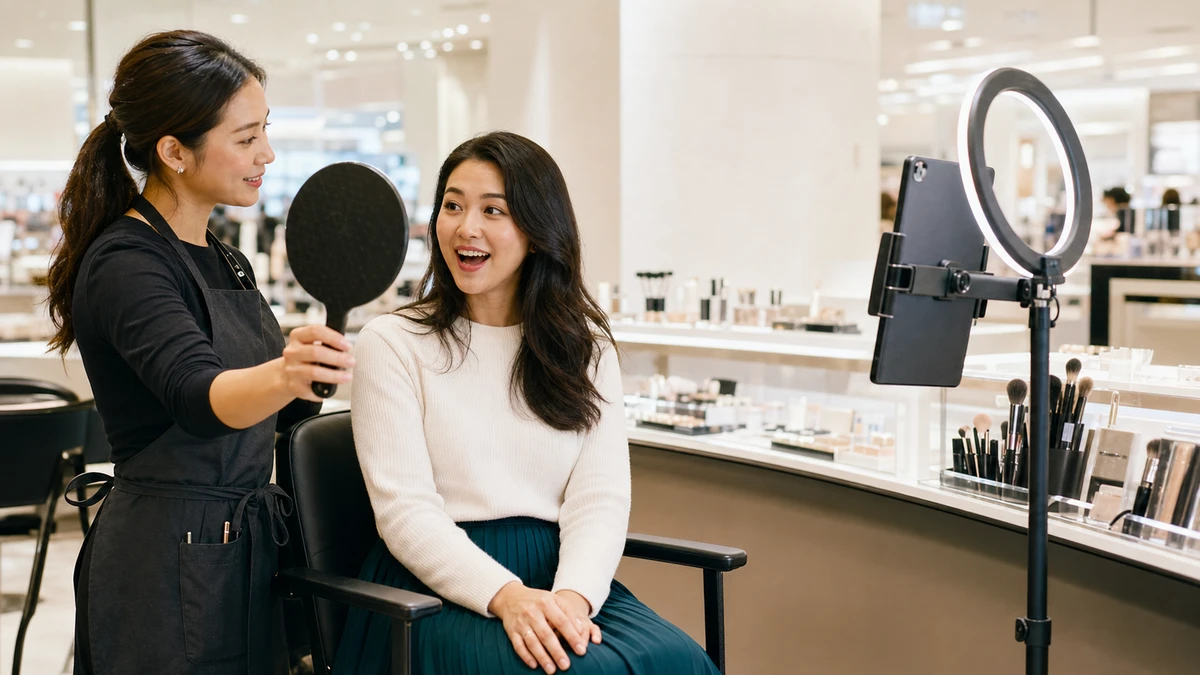
A customer settles into the chair at a cosmetics counter. For forty minutes, the artist works through primer, foundation, contour, and lashes, then turns the hand mirror so the customer can see the finished face. That reveal is the high point of the visit. Then the customer pays, walks out, and by evening the look is half gone. Nothing shareable was ever created.
An interactive cosmetics display turns that moment into makeover UGC: the photos and short videos customers post themselves. It captures the finished look as the makeover ends, turning a service the counter already performs into a repeatable stream of shareable, brand-tagged content. Most beauty retailers treat customer content as something to commission from creators or coax out of shoppers with a hashtag sign. They overlook the strongest UGC format in the category, one their own counter produces many times a day and lets walk out the door uncaptured.
The Makeover Is the UGC Format the Store Already Produces
Ask a beauty retailer where customer content comes from and the answer is usually a budget line: creators hired to film a tutorial, an agency retained to produce a batch of posts, a marketplace booked for a run of clips. Content is something the store buys.
The before/after answers the only question a beauty shopper has
A makeup buyer wants one thing settled before purchase: how will this look on me? A before/after transformation answers it directly, which is why it tends to outperform polished brand advertising. Traackr’s Creator Advantage 2026 report, summarized by BeautyMatter, found that routine-led, demo-first formats (GRWMs, tutorials, single-product use cases, and before/after transformations) consistently beat campaign-driven posts on both engagement and repeat participation, across a dataset of more than 10 million pieces of branded content. The format wins because it shows a real face changing, not a claim.
People believe that kind of evidence. Nielsen’s 2012 Global Trust in Advertising survey, covering 28,000 respondents across 56 countries, found 92% of consumers trust recommendations from people they know above any form of paid advertising. A customer’s own makeover photo, posted to their own feed, lands as a recommendation. A commissioned creator clip lands as an ad.
The store runs the production line and keeps none of it
Here is the part retailers miss. A creator’s before/after is staged at home with ring lights and retakes. A beauty counter produces a real one, live, with a trained artist and the actual products, again and again through the day. The store is already running the production line. The output is simply never recorded. The customer sees the reveal in a hand mirror, the moment passes, and the only copy of that transformation walks out on the customer’s face.
What an Interactive Cosmetics Display Does at the Makeover Station
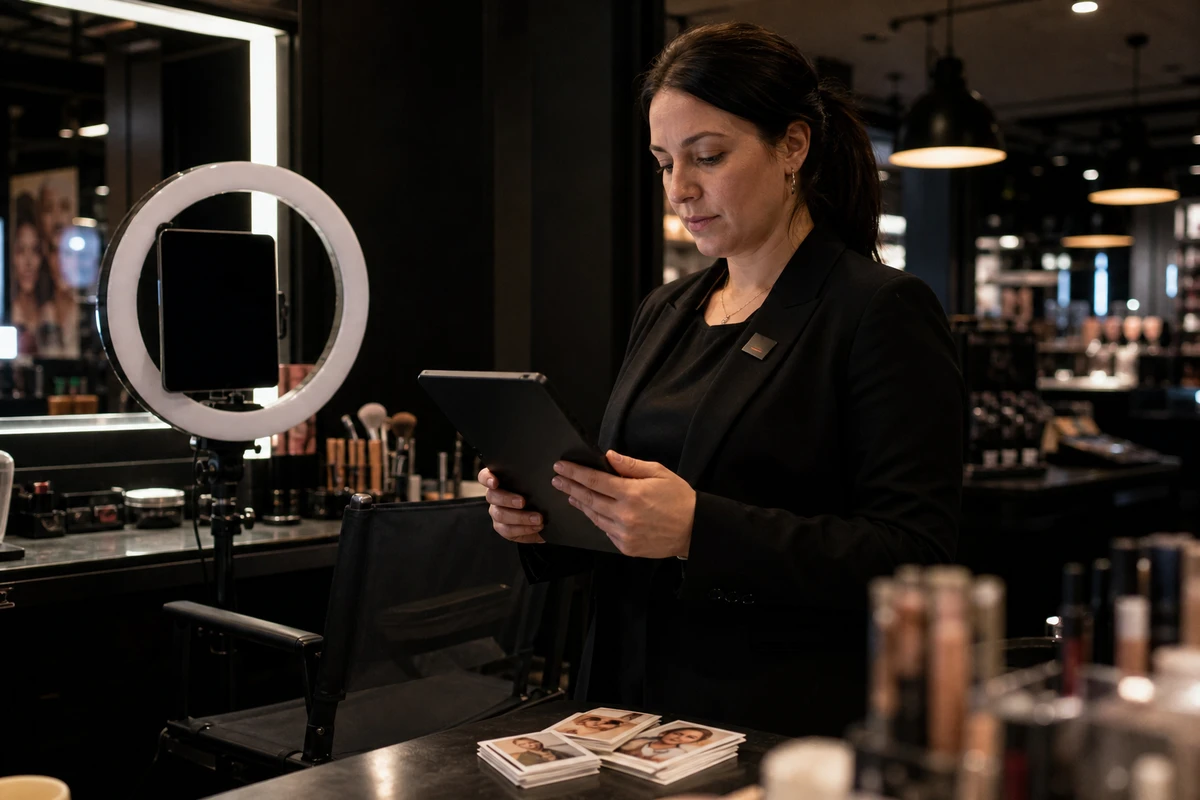
A retailer who has only seen virtual try-on apps pictures the wrong thing here. The interactive display that captures makeover UGC is not a phone filter and not an at-home AR tool. It is a physical screen-and-camera station, a tablet-based photo and video kiosk or a smart mirror, placed at or beside the makeover chair.
Two roles: the capture point and the try-before layer
The station can play two roles. Its main role is the capture point: it photographs or records the finished look, applies a branded frame or overlay, and delivers the file to the customer’s phone within seconds by QR code, text, or email, often with a printed takeaway as well. Simple Booth’s HALO kit is one ready-made version of this capture point: an iPad photo booth with a built-in 2,100-lumen ring light, so a counter that does not sit in strong light can still produce an evenly lit shot.
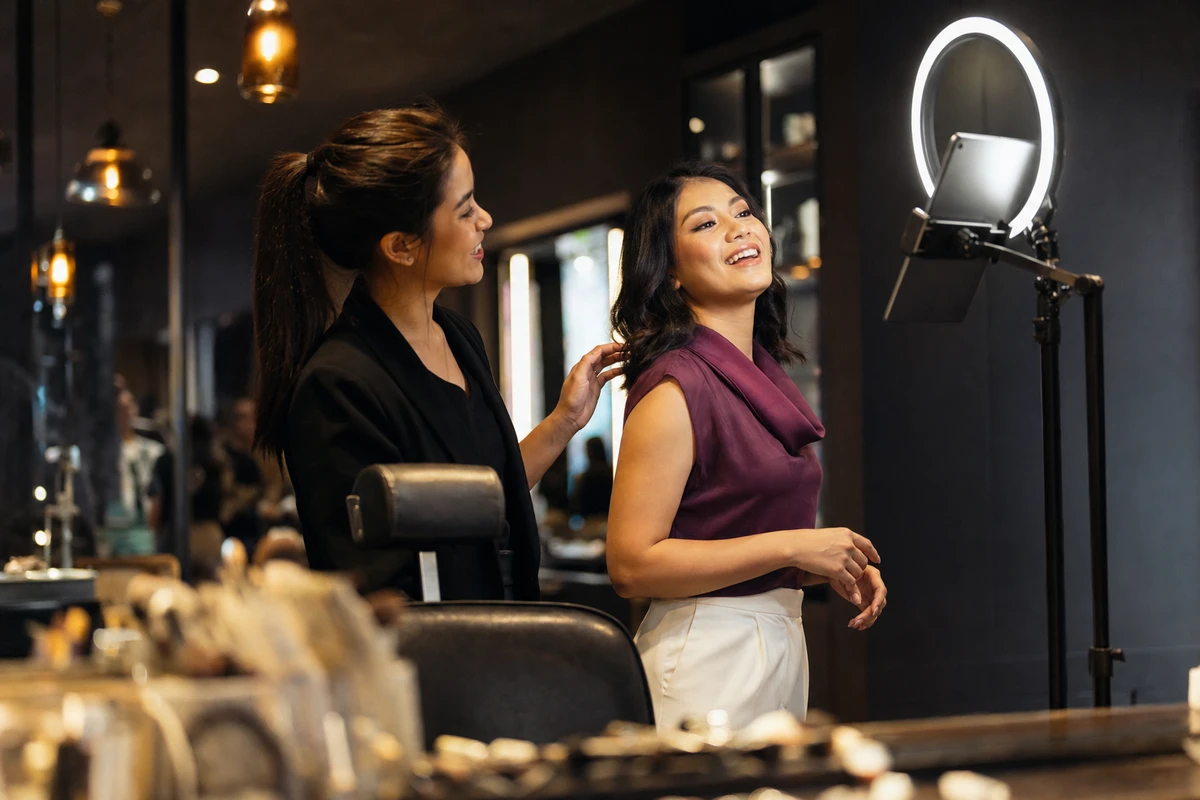
A second, lighter role sits earlier in the visit: some displays act as a try-before layer, letting a customer preview shades before the artist begins. Lancôme has run a version of this idea in shopping-centre locations, an RFID-triggered touch podium that activates product information when a shopper lifts a sample, according to its builder Ki-Wi Digital. That is a product-presentation tool rather than a content tool, and it should not be confused with the capture station, where makeover UGC actually comes from.
The Flannels Beauty Booth, in practice
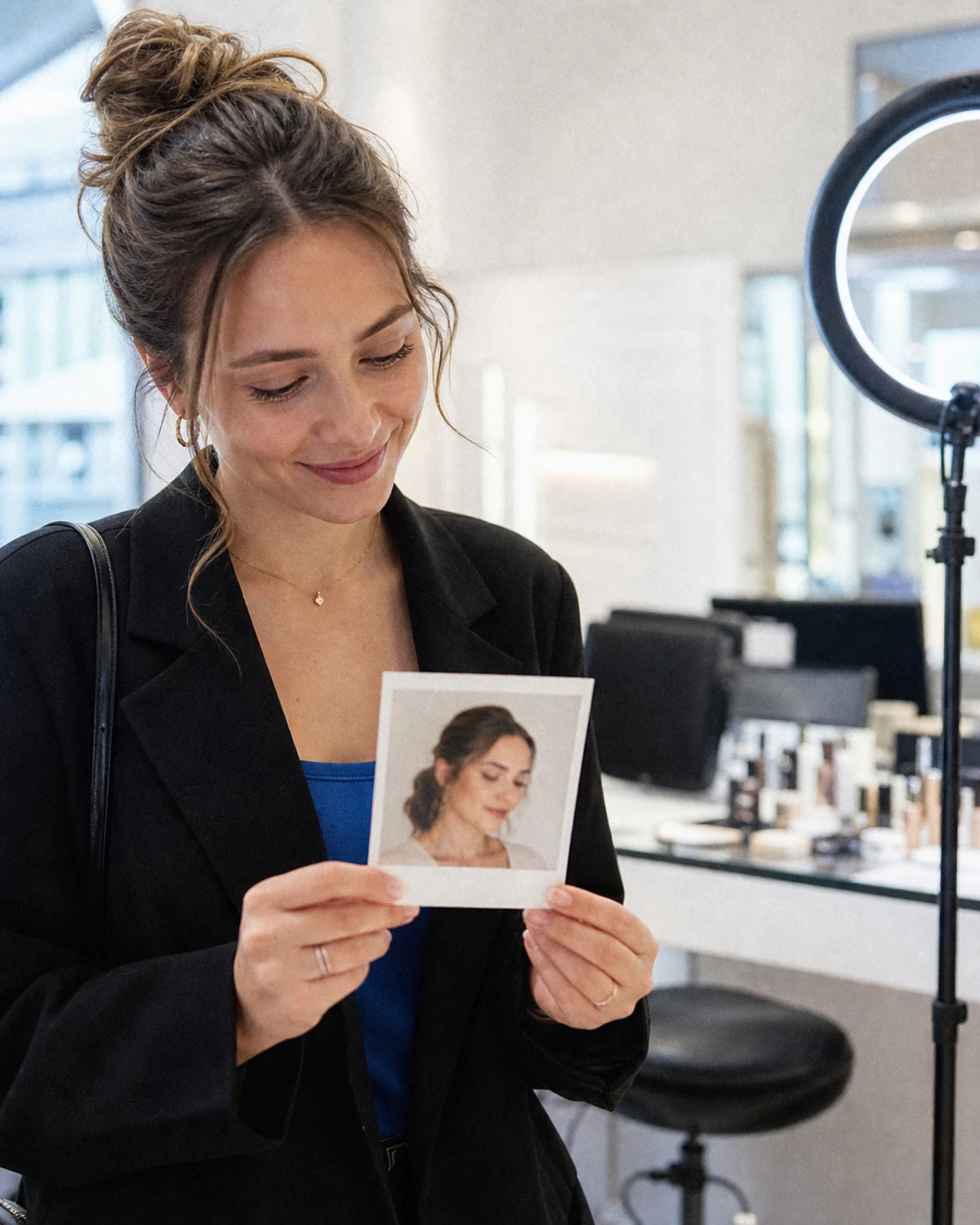
The clearest worked example is the Beauty Booth that Flannels (the Frasers Group luxury retailer) installed at its Meadowhall flagship in Sheffield. According to the technology supplier Noonah, the booth is a custom smart mirror with foot-pedal hands-free capture (a real concern around shared cosmetics surfaces), a fan that activates at the moment of capture for an editorial finish, and on-mirror prompts that walk the customer through the whole thing without staff hand-holding. The finished shot downloads to the customer’s phone by QR code and prints as a branded Polaroid-style card.
Flannels’ stated aim was to make cosmetics shopping more shareable and to draw Gen Z shoppers into the store, a group Retail TouchPoints (2025) reports is actively seeking in-store experiences that bridge the physical and digital sides of a brand. The Sheffield flagship’s launch and beauty hall were covered by independent trade press including Drapers.
A selfie wall is decor; a display is infrastructure
A painted selfie wall with a hashtag is decoration. It produces an image only if the customer decides to take one, frame it, and post it. An interactive display structures the moment instead: it prompts the capture, handles delivery, and records reuse permission. One is a backdrop. The other is a content line.
Why a Display Beats the Hashtag Sign
Most beauty retailers already have a customer-content strategy. It is a branded hashtag, printed on a sign near the register or on the bag, and a hope that happy shoppers will post. This is the default move across the industry, and it leaks badly at every step.
The hashtag leaves every step to the customer
Start with the photo itself. A hashtag sign asks the customer to produce the content: raise a phone, photograph their own face, judge it good enough, and post it. Most people will not post an unlit phone selfie of their own face, so most post nothing. A capture station removes that step by producing a polished, well-lit, on-brand image the customer is glad to be seen in.
Then there is timing. A customer who intends to post later usually does not; the intent fades with the makeup. Instant delivery to the phone catches the impulse while the customer is still in the chair and still looking at the result. And because the file arrives already framed and branded, the store’s name travels with the image whether or not the customer writes a caption. The screen can prompt the share and the tag in the moment, rather than relying on a sign across the room the customer has already walked past.
Permission, captured once, at the right moment
A stray customer post creates a legal problem the hashtag approach never solves. A retailer cannot safely pull a shopper’s photo from a tagged post and run it as a paid ad just because the store was tagged. Permission has to be on record. A capture station collects opt-in and reuse consent at the point of capture, as a checkbox on the screen, so the content is cleared for marketing use the moment it exists.
One capture, two content streams
The payoff is that a single capture feeds two channels at once. The customer posts to their own feed, which carries the store into a personal network as a peer recommendation. The retailer keeps an identical, permission-cleared copy in an owned library, usable in paid social, on product pages, and on the store’s own screens. The hashtag sign, at best, delivers only the first, and only sometimes.
Running the Numbers: Makeover UGC as a Content Line
The case for a capture station is not really about technology. It comes down to cost per asset.
Take a cosmetics counter that completes 15 makeovers on an average day. Assume 60% of those customers opt in to being photographed and getting the file sent to their phone. (Sixty percent is a planning assumption drawn from photo-activation practitioners, not a measured industry statistic, and a given store should expect to learn its own rate within a few weeks.) That is 9 captures a day, and roughly 270 brand-tagged assets a month.
The owned library, against the cost of commissioning
Those 270 assets a month go straight into the store’s owned library: product-page images, paid-social creative, content for in-store screens. The influencer-marketing agency inBeat puts the cost of beauty UGC produced for brand use at roughly $300 to $1,000 per asset. A retailer commissioning even a modest 20 assets a month would spend at least $6,000, and likely well above that.
The capture station’s incremental cost per asset is close to zero. The makeover is already staffed, the artist is already paid, the products are already on the customer’s face. The station adds a few seconds at the end. That gap, paid labor against near-zero labor, is the structural advantage commissioned UGC can never close.
The reach into personal networks
The second return is organic. Suppose 40% of the customers who receive their file also post it to their own feed. That is about 108 customer posts a month. Even at a few hundred followers per personal account, the store’s branded look lands in tens of thousands of personal feeds a month, carried each time as a recommendation from someone the viewer actually knows.
That organic reach matters because the alternative source of new visits has gone flat. Placer.ai data shows beauty-chain foot traffic grew only about 1.5% in 2024, down from roughly 18% in 2023, with Ulta Beauty at about 1.9%. New customers are not arriving on their own. Content that travels through customers’ networks is one of the few growth levers a single store actually controls.
Where the Makeover Display Fits the Store
A capture station works or fails on placement and on who runs it, and both are simpler than retailers expect.
Placement and timing
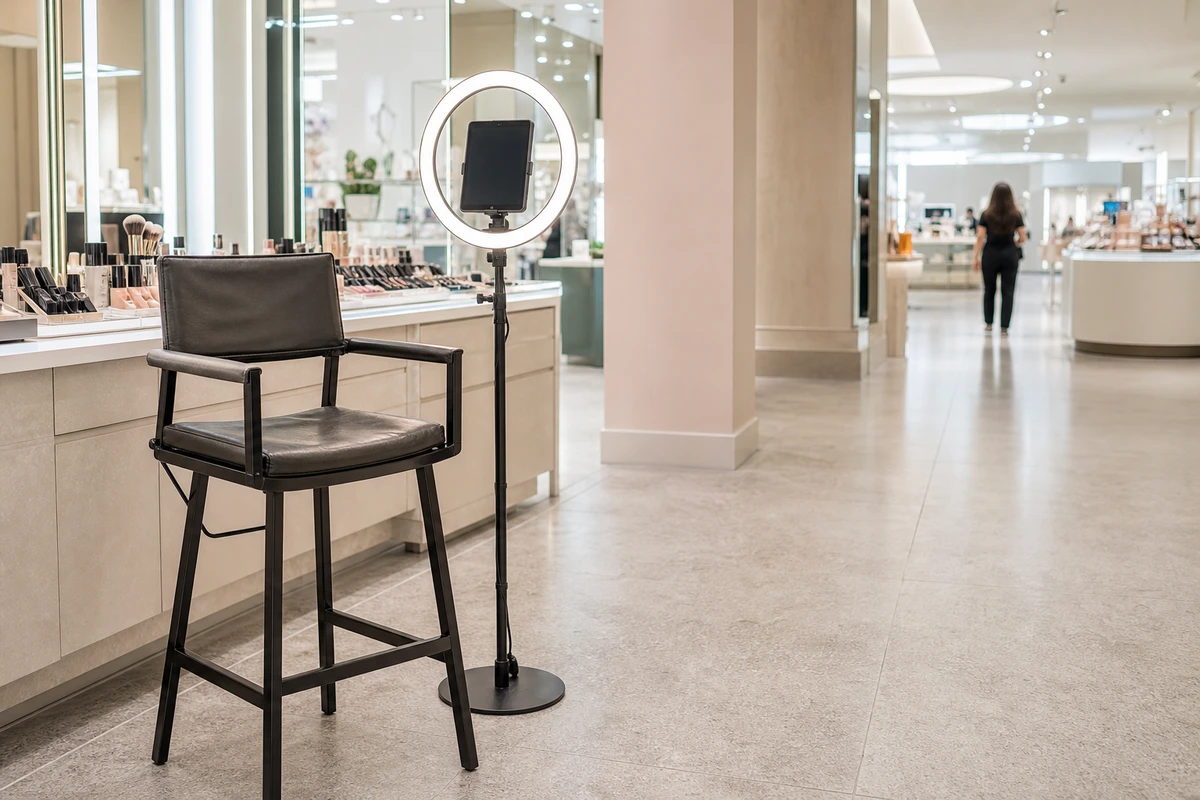
The station belongs at or directly beside the makeover chair, inside the same good light the artist works in. A display stranded by the front entrance captures nothing, because no transformation has happened there yet.
Timing matters as much as placement. The capture should come right after the reveal, while the products used are still in the customer’s hand. Done then, the photo is not a separate errand; it becomes a natural bridge into the purchase conversation, because the customer is looking at a result they want to keep.
Who runs it
The honest answer is almost nobody extra. The artist who performed the makeover is already standing there, right at the moment the customer is happiest with the result. Guiding the customer into the capture is one sentence of script: “let’s capture your look before you go.” That is why incremental labor is near zero, and it is also why touchless or foot-pedal capture matters, because neither the artist nor the customer should be tapping a shared screen with product on their hands.
Events are when capture volume spikes
The display earns the most during in-store events, when makeover volume climbs, and the industry is already moving that way. Glossy reported in April 2025 that Ulta Beauty planned about 70,000 in-store events for the year, up from 50,000 in 2024, and EventTrack 2025 (Event Marketer) found 74% of Fortune 1000 marketers expected to increase experiential spending.
Seasonal peaks stack on top of that. PassBy’s foot-traffic report found beauty, perfume, and cosmetics stores were the most-visited retail category on Valentine’s Day 2025, a day when retail visits overall rose about 49.6% year over year. A masterclass or a Valentine’s push is a day of unusually high makeover volume, which is exactly a day of unusually high content output if the capture station is there to catch it.
Measuring Whether the Display Earns Its Place
A capture station is a purchase, and a retailer should be able to say within a month whether it paid for itself.
The numbers worth watching
A few lines tell the whole story:
- Capture rate — the share of makeovers that produce a file.
- Share rate — the portion of those captures the customer posts to a personal feed.
- Owned-asset yield — the count of assets added to the library each month.
- Tagged-post reach — the impressions those customer posts generate.
- Redemption and repeat-visit rate — when the store sends a discount with the photo, the share of customers who use it and return, which closes the loop back to revenue.
There is a quieter return to track too. Because delivery runs through the customer’s phone number or email, and consent is recorded at capture, every captured customer is also a contact the store may follow up with. One moment at the makeover chair produces both a piece of content and a permissioned data point.
This is a content line, not a stunt
The math only works on repetition. The asset library and the network reach compound with consistent daily capture, the way a counter’s takings compound across a quarter. A retailer who runs the station hard for two weeks and then lets it sit will not see the numbers move, and should not conclude the model is broken.
The makeover is happening at the counter today, fully staffed and paid for, whether or not anyone captures it. The only real decision is whether that transformation leaves the store as a private memory on one customer’s face, or as content that brings the next customer through the door.
Sources
- Nielsen (2012). “Global Trust in Advertising and Brand Messages.” https://www.nielsen.com/insights/2012/global-trust-in-advertising-and-brand-messages-2/
- Traackr (2026). “Creator Advantage 2026 US Report.” https://www.traackr.com/influencer-marketing-reports/2026-creator-advantage-us-report
- BeautyMatter (2026). “The Creator Economy Has a Winner, and It’s Beauty.” https://beautymatter.com/articles/the-creator-economy-has-a-winner-and-its-beauty
- Retail TouchPoints (2025). “Gen Z May be Digital-First, but They’re Also Fans of In-Person Retailing.” https://www.retailtouchpoints.com/features/trend-watch/gen-z-may-be-digital-first-but-theyre-also-fans-of-in-person-retailing
- Noonah (vendor-published case study). “Smart Mirror x Flannels Beauty Booth.” https://noonah.com/project/beauty-booth-for-in-store-retail-experience/
- Ki-Wi Signage (vendor-published). “Interactive Digital Signage Improves Presentation in Cosmetic Stores.” https://www.kiwisignage.com/blog/interactive-digital-signage-improves-presentation-in-cosmetic-stores
- Drapers (2021). “Flannels to Launch New Sheffield Store with Inaugural Beauty Space.” https://www.drapersonline.com/news/flannels-launch-new-sheffield-store-with-inaugural-beauty-space
- inBeat Agency (2026). “The Ultimate Guide to UGC Rates in 2026: All Questions Answered.” https://inbeat.agency/blog/ugc-rates
- Placer.ai. “Beauty and Fitness Foot Traffic: From Post-Pandemic Correction to New Normal.” https://www.placer.ai/anchor/articles/beauty-and-fitness-foot-traffic-from-post-pandemic-correction-to-new-normal
- Glossy (2025). “Ulta Beauty Strategies: Why Ulta Added 20,000 New In-Store Events for 2025.” https://www.glossy.co/beauty/ulta-beauty-strategies-why-ulta-added-20000-new-in-store-events-for-2025/
- Event Marketer (2024). “Exclusive Research: EventTrack 2025.” https://www.eventmarketer.com/article/eventtrack25/
- PassBy (2025). “Valentine’s Day Top Retailers + Foot Traffic Data 2025.” https://passby.com/top-retail-valentines-day-foot-traffic-data/