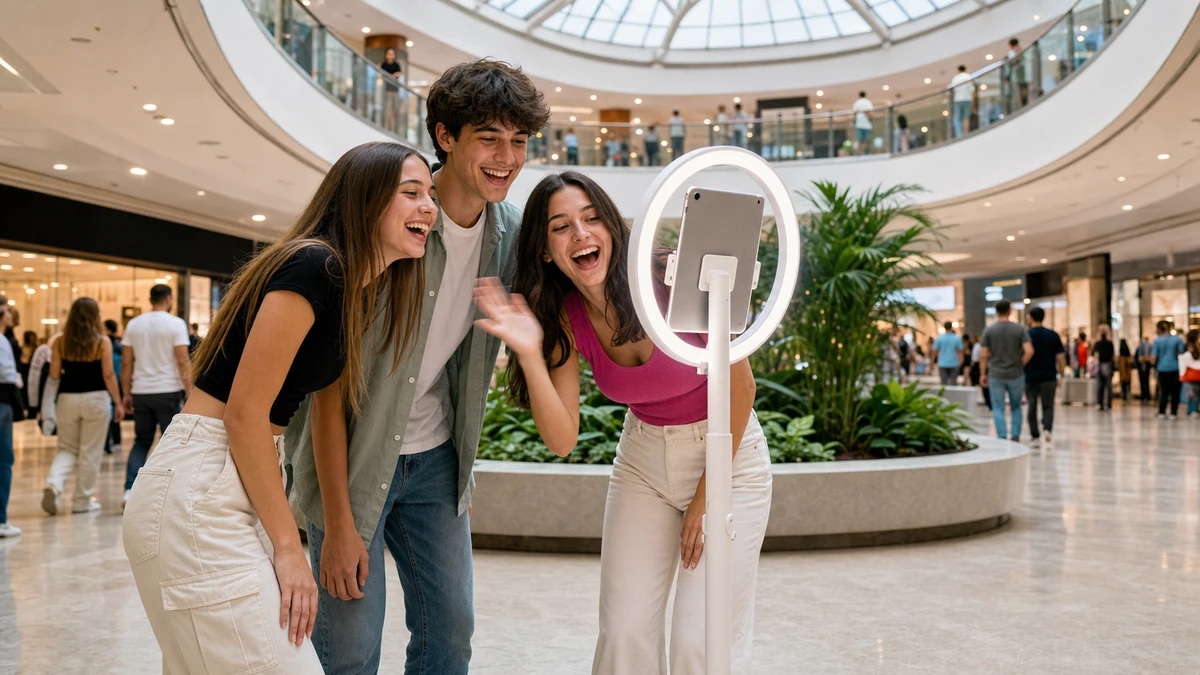
Walk through the center court of a regional mall on a Saturday afternoon and count the people who are not shopping. A family waits on a bench while one of them finishes at a store. Three teenagers sit near the fountain because they came to meet, not to buy. A couple kills twenty minutes before a movie. That waiting time belongs to the property, and most malls earn nothing from it.
The best photo booth for a shopping mall is one that runs unattended for full mall hours in a common area, captures opt-in contact details the property itself can use, and turns one of those idle minutes into a branded photo that leaves the building. That is the short answer. The harder part is not picking a brand. It is that “mall photo booth” describes two different businesses that happen to share a shape, and choosing the wrong one is the expensive mistake.
This guide is for whoever controls the common area: a mall marketing director, a general manager, a specialty-leasing manager. It is not for a single store owner. The decision a property makes about a common-area booth is nothing like the decision a tenant makes inside its own four walls, and the rest of this guide is about getting that property-level decision right.
Two Different Machines People Call a “Mall Photo Booth”
A specialty-leasing manager who searches for a mall photo booth gets a catalog full of machines that look interchangeable. They are not. Two products sit behind that one phrase, and they serve opposite goals.
The coin or card-operated amusement kiosk
The first is the coin or card-operated amusement kiosk. The shopper feeds it money, poses, and walks away with a print. Equipment vendors sell this model openly: PhoPrint describes its cashless mirror booth for malls as “an innovative, interesting and profitable business idea,” and Digital Centre frames its mall photo booths around “revenue generation” (both are vendor product pages, used here only as evidence of how the category is sold). The value of this machine is the per-print transaction. The photo is the product the shopper bought, and it never works for the mall again.
The marketing-grade branded experience
The second is the marketing-grade branded experience. It is free to the shopper. The value is not the coins in the slot. It is the opt-in contact captured during the session and the branded photo that carries the mall’s name into a social feed. The shopper still walks away with a picture, but the property walks away with a named contact and a piece of content it can reuse.
They are different products with different economics, often sold a few pages apart in the same catalog. The rest of this guide is about choosing between them, then choosing well inside whichever model wins.
Who’s Actually Buying: The Landlord, Not the Store
A boutique owner choosing a photo booth is decorating a room she controls completely. A mall general manager is choosing an installation for a court shared by a hundred tenants, a landlord, and tens of thousands of weekend visitors. The same two words, “photo booth,” hide that gap, and most photo-booth advice online was written for the boutique owner.
Footprint
A shopping mall is a multi-tenant property. The tenants own their transactions, their floor space, and their loyalty relationships with the customers who walk into their stores. The landlord owns the building and the common area: center court, the atriums, the food-court seating, the entrances, the seasonal photo set. This guide is about the common area, and the distinction is not pedantic. It changes the mechanism.
The common area is the one place in the property where every tenant’s foot traffic converges. A shopper visiting a single store still crosses it. The landlord already owns that space and the right to market within it, and dwell time there is high by design, because people are waiting for someone, resting between stores, eating, or meeting friends. A booth inside one store reaches that store’s customers during a hurried purchase. A booth in the common area reaches the whole property’s customers during the slack minutes when they have nothing to do. That is why generic “retail photo booth” content misleads a mall operator: it optimizes for a transaction, and the common area is not where the transaction happens.
Malls are now spending heavily on exactly this kind of common-area draw. The trade calls it retailtainment, experience-led space that earns its keep by pulling people in rather than by selling to them directly. Market research firm Metatech Insights estimated the experiential-retail market at $132 billion in 2025 and projected it to reach $543 billion by 2035 (Metatech Insights, 2025). NRF named “Is the mall cool again?” among its ten retail trends for 2026.
The shift is driven by who is in the building: Capital One Shopping’s 2025 research finds that 73% of Gen Z visit a mall in a typical month, and that most of them go primarily to socialize rather than to buy, while Retail TouchPoints describes the new mall strategy as courting a generation hungry for social contact. A common-area photo booth is one small, measurable instrument inside that much larger bet.
The Operating-Model Decision: Concession Rent vs. Property Marketing Asset
A specialty-leasing manager and a marketing director can stand in the same center court and see two different machines. The leasing manager sees a rent line. The marketing director sees a way to reach shoppers. A property has to decide which of them is right, because a booth can serve one of those goals well and the other badly. There are three operating models, and they are not close substitutes.
To lease the space to a vending operator
The first is to lease the space to a vending operator. A specialty-leasing or kiosk license puts a third party’s coin-operated booth in the common area, and the landlord collects rent. Short-term kiosk leases run from about $1,500 a month in community and regional malls to $8,000 a month in premium properties, on Rentail.space’s market data (Rentail.space, 2026). The mall earns a predictable, modest income line. It also gets a brand-neutral machine it does not control and no access to the data the booth collects.
To run a paid booth in-house
The second is to run a paid booth in-house. The mall keeps the per-print revenue instead of handing it to a vendor. But payment is friction. A shopper deciding whether to feed a few dollars into a machine mostly decides not to, so a paid booth turns over a fraction of the volume a free one would, and the data it captures is thin, because a paying customer is in a hurry.
To run a free, mall-branded booth as a marketing
The third is to run a free, mall-branded booth as a marketing asset. No coins, no card reader, no per-session revenue. Every session instead becomes an opt-in contact and a branded photo that leaves the building on a shopper’s phone.
| Model | Revenue to the mall | Shopper data | Brand control | Session volume |
|---|---|---|---|---|
| Lease space to a vendor | Rent ($1,500–$8,000/mo by mall tier) | Vendor keeps it | Brand-neutral machine | Vendor’s concern |
| Paid booth, run in-house | Per-print revenue, capped by payment friction | Thin, captured from rushed payers | Mall-controlled | Low |
| Free, mall-branded booth | None per session | Opt-in contact every session | Fully mall-branded | High |
The counter-intuitive part is that the third model, the one that forgoes the obvious money, is usually worth the most to a mall. The reason is scale. Per-print revenue from a concession is a small line against a property’s marketing budget and its leasing economics. Owned shopper data and branded social reach are assets a mall has historically never had at all. Trading a few thousand dollars of kiosk revenue for thousands of opted-in contacts a month is not a close call for a landlord whose actual problem is foot traffic.
What the Free Model Actually Builds: A Property-Wide First-Party Data Asset
A mall sends an email and reaches almost no one, because it has almost no one’s email. The tenants hold the purchase data and the loyalty sign-ups. The landlord, for all the foot traffic moving through the building every day, markets to an anonymous crowd. A free common-area booth is the cheapest instrument that fixes that, because it converts anonymous foot traffic into named, opted-in contacts the property can email or text directly.
Take a single open-air booth in the center court of a mid-tier regional mall. It runs eleven hours a day, seven days a week, with no attendant. Suppose it draws 60 sessions on an average day, a modest number for a free machine sitting in a high-dwell court where shoppers are already standing around. That is roughly 1,800 sessions a month. If half of those shoppers agree to have their photo sent by email or text and check the box that lets the mall contact them again, the property adds about 900 opted-in contacts a month. After a year it holds a list of more than 10,000 shoppers it can reach directly, a list it did not have before the booth arrived.
Set that against the paid model
Set that against the paid model. A coin-operated booth in the same court will not see 60 sessions a day, because payment is friction and most passing shoppers will not stop to pay. Fifteen paid sessions a day at $5 each is about $2,250 a month in gross revenue, before the cost of paper, ink, and the vendor’s share. The paid booth earns a modest, real number. The free booth earns nothing per session and instead builds an asset the mall has never owned: a direct line to its own foot traffic.
That asset matters because of where it gets used. Email consistently ranks among the highest-return marketing channels a company can run. In Litmus’s 2025 State of Email survey of around 500 marketers, 35% of companies reported $10 to $36 back for every $1 spent, and another 30% reported $36 to $50 (Litmus, 2025). A mall newsletter, an events list, a loyalty-app prompt, a gift-card promotion: every one of those runs better with 10,000 known shoppers behind it than with an anonymous crowd.
The visit data sharpens the point
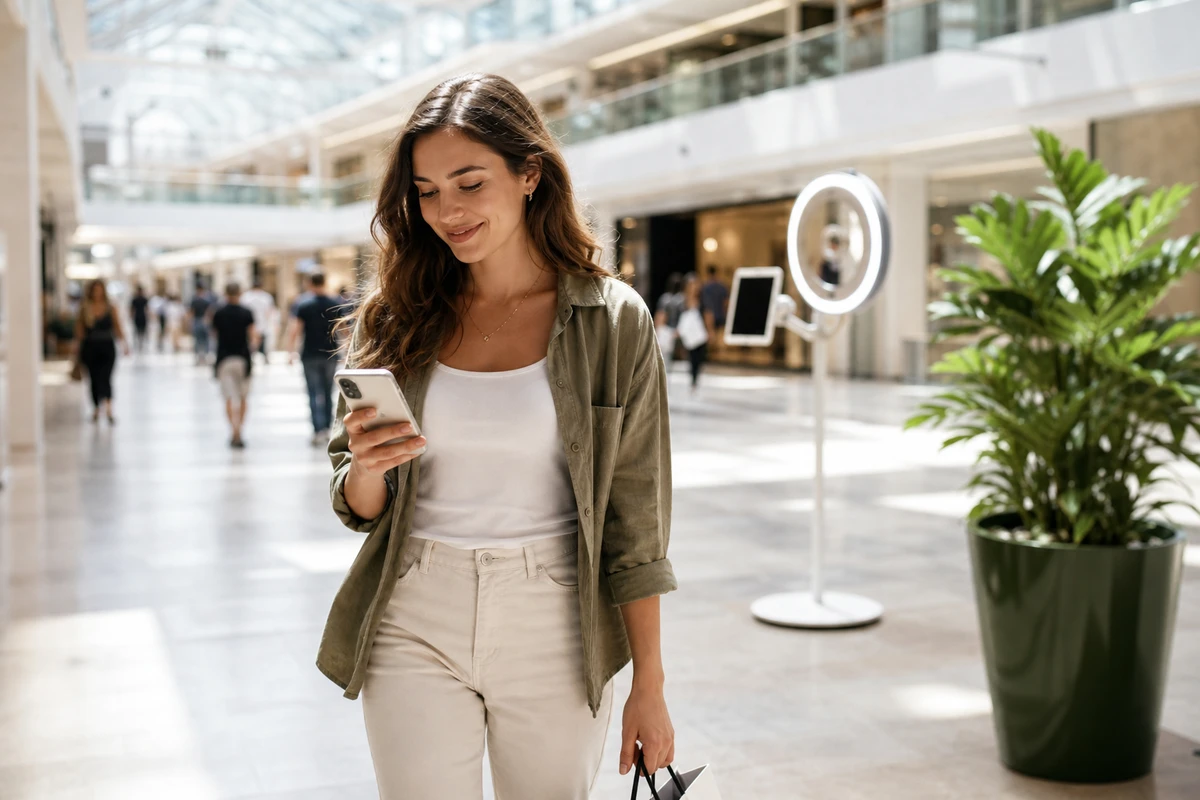
The visit data sharpens the point. Capital One Shopping’s 2025 research puts the median indoor mall visit at 61 minutes and the average American adult’s shopping-center visits at 5.2 a month, with most shoppers spending less than $48 per trip (Capital One Shopping Research, 2025). A booth contact is not worth one $30 purchase. It is worth the ability to pull a repeat visitor back for the next event, the next sale, the next slow Tuesday.
The obvious objection inside a mall is ownership. Don’t the tenants own the customer? They own their customers’ purchase data, and they should. But property-level marketing and tenant-level marketing are different jobs. A tenant wants a shopper back inside its store. The landlord wants the shopper back on the property, on a weeknight, for an event, in a soft month. The booth feeds the second job, the one no tenant will ever do for the mall. A property does not need a 100,000-square-foot Netflix House, NRF’s headline example of experiential retail at the King of Prussia mall (NRF, 2026), to start building that data flywheel. A single common-area booth that runs unattended and records opt-ins does it at a fraction of the cost.
Form Factors, Ranked for a Mall Common Area
An event company arrives at a catered reception with a 360 booth, an attendant, and a three-hour booking. A mall common-area booth has an attendant for none of its eleven daily hours and a crowd that did not come to use it. The form factor that suits the first job often fails the second, so the ranking that matters is the one decided by the mall context, not by generic event advice.
Staffing
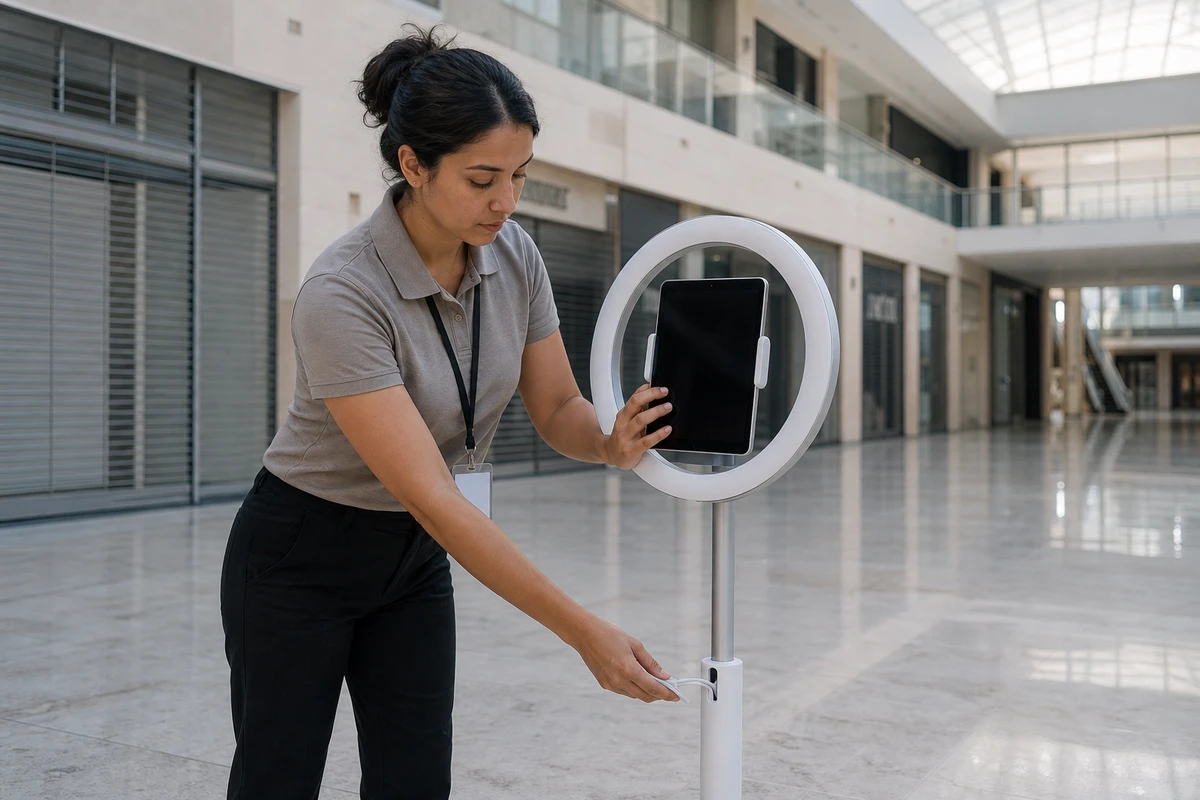
Judged on those terms, an open-air booth built around a tablet on a stand fits a mall common area best. It is visible from a distance, so it advertises itself across the court and pulls people in without signage. Its footprint is small and there is no enclosure, so it does not block a walkway and there is no interior for staff to clean or police. Turnover is fast, which matters when a weekend afternoon brings a queue. And the whole unit, plus the photo it produces, is a surface the property can brand. Simple Booth’s HALO kit is one booth built that way: an iPad on a stand a shopper walks up to and operates alone, with a built-in 2,100-lumen ring light that keeps the photo evenly lit whether the court is bright at midday or dim near closing.
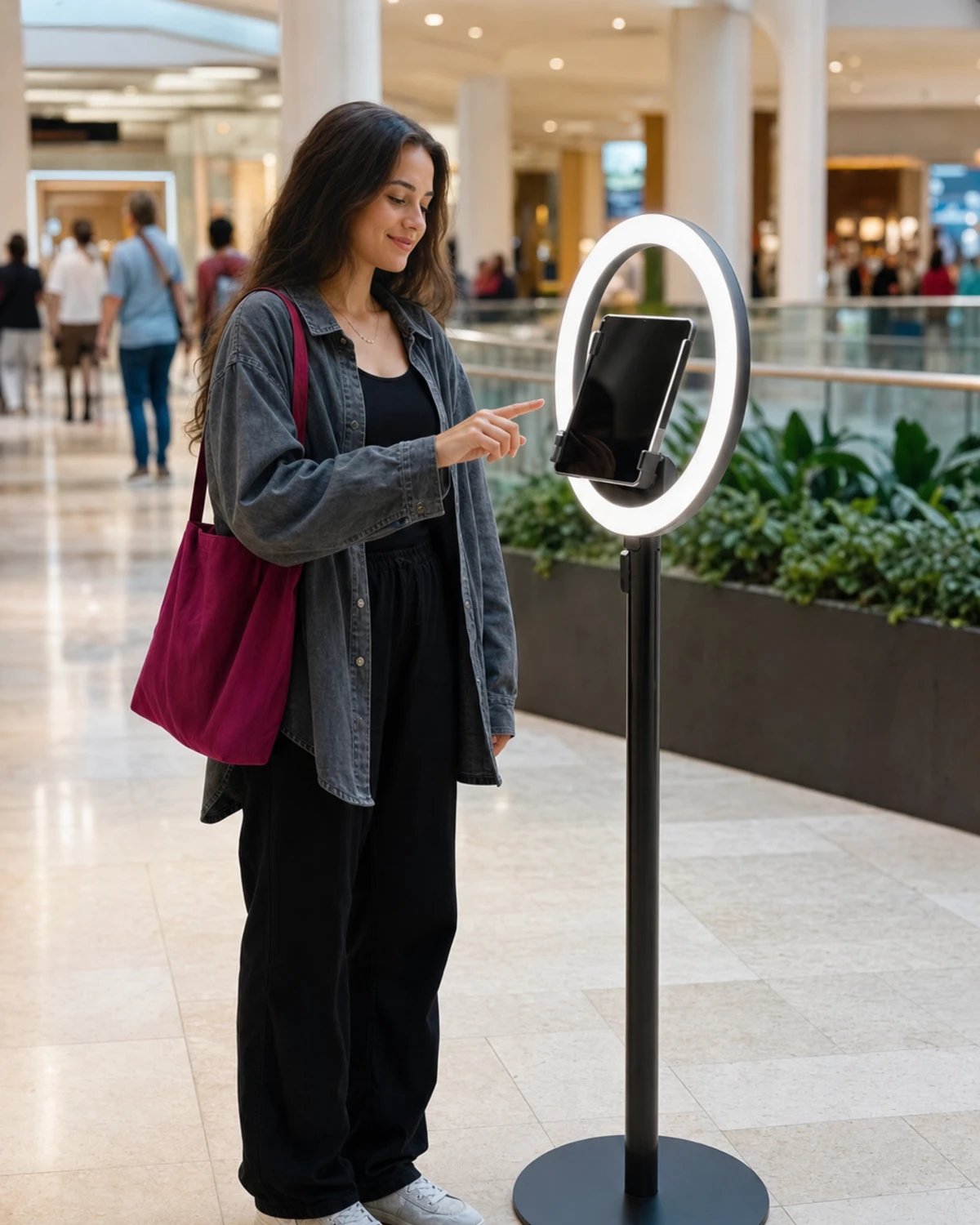
A mirror booth offers a similar open footprint and a strong visual draw, in a larger and usually costlier unit. An enclosed kiosk, the Korean-style purikura booth, is built for the paid model: the enclosure justifies the fee and gives the shopper privacy, but it eats floor space, hides its users from the court, and needs regular cleaning. A 360 booth is a spectacle and a good choice for a holiday week or a short brand activation, but its platform and safety standback make it a poor permanent fixture in a busy walkway. A roaming or portable unit suits a multi-floor property running pop-ups, not a fixed point that has to capture data in the same place every day.
This is a category ranking, not a hardware verdict, and a deeper comparison of specific units belongs in its own technical explainer. For a permanent common-area install the priorities are constant: visibility from across the court, a small footprint, fast turnover, and unattended reliability. The open-air tablet form factor is the one that meets all four at once.
Placement, Footprint, and Sightlines in a Shopping Center
The first instinct is to put the booth in center court. It is the right instinct and the most expensive floor in the building. Center court delivers the highest visibility and the strongest pull from across the property, and it is also the floor with the highest specialty-leasing value, so the placement decision is also a cost decision.
The realistic candidates each trade something
The realistic candidates each trade something. Center court maximizes visibility. Atrium and seating zones offer the highest dwell, because people are already sitting still. The food court supplies a captive, waiting audience. Main entrances make a strong first impression but risk a queue tangling with people coming through the doors. A booth’s footprint is not free floor space. On Rentail.space’s market data, prime mall positions near entrances or the food court lease at roughly $23 per square foot (Rentail.space, 2026). An open-air booth with its queue standback occupies perhaps 30 to 40 square feet, so the honest cost of the install includes the leasing value of the floor it stands on, and the chosen operating model has to clear that cost.
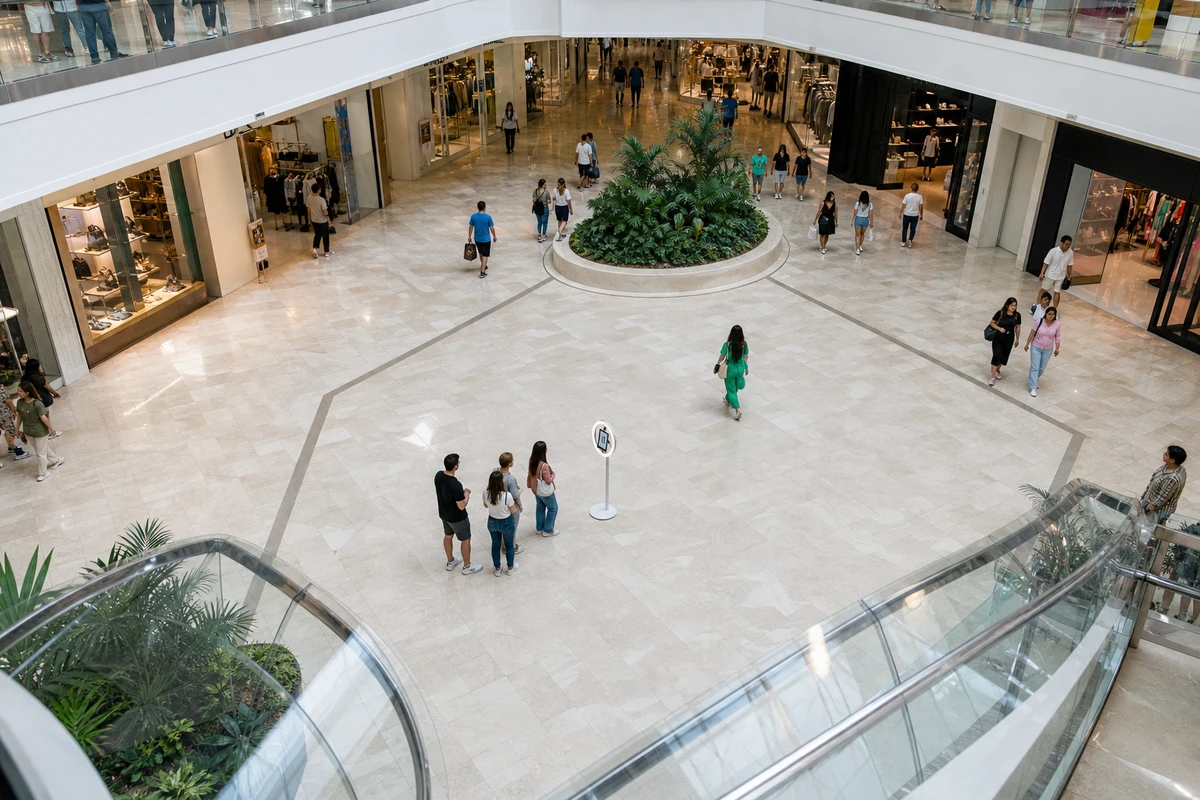
The practical constraints are easy to underestimate from a catalog. A common-area location needs reliable power and Wi-Fi, which an open court does not always supply where the sightlines are best. Lighting shifts under skylights as the day moves, and a booth has to produce a usable photo at noon and at dusk. ADA clearance has to be kept around the unit and its queue. And the queue itself cannot be allowed to block a walkway during a Saturday peak.
The seasonal photo set is the booth’s natural anchor. Malls have run holiday photo experiences for decades, and the Santa portrait is the original mall photo product (Face Place Photo, vendor blog, used here as historical context). The traffic is real: Placer.ai data reported by Retail TouchPoints shows indoor mall visits on “Super Saturday,” the last Saturday before Christmas, running about 177% above the year’s daily average (Retail TouchPoints, 2025). A permanent booth placed near or rotated into the holiday set extends a behavior families already accept into the other ten months of the year, which is the question the seasonal-only model never answers.
Running It Unattended Across Full Mall Hours
A mall opens at ten and closes at nine, seven days a week, and nobody on the facilities team is going to stand next to a photo booth for those eleven hours. Holiday season pushes closing later still. A booth in a common area has to run itself, all day, every day, or it becomes a dead machine in the most visible spot in the building.
Staffed Event Gear Does Not Fit
That requirement quietly disqualifies most event equipment. A booth built for a staffed three-hour rental assumes someone is there to restart it after a crash, unlock the tablet, and hand shoppers their photos. Strip the attendant out and the gaps show. The buying questions for a mall are operational, not aesthetic.
Unattended Uptime
A common-area booth needs unattended uptime, which means it recovers on its own after a software crash or a power blip rather than waiting for a technician. The device has to be secured for an unstaffed public space, which means mobile device management that locks the tablet to the booth app, a physically secured enclosure or tether, and a way to lock or wipe it remotely. It has to survive its environment, including the heat that builds under a skylight on a long afternoon.
Self-Serve Delivery
It has to deliver photos without a human in the loop, by QR code, text, or email, so a shopper never needs to find someone for help. And on a multi-floor property it needs remote monitoring, so facilities sees a booth go down on a dashboard before a shopper reports a dark screen in center court. The deeper detail on device management and fleet monitoring is a subject of its own, but the filter at the buying stage is simple: a unit that needs an attendant is not a mall booth.
Measuring Whether It Works: Mall KPIs, Not Event KPIs
When ownership asks whether the booth worked, the wrong answer is the number of prints it made. Print counts and hours booked are event-rental metrics. They tell a landlord nothing about the property.
A mall measures a common-area booth on property KPIs. Foot-traffic lift in the booth’s zone, set against the rest of the floor, shows whether it pulls people and holds them. Dwell time shows whether it lengthens visits. The running count of opt-in contacts shows the data asset growing month over month. UGC reach, the impressions earned when branded photos travel on shoppers’ feeds, shows media the property did not pay for. Event RSVPs driven from the booth’s contact list show the channel converting. And cost per opt-in, the booth’s monthly cost divided by contacts captured, produces a number a marketing team can set beside its other acquisition channels.
Those metrics reframe what the booth is. It is not an amusement line item. It is a leasing and tenant-retention asset. A property that can show a prospective tenant its captured shopper data, its branded social reach, and a working events list is a more attractive property to lease space in than one that markets to an anonymous crowd. The booth becomes an amenity the mall offers its tenants, evidence that the landlord is actively driving traffic rather than passively collecting rent. That is a story a leasing team can tell a tenant. A stack of printed strips is not.
A Mall Photo Booth Buying Checklist
Before signing anything, a property can hold the shortlist against the mall context. A booth worth installing in a common area:
- Runs unattended for full mall hours, with automatic recovery after a crash.
- Exports opt-in contact data the property controls and can move into its own CRM or loyalty app, not data locked inside a vendor’s account.
- Allows full brand customization of both the unit and the photo output, so every session carries the property’s name.
- Has a footprint sized to the chosen common-area location, with the queue standback accounted for.
- Secures the device for an unstaffed public space.
- Reports the property KPIs that matter to ownership, not event print counts.
- Comes with support coverage that spans mall operating hours, including weekends and holiday extensions.
- Hands captured contacts cleanly into the mall’s existing marketing systems.
The decision rule sits underneath the checklist. If the goal is a small, passive rent line and nothing more, the right move is to lease the common-area space to a coin-operated concession and let a vendor own everything else. If the goal is foot traffic, a direct line to the property’s own shoppers, and a marketing amenity the mall can offer its tenants, the right machine is an owned, free, branded booth, and every line of that checklist should be bought for it.
Frequently Asked Questions
Should the mall run the photo booth itself or lease the space to a vendor?
It depends on the goal. Leasing the space to a vendor produces a small, passive rent line, but the vendor keeps the per-print revenue and the shopper data, and the machine stays brand-neutral. Running the booth in-house lets the mall keep the data, the branding, and control of the experience. For a property whose real problem is foot traffic and tenant retention, running it in-house as a free, branded booth is the stronger position.
Is a free photo booth or a paid (coin-operated) one better for a shopping mall?
A paid booth earns modest per-print revenue, but payment friction caps how many shoppers use it and the data it captures is thin. A free booth earns nothing per session but maximizes sessions, opt-in contacts, and branded photos leaving the building. For a landlord, the data and social reach of the free model outweigh the rent line from the paid one.
Where is the best place to put a photo booth in a mall?
Center court gives the highest visibility, atrium and seating zones give the highest dwell time, and the food court supplies a captive waiting audience. Entrances make a strong impression but risk queue congestion. Any location should be weighed against the specialty-leasing value of the floor it occupies, and placing the booth near the seasonal photo set gives it a proven anchor.
Does a mall photo booth need a staff member to run it?
It should not, if it is chosen correctly. A common-area booth has to run unattended for full mall hours, which means automatic recovery after a crash, a locked and secured device, photo delivery by QR code, text, or email, and remote monitoring. A unit built for staffed event rentals will fail that test.
Who owns the customer data a mall photo booth collects, the mall or its tenants?
If the mall runs the booth, the mall owns the opt-in contacts it captures. If a vendor runs it, the vendor often keeps that data. Property-level data is also distinct from tenant data: tenants own their purchase and loyalty records, while the mall’s booth builds a separate, property-level list used for traffic, events, and loyalty marketing.
How does a shopping mall measure the return on a photo booth?
On property KPIs: foot-traffic lift in the booth’s zone, dwell time, opt-in contacts captured, UGC reach, event RSVPs driven, and cost per opt-in compared with the mall’s other channels. Event-rental metrics like the number of prints made or hours booked do not measure anything a landlord cares about. Sources
- Capital One Shopping Research (2025). “Mall Foot Traffic Statistics (2025 Report).” https://capitaloneshopping.com/research/mall-foot-traffic-statistics/
- Digital Centre (vendor product page, cited for category positioning only). “Shopping Mall Photo Booths.” https://www.digital-centre.com/photobooths/shopping-mall-photobooths/
- Face Place Photo (2016, vendor blog, cited as historical context only). “Santa + Face Place Photo Booth = Mall Fun and Increased Profits.” https://faceplacephoto.com/holiday-photobooth/santa-face-place-photo-booth-mall-fun-increased-profits/
- Litmus (2025). “The ROI of Email Marketing.” https://www.litmus.com/blog/email-marketing-roi/
- Metatech Insights (2025). “Experiential Retail Market Share, Size & Growth 2025–2035.” https://www.metatechinsights.com/industry-insights/experiential-retail-market-3063
- NRF (2026). “10 Trends and Predictions for Retail in 2026.” https://nrf.com/blog/10-trends-and-predictions-for-retail-in-2026
- PhoPrint (vendor product page, cited for category positioning only). “Mirror Photo Booth With Payment System In Shopping Mall.” https://www.phoprint.com/product/shopping-mall-payment-photo-booth-b-series/
- Rentail.space (2026). “Where Can I Lease a Kiosk in a Mall for 3–6 Months?” https://rentail.space/blog/2026-02-20-where-can-i-lease-a-kiosk-for-3-6-months
- Retail TouchPoints (2025). “Malls’ New Success Strategy: Attracting Gen Zers Hungry for Social Contact.” https://www.retailtouchpoints.com/topics/retail-store-design/experiential-retail/malls-new-success-strategy-attracting-gen-zers-hungry-for-social-contact