
A buyer signs the last document, the delivery coordinator hands over the keys, and the new owner walks to the car and lifts a phone for a photo. That photo is going somewhere. It lands on the customer’s own feed, tagged or untagged, on-brand or not, then settles into a camera roll the dealership will never see again.
A showroom guest-experience photo booth exists to catch that moment on the dealership’s terms. The question a general manager actually has is narrow and financial: is a customer-facing booth on the showroom floor worth the line item, and how fast does it pay for itself? The short answer is that the break-even point on a dealership photo booth arrives at a threshold most operators would find almost trivially low, a fraction of the gross on a single car. But there is a trap in the way. Search “dealership photo booth break even” and the results return a $40,000 machine that does something else entirely. Clear that confusion up first, and the model behind it is simple arithmetic.
Two Different Machines Share the Name “Dealership Photo Booth”
A used-car manager opens a thread on the DealerRefresh operator forum: “We are a large used dealer looking to add a photo booth. We photo 150 cars per month.” That manager is not talking about photographing customers. “Photo booth” in dealer usage almost always means an inventory-imaging studio, and any operator pricing a customer-facing booth has to name that confusion before the numbers will make sense.
The inventory-imaging studio is a turntable rig or walk-in enclosure that photographs vehicles for online listings and vehicle detail pages. It is expensive industrial equipment. Vendor-published pricing puts a traditional inventory studio in the range of $40,000 to $100,000 to buy outright, with one vendor listing an enclosed booth at $38,000 and rented studios in the $1,350 to $1,700 a month range. Its break-even is an inventory-merchandising calculation. Faster, more consistent listing photos sell stock sooner, which lifts turn rate and trims floorplan carrying cost. One vendor claims its studios “pay for themselves in as little as 4 months” on that mechanism. That is a legitimate analysis, but it answers “how do I move stale inventory,” and an operator who wants that math should price the studio against turn rate.
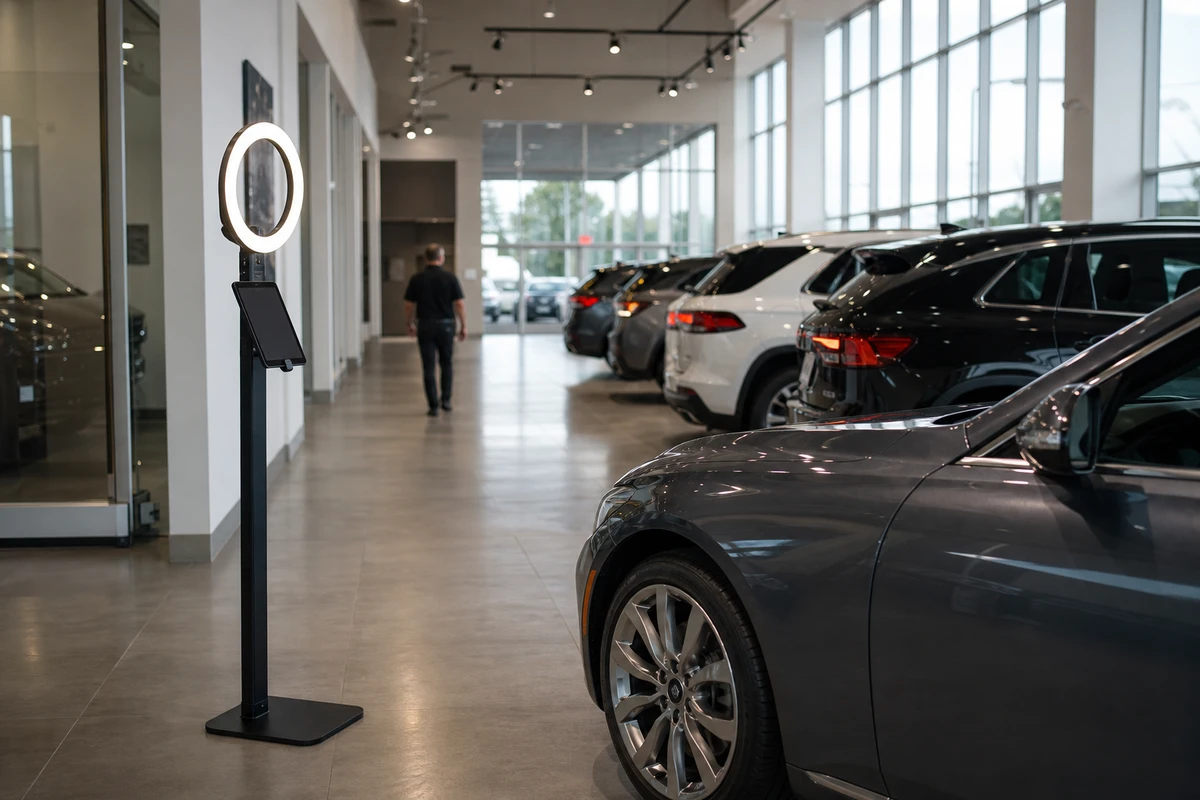
The showroom guest-experience booth is a different object. It is usually a compact, iPad-based open-air booth that stands on the showroom floor, in the delivery bay, or in the service lounge. It photographs customers, not cars. Its job is branded content, first-party data capture, and event engagement. Simple Booth’s HALO kit is one product in this category: an iPad open-air booth that sets up in under a minute and sends each guest their photo by QR code, email, or text while capturing an opt-in contact the store can export. The two machines sit in different parts of the property, cost an order of magnitude apart, and break even on completely unrelated mechanisms. Everything below is about the second one.
Why Dealership Break-Even Math Is Not Rental-Operator Math
Search for general photo booth break-even guidance and most of it is written for a rental company: buy a booth for one figure, clear a profit on each booked event, divide one by the other, and expect payback in six to twelve months. A dealership has no booked events to divide by. It does not sell booth time. “Booth events” is simply not a unit a franchised store has on its books, so the rental-operator formula produces a number that means nothing.
The dealership version of the question uses the store’s own units. The booth is a fixed annual operating cost, and it is measured against throughput the store already produces: vehicles retailed, repair orders written, showroom traffic. Break-even is the point where the booth’s combined annual return clears its fully loaded annual cost. Nothing more exotic than that.
What makes this reframe land is the size of a single car deal. Among publicly traded dealer groups, front-end gross profit on a new vehicle was $3,284 per unit in the second quarter of 2025, according to Haig Partners. Front-end gross on a used vehicle was $1,528 in the third quarter of 2025, back at pre-pandemic levels. A guest-experience booth costs one to a couple of thousand dollars a year to own. Set against a single deal’s gross, the booth does not need to “generate events.” It needs to influence a fraction of one incremental sale, or hold onto a small handful of service customers, to cover a full year of itself.
The Four Ways a Showroom Booth Pays a Dealership Back
The delivery photo from the opening scene does not just sit on a phone. It travels, and a dealership recovers a booth through four channels that all run at once.
Earned media
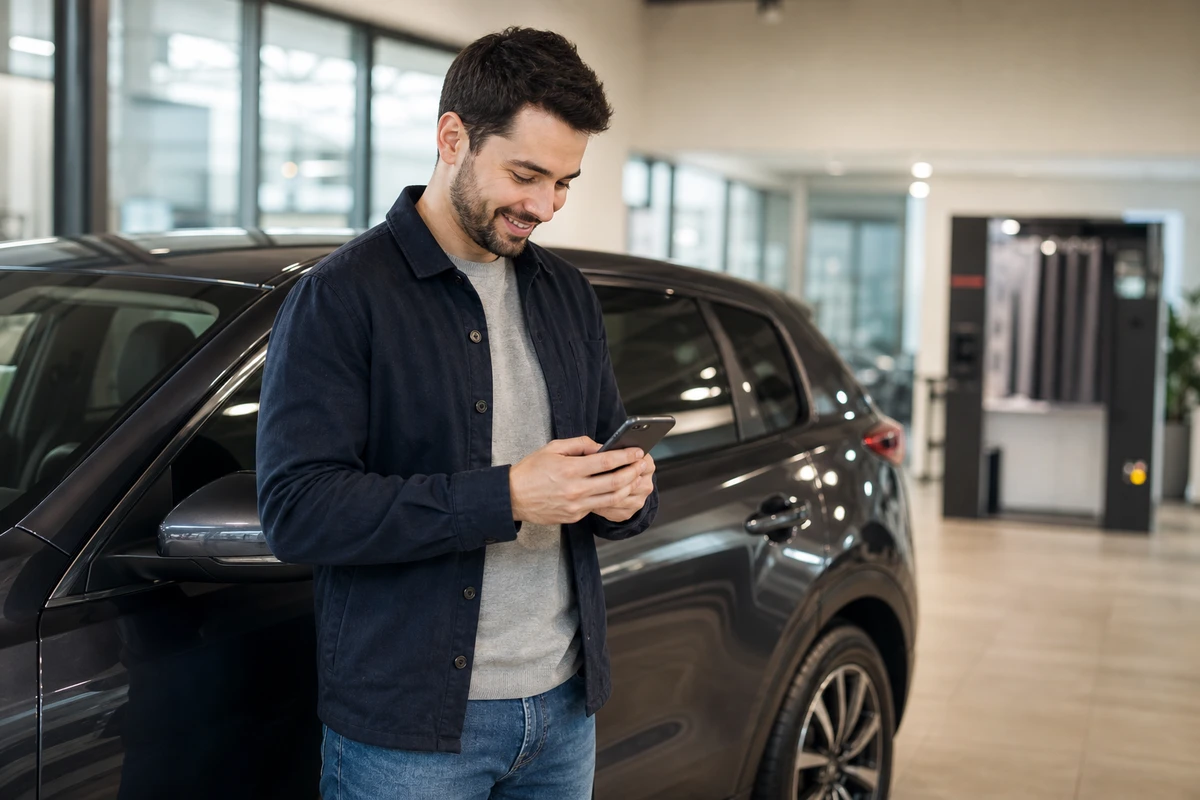
The first is earned media. A captured delivery photo carries the dealership’s branding and goes out to the customer’s own network. That network is disproportionately local and demographically similar to the buyer, so the reach behaves like targeted local awareness the store would otherwise pay for. It works because the messenger is a real, named neighbor rather than an ad. Cox Automotive’s 15th Annual Car Buyer Journey Study found that 86% of satisfied buyers both repurchase from and recommend the same dealer, which is the behavior a branded delivery photo puts into circulation.
First-party data
The second is first-party data. The booth collects opt-in email and phone numbers at the moment of delight and routes them into the CRM. This matters because a dealership’s repeat and service business runs on its database. An owned, consented contact compounds over years of ownership, unlike a third-party lead, which is often non-exclusive and sold to competing stores at the same time. Fullpath’s analysis puts a loyal automotive customer’s lifetime value, across vehicle purchases, service, and referrals, near $47,700. Every consented contact is a small claim on that figure.
Service-lane engagement
The third is service-lane engagement. A booth in the service lounge, or tied to service events, keeps fixed-operations customers in the database and keeps the dealership’s brand present during a visit that is otherwise a wait. Service retention is the steadiest margin a store has, and Cox Automotive and Kelley Blue Book research finds that 74% of customers who service their vehicle at the selling dealership buy their next vehicle there. That retention is under pressure: Reynolds and Reynolds put industry brand retention at just 43.9% in 2024, and AutoSuccess Online, reporting Cox Automotive data, noted that service retention for cars two years or newer fell from 72% in 2023 to 54% in 2025. A booth that makes a service visit memorable is a direct response to a measured problem.
Showroom event amplification
The fourth is showroom event amplification. Model launches, owner-appreciation nights, and manufacturer ride-and-drive events draw a crowd the dealership has already paid to assemble through invitations, catering, and staff time. A booth turns that crowd into content: every guest who steps in leaves with a branded photo that keeps circulating after the event ends, and the resulting stack of images becomes proof the store can use to promote the next one. The booth does not create the event’s value. It captures a return on a budget the store has already committed.
These channels run concurrently. The first two are the quantifiable backbone of an honest model; the third and fourth are real but estimated more directionally.
What Actually Belongs in the Cost Denominator
When a general manager prices the booth for next year’s budget, the temptation is to write down the hardware price and stop. Most generic photo booth cost guides do exactly that, and it produces a number that is too low to defend. The fully loaded annual cost of ownership has more lines.
Hardware and one-time setup
- Hardware and one-time setup. A commercial-grade iPad open-air booth, with backdrop and branded surround, runs roughly $3,000 to $8,000. Consumer setups cost a fraction of that and will not survive showroom-floor use.
- Software subscription. This is the line generic cost lists most often omit, and it is an annual cost, not a one-time one. BoothLedger’s 2026 software comparison puts commercial single-location platforms at roughly $200 to $600 a year on annual billing.
- Consumables. A digital-only booth that shares photos by text or QR code carries near-zero cost per session. A printing booth does not: industry cost estimates put a dye-sublimation print near $0.34 in combined paper and ink. Printing is a lever the dealership controls, not a fixed cost.
- Staffing. A self-serve booth needs almost no marginal labor. The delivery coordinator or salesperson triggers the delivery photo as one step in a handoff they already run, so the store does not hire for it. This is where dealership economics are genuinely lower than the staffed-rental model assumes.
- Floor space. The footprint is small, but it is not free, and an honest model names it rather than pretending otherwise.
- Depreciation. IRS Publication 946 classifies photography equipment as five-year property, so a $3,500 booth annualizes to $700 a year of depreciation, an accounting-standard figure.
- Co-op and compliance. Booth overlays may need to meet manufacturer brand standards, and OEM co-op funds may offset part of the cost. Ansira’s 2025 analysis of automotive co-op notes that co-op programs are shifting toward experiential, outcome-tracked spend, which a data-capturing booth fits well. Eligibility varies by manufacturer, so this is a question for the factory rep rather than a guaranteed line. On the legal side, the booth’s opt-in screen should capture an image release and the prior express written consent the TCPA requires before marketing texts. Collecting both at the point of capture turns consent into a feature of the booth rather than paperwork chased down later.
For a digital-first, mid-range deployment, those lines come to roughly $700 in hardware depreciation, $300 in software, and a modest allowance for space and incidentals: a fully loaded annual cost near $1,100.
A Worked Break-Even Scenario, Start to Finish
Take a mid-size franchise store that retails 100 vehicles a month, which is 1,200 deliveries a year. The booth is a $3,500 self-serve, digital-first model on an annual software plan.
Cost
The $3,500 booth over a five-year life is $700 a year. Software is $300 a year. Digital-only delivery keeps consumables near zero. With a small allowance for floor space and incidentals, the fully loaded annual cost is about $1,100.
Channel 1, earned media
Of 1,200 deliveries, a conservative 40% use the booth, which is 480 sessions. If 55% of those customers post the branded photo publicly, that is 264 posts. At an average local audience of 300 people per post, the booth produces about 79,200 impressions a year. Valued at roughly $11 per thousand impressions, the CPM implied by WordStream’s 2025 Facebook automotive benchmarks, that reach is worth about $870 in equivalent paid awareness.

Channel 2, first-party data
If half of the 480 booth users opt in, the store adds 240 owned, consented contacts a year. Value each contact at a deliberately low $10, well under the $30 to $100-plus a purchased automotive lead typically costs (a range discussed in dealer communities such as DealerRefresh, where exact rates are negotiated and not publicly listed). That is $2,400 a year in first-party data value.
Channels 3 and 4 add service-lounge opt-ins and event engagement. Leaving them out of the strict math keeps the model conservative; treat them as a margin of safety rather than a headline number.
The reframe is the part worth remembering. A $1,100 annual cost is about one-third of a single new vehicle’s $3,284 front-end gross, and roughly three-quarters of one used vehicle’s $1,528. It is less than the $1,500 to $2,000 in service revenue a single retained customer generates in one additional year of ownership.
The result: first-party data alone returns $2,400 a year, or $200 a month, so the $1,100 cost is recovered in about five and a half months. Add earned media and the combined return is $3,270 a year, or about $273 a month, which brings break-even forward to roughly four months. Run the optimistic case, where 70% of deliveries use the booth: 840 sessions produce about $1,525 in earned media and $4,200 in first-party data, a combined $5,725 a year, and break-even arrives a little over two months in. Conservative or optimistic, the booth clears its cost inside half a year, before service-lane and event returns are counted at all.
Five Variables That Move the Break-Even Date
Two dealerships buy the same booth in January. One has broken even by spring; the other is still waiting in the fall. The hardware is identical. Five variables explain the gap.
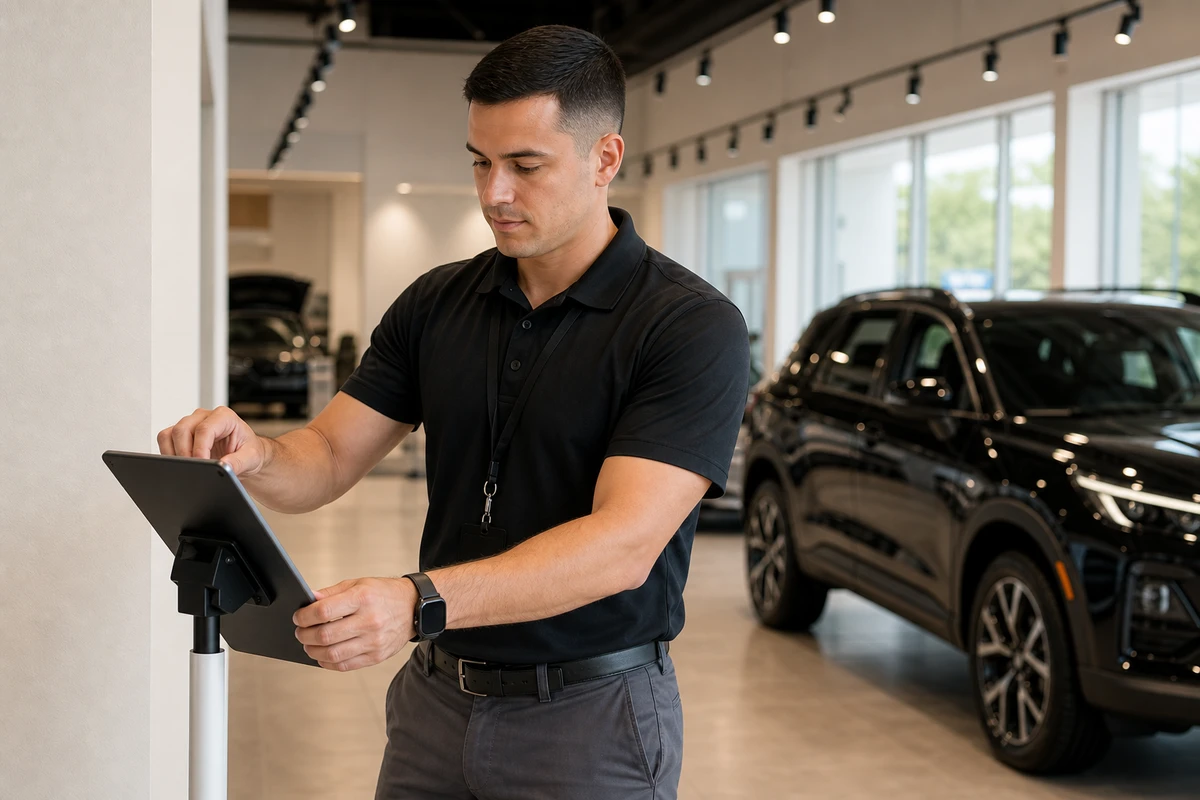
- Delivery capture rate — the share of deliveries that actually use the booth. This is the largest swing factor, and it is governed by process. A booth that is a checklist step in every delivery captures most of them; a booth left to chance captures few.
- Opt-in rate — the share of booth users who consent to email or text. It is set by how the share-and-consent screen is designed and worded.
- Digital versus printed delivery — printing adds a physical keepsake but loads real per-session cost; digital-only sharing keeps marginal cost near zero and shortens payback.
- Single rooftop versus dealer group — a multi-store group amortizes one software relationship and one playbook across many showrooms, pulling each store’s break-even date sharply forward.
- Process placement — a booth anchored to the delivery handoff, the service write-up, or an event run-of-show gets used and breaks even. A booth treated as standalone décor gathers dust.
A dealer pressure-testing an estimate should move these five before anything else, because they change the break-even month more than the hardware price does.
The right question is not how many photos a booth must produce before it pays off, and it is not the one the search engine answers when it offers a $40,000 inventory studio to an operator pricing a showroom amenity. It is how fast four stacked returns clear one fixed annual cost, and for a tool this inexpensive relative to a single car’s gross, that threshold is a fraction of one incremental deal. The booth that clears it fastest is the modest one: compact, self-serve, digital-first, and wired to the CRM, anchored to the delivery handoff so every car that leaves the lot leaves a branded photo and a consented contact behind it.
Sources
- Haig Partners (2025). “New Vehicle Gross Profits Rebound in Q2 2025: What It Means for the Future of Dealership Valuations.” https://haigpartners.com/resources/new-vehicle-gross-profits-rebound-in-q2-2025-what-it-means-for-the-future-of-dealership-valuations/
- Haig Partners (2025). “Q3 2025 Haig Report®: Used Vehicle Gross Profits Slip Back to Pre-Pandemic Levels.” https://haigpartners.com/resources/q3-2025-haig-report-used-vehicle-gross-profits-slip-back-to-pre-pandemic-levels/
- Cox Automotive / Autotrader B2B (2025). “Stats and Insights from the 15th Annual Car Buyer Journey Study.” https://b2b.autotrader.com/resources/stats-and-insights-from-the-15th-annual-car-buyer-journey-study/
- Cox Automotive / Kelley Blue Book (n.d.). “The True Value of a Lifetime Customer.” https://issuu.com/coxautoinc/docs/the_true_value_of_a_lifetime_customer_from_kbb
- AutoSuccess Online (2025). “Dealership Service Retention Crisis: Cox Automotive.” https://www.autosuccessonline.com/dealership-service-retention-crisis-cox-automotive/
- Reynolds and Reynolds, reported by Digital Dealer (2024). “Auto Brand Retention Grew in 2023: Reynolds and Reynolds.” https://digitaldealer.com/dealer-gm/auto-brand-retention-grew-in-2023-reynolds-and-reynolds/
- Fullpath (2023). “Lifetime Value for Dealerships Whitepaper.” https://www.fullpath.com/wp-content/uploads/2023/05/LTVforDealershipsWhitepaper.pdf
- WordStream (2025). “Facebook Ads Benchmarks 2025: New Data, Trends, and Insights for Your Industry.” https://www.wordstream.com/blog/facebook-ads-benchmarks-2025
- BoothLedger (2026). “7 Best Photo Booth Software in 2026 (Tested & Compared).” https://boothledger.com/blog/best-photo-booth-software
- Internal Revenue Service (2025). “Publication 946: How To Depreciate Property.” https://www.irs.gov/publications/p946
- ActiveProspect (n.d.). “Complete TCPA SMS Consent Guide.” https://activeprospect.com/blog/tcpa-consent/
- Ansira (2025). “Experiential Marketing for Automotive Brands: Using Co-Op to Win the 2026 Buyer.” https://ansira.com/blog/automotive-experiential-and-co-op-marketing/
- DealerRefresh Forum (n.d.). “Photo Booth Services” thread. https://forum.dealerrefresh.com/threads/photo-booth-services.9525/