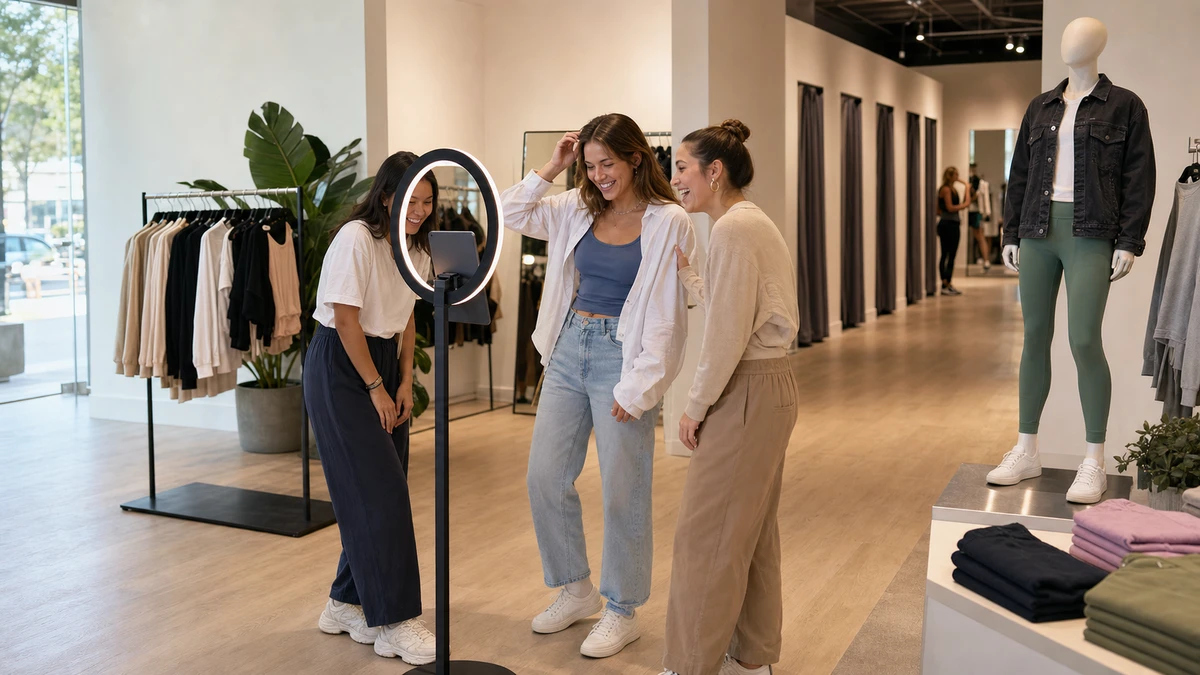
A shopper spends eleven minutes in a specialty apparel store on a Saturday afternoon. She tries on a jacket, photographs herself in the fitting-room mirror, asks an associate about a smaller size, puts the jacket back on the rack, and leaves. The store now knows nothing about her. No name, no email, no record that the jacket interested anyone at all. Had she bought it, the register might have asked for an email while she paid. She didn’t, so the one place the store collects customer information never got its turn.
A retail store has two places to capture customer data: the register, and everywhere else. This is data about people, not the shelf-audit data about which product sits where. Almost every guide to retail in-store data capture optimizes the first place. Loyalty enrollment, digital receipts, POS identification, a QR code printed on the receipt. That channel is close to a structural ceiling. The second channel, everywhere else, is experiential technology: installations a shopper chooses to engage with because the experience is worth a few minutes of attention. This article covers why experiential installations capture data the register cannot, from shoppers the register never reaches, and how retailers run them as a deliberate channel.
Why the checkout ask has hit its ceiling
Retailers did not under-invest in checkout capture. They built loyalty programs, added QR codes to receipts, and trained associates to ask. The ceiling is structural, not a matter of effort. Three limits cap the register ask, and no amount of training removes them.
It only reaches the people who bought
Picture that same Saturday in the apparel store. TruRating analyzed more than a billion in-the-moment customer ratings tied to transaction data and found specialty retail stores convert roughly 15 to 30 percent of visitors, with big-box running lower and grocery higher. Take the middle of that range: about one in five walk-in visitors completes a purchase. The checkout ask, by definition, only reaches that one in five. The other four leave without ever passing a register. They are the largest group in the store and completely invisible to any capture method that lives at the till. A retailer optimizing checkout email capture is optimizing the smallest reachable slice of its foot traffic.
The associate is the bottleneck
The register ask depends on a person asking it, and that associate often does not want to. When the ask becomes a quota, it gets worse. The Philadelphia Inquirer reported in 2018 on retail associates pressed to collect emails: one Five Below worker was expected to capture an address from a quarter of the customers she rang up, and when she fell short, her weekly hours dropped from ten or fourteen down to four. Associates under that pressure did the predictable thing. Some invented addresses to hit the number. A capture process that punishes the associate produces a list padded with fiction.
What the register captures is thin, and often wrong
Even when the ask works, what arrives is poor. Data Ladder, a data-quality firm, analyzed more than eleven billion email addresses and found only 62 percent of the addresses customers submitted were actually valid. Manual entry at a busy counter produces typos, wrong fields, and the secondary address a shopper never checks. One retailer in their analysis spent $15,000 on an email program with 40 percent of it going to duplicate or dead addresses, $6,000 spent mailing no one.
The record itself is also thin. A register capture is an email and a purchase. It says what the shopper bought, never what they considered, tried, or wanted. Speaking at NRF 2024, Forrester analyst Brendan Witcher put the consequence plainly: feed a system “low quality data, like age, gender and zip code,” and “you’re going to get mediocre results.” The checkout ask is built to collect exactly that kind of data.
What experiential data capture actually means
A skincare brand sets up a screen near its display that scans a shopper’s skin and emails back a routine. Two aisles over, a field merchandiser photographs a shelf to check it matches the planogram. Both involve a screen, and both “capture data,” and search engines lump them together under the same phrase, retail in-store data capture. They are not the same activity, so it helps to rule out the confusions first.
It is not retail-execution data capture
Search the term and half the results are shelf-audit tools: software that field merchandisers use to photograph displays, confirm planogram compliance, and report stock levels. That is operational data about products on shelves. Useful, but a different job. Experiential data capture is about people, the customers walking the floor, not the floor itself.
It is not the checkout ask in a new costume
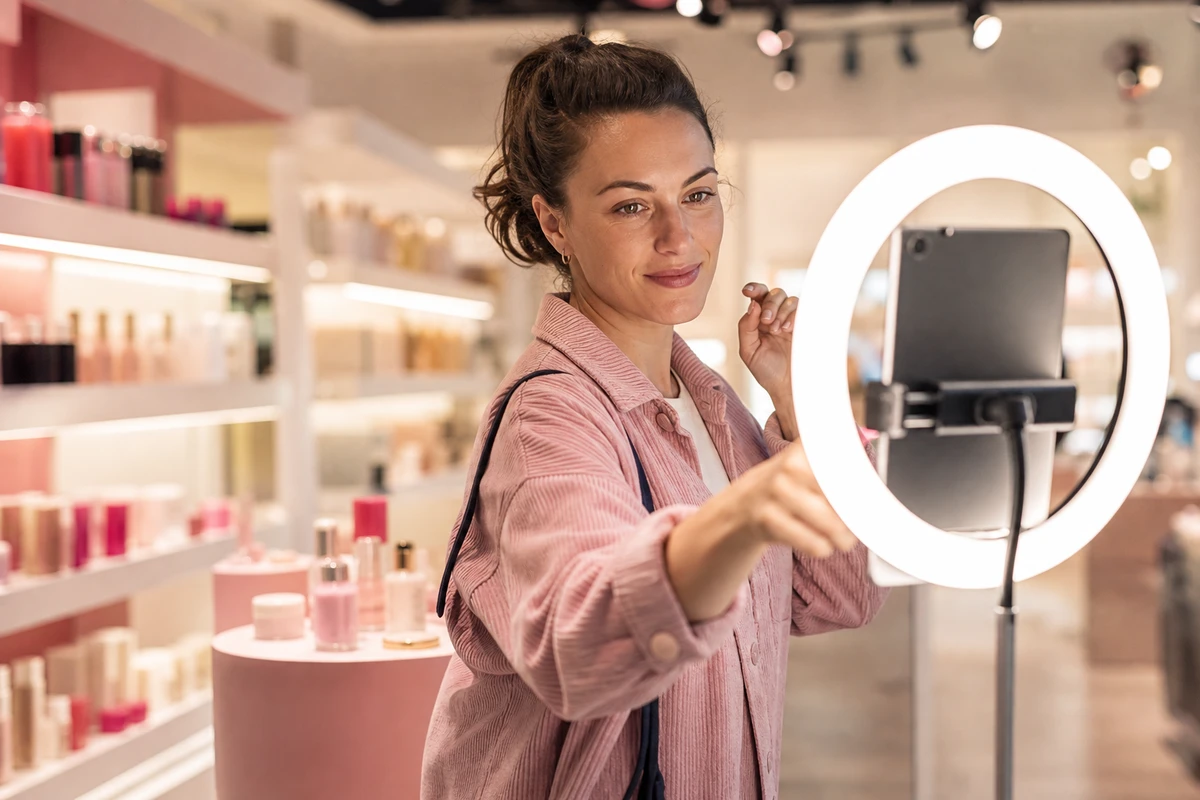
It is also not loyalty enrollment moved three feet to the left. The defining feature is not where the screen sits. It is the direction of the value. At an experiential installation the shopper engages because the experience returns something they actually want: a branded photo to keep, a look at themselves in a product through an augmented-reality mirror, a personalized recommendation, a quiz result. The contact field is simply how that result gets delivered. The data is a byproduct of giving the shopper something, not the price of admission.
The categories, and the one thing they share
In practice this covers a handful of formats:
- Branded photo and content activations send the shopper their image or video by email or text.
- AR try-on mirrors and virtual fitting let a shopper see a product on themselves and email the result.
- Product-trial and personalization stations run a skin, shade, or fit scan and deliver the recommendation digitally.
- Interactive touchscreens and gamified displays return a score or an offer.
- Sampling and quiz stations gate the outcome behind a QR entry.
The formats differ, but the mechanism is identical: a single contact field stands between the shopper and a result they decided they wanted. That last condition is the one that matters. An installation that entertains but delivers nothing digital, a screen a shopper taps and walks away from, captures no data at all. If there is no result to send, there is no reason for the shopper to leave an address.
Why shoppers share more when they are not at the register
A shopper who just made a fun photo at an installation and a shopper standing third in the checkout line are, on paper, the same customer. They behave nothing alike when asked for an email. The reason is worth understanding, because it determines how to design the capture.
Emotional state governs whether people share
Experiential marketers who do this for a living are blunt about the lever. In Marketing Brew, Adam Salacuse of the agency Alt Terrain said people “are more apt to give their information out when they’re in a good mood, when they’re having fun, when they’re emotionally engaged,” and added the warning that matters: “you don’t want to feel like a transaction.” Marc Simons of Giant Spoon, quoted in the same piece, said the capture has to be “part of the in-world experience,” not bolted on. A shopper at a register has already made the transactional decision and is waiting to leave. A shopper enjoying an installation is in the opposite frame.

The value exchange runs the other way
This is the mechanism, stated plainly. At the register, the store asks the shopper to give something up for the store’s benefit, and offers a vague future discount in return. At an experiential installation, the shopper receives something first, the photo or the AR look or the recommendation, and the contact field is how it arrives. The incentive and the capture are the same action. The shopper is not doing the store a favor. The shopper is collecting their own result, and nobody has to be talked into it.
Experiential capture records what the shopper declared
There is a data-quality consequence on top of the volume one. A register capture is an address. An experiential capture is an address plus a declared preference: the shade they tested, the style the quiz returned, the product they tried on, the photo they chose to make. That is closer to what Forrester named zero-party data, information a customer shares directly and deliberately, than to the behavioral scraps a POS infers. At NRF 2024, Sephora’s VP of product Sneha Narahalli described the company’s approach as looking at “the opportunity to collect data at every experience.”
Why that matters: personalization runs on preference data. McKinsey’s 2021 research found 71 percent of consumers expect companies to deliver personalized interactions, and 76 percent get frustrated when they don’t. The register does not collect that kind of data. An experiential installation collects it as a side effect of working.
The capture-rate math
The argument so far is directional. Here it is as arithmetic. The point of the exercise is not the exact figures, which vary by store, but the size of the gap between the two channels.
Take a 2,000-square-foot specialty apparel store on a moderately busy street, counting 300 visitors on a typical trading day. At TruRating’s specialty-retail midpoint of a 20 percent conversion rate, 60 of those visitors buy something and 240 browse and leave. A checkout email ask can only reach the 60 buyers. There is no audited public benchmark for how many asked customers actually hand over a usable email, so treat the next number as illustrative rather than measured: say a well-run register captures an address from 25 percent of buyers. That is 15 a day. Apply Data Ladder’s 62 percent validity rate, because these are keyed in by an associate at a counter, and about 9 are deliverable.
Now put an experiential installation in a dwell zone of the same store, near the fitting rooms or a feature display. It reaches buyers and browsers alike. Say it draws in a quarter of all 300 visitors, 75 engagements. Photo-activation vendors report email-capture rates of 60 to 80 percent when a digital result is the incentive (vendor-reported, not independently audited, so read it as a range, not a promise). At 70 percent, that is roughly 52 opt-ins a day, and because each shopper typed their own address to receive their own result, nearly all are deliverable.
Over a 26-day trading month, the register channel yields about 234 deliverable contacts. The experiential channel yields about 1,350. Same store, same foot traffic, same month.
From opt-ins to revenue
The contact count is the load-bearing number, and it already favors the second channel by nearly six to one. Revenue depends on what happens next, and there the comparison can only be directional. Klaviyo’s 2024 benchmark data, drawn from more than 325 billion emails sent by ecommerce brands on its platform, reports that a welcome series for a new contact earns about $2.65 per message sent on average, against $0.11 for a one-off broadcast campaign. Treat the first follow-up to the roughly 1,100 extra experiential contacts as a welcome message: at $2.65 a send, that single first email is worth around $2,900, before any later campaign touches them. Email also remains a high-return channel for retail generally; Litmus, drawing on a survey of marketers, puts the return at roughly $45 per dollar spent in the retail, ecommerce, and consumer-goods sector. The exact ratios will not match any one store. The structural fact will: the experiential channel started the month with almost six times the contacts and richer data on each one.
Designing capture that does not feel like a transaction
Two stores can buy the same AR mirror and get opposite results. One placed it by the fitting rooms and wired the email delivery into its CRM. The other stood it in a window as decoration. The hardware was identical. The design decisions were not, and a few of them separate a data-capture channel from an expensive distraction.
Put it where shoppers already linger
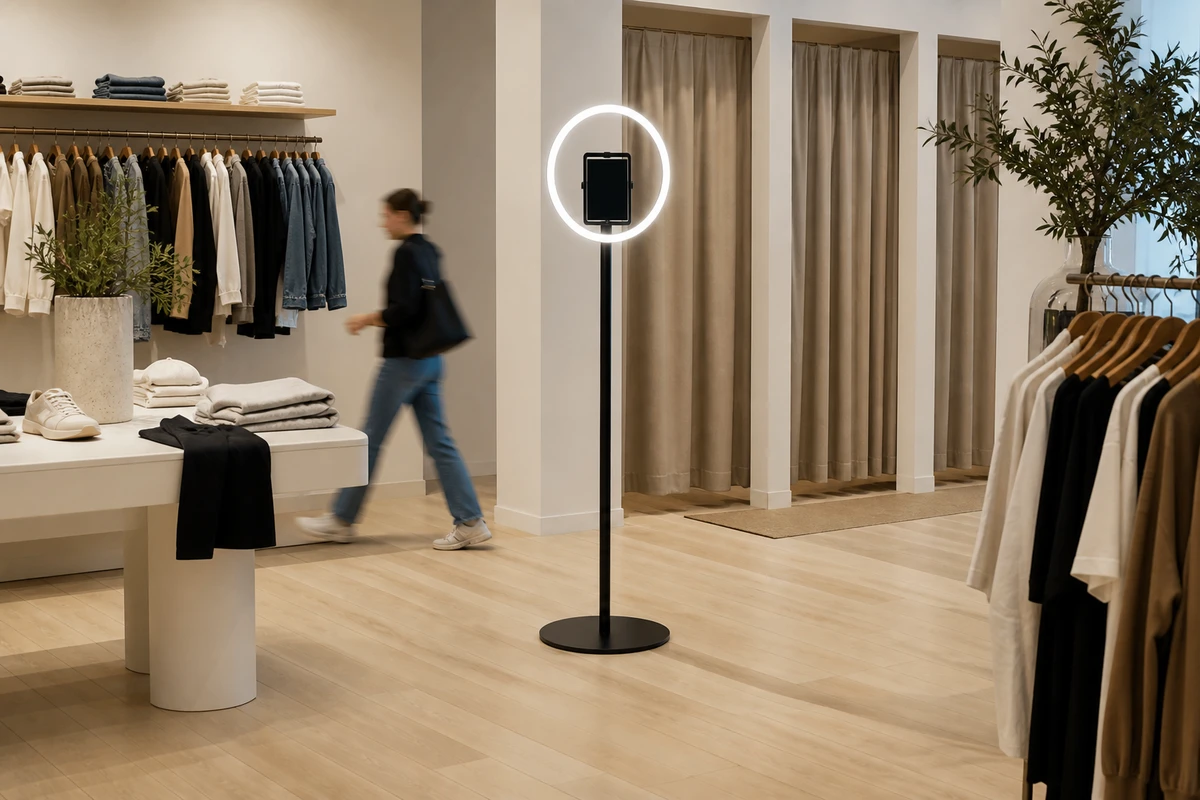
The first decision is location, and it is the opposite of the register. A capture point belongs in a dwell zone, a place where shoppers already slow down and have a minute: near the fitting rooms, beside a feature display, in a product-trial area. The register is where shoppers are most rushed and most transactional. Moving the ask out of the queue is most of the battle.
Make the result the reason, never “join our list”
The ask should never read as “join our list.” The shopper should be there for the result, the photo or the scan or the recommendation, with the contact field as the delivery step. One field, email or phone, and the result arrives immediately. Discount bait is the tempting shortcut and the wrong one. Dave Kersey, chief media officer at GSD&M, told Marketing Brew that with one-time discount offers “people will sign up just for the immediate discount, but it doesn’t really connect them to the brand long term.” A coupon list is a list of coupon hunters. A list built from people who chose to try a product or make a photo is a list of people who signaled interest in the product itself.
Kersey also notes that shoppers are “becoming more aware of what they’re signing up for,” and Salesforce’s State of Commerce research found only 17 percent of customers fully trust companies with their data. A screen that states plainly what the address is for is doing real work, not adding legal boilerplate.
Let the technology make the ask
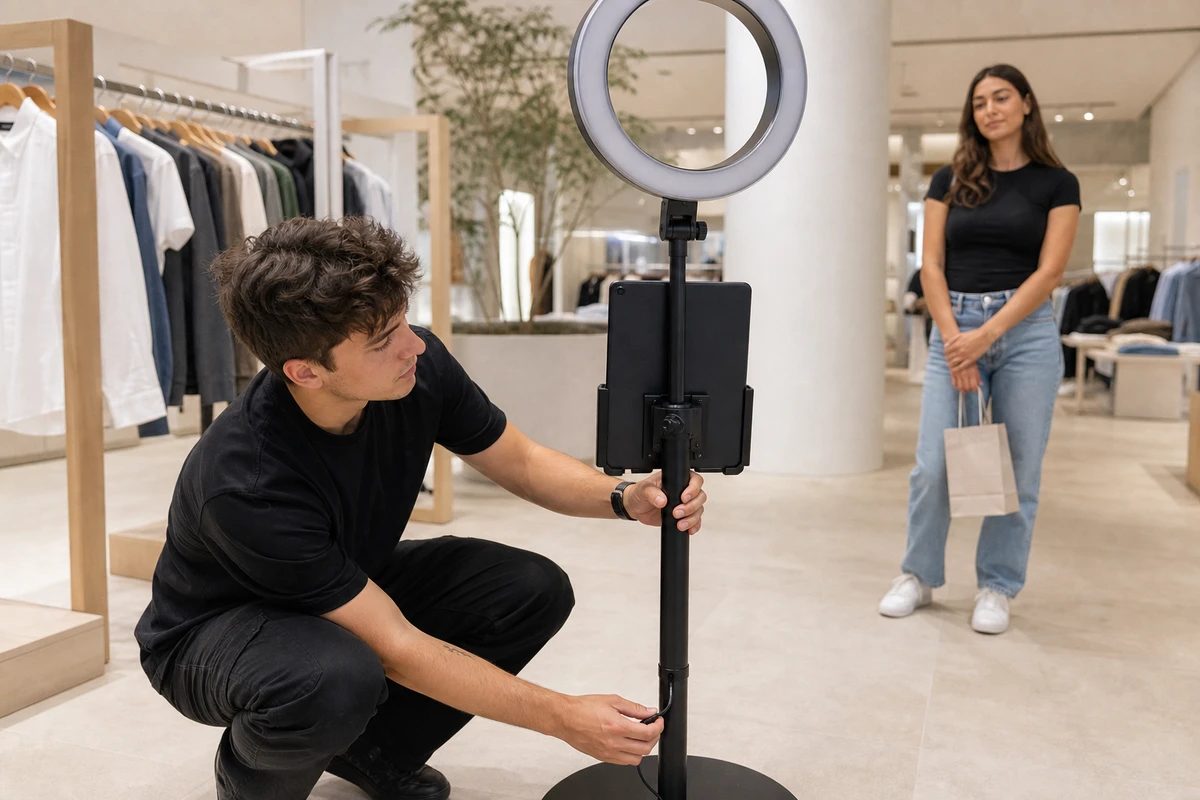
An installation that captures through a screen removes the associate from the capture step. The reluctance that throttles register capture stops being the bottleneck, because the shopper interacts with the technology directly. Staff can focus on selling and on inviting shoppers over, not on hitting an email quota.
What to check before buying
The buying decision comes down to what happens to the data. An experiential installation is only a capture channel if the contact data leaves the device. Before committing, an operator should confirm three things: the result is delivered digitally, by email or text, so a contact field is genuinely required; the captured contacts export to the store’s CRM or email and SMS platform rather than sitting in a vendor dashboard; and each record is timestamped and tagged with what the shopper engaged with. An installation that entertains the floor but exports nothing is a marketing cost, not a capture channel.
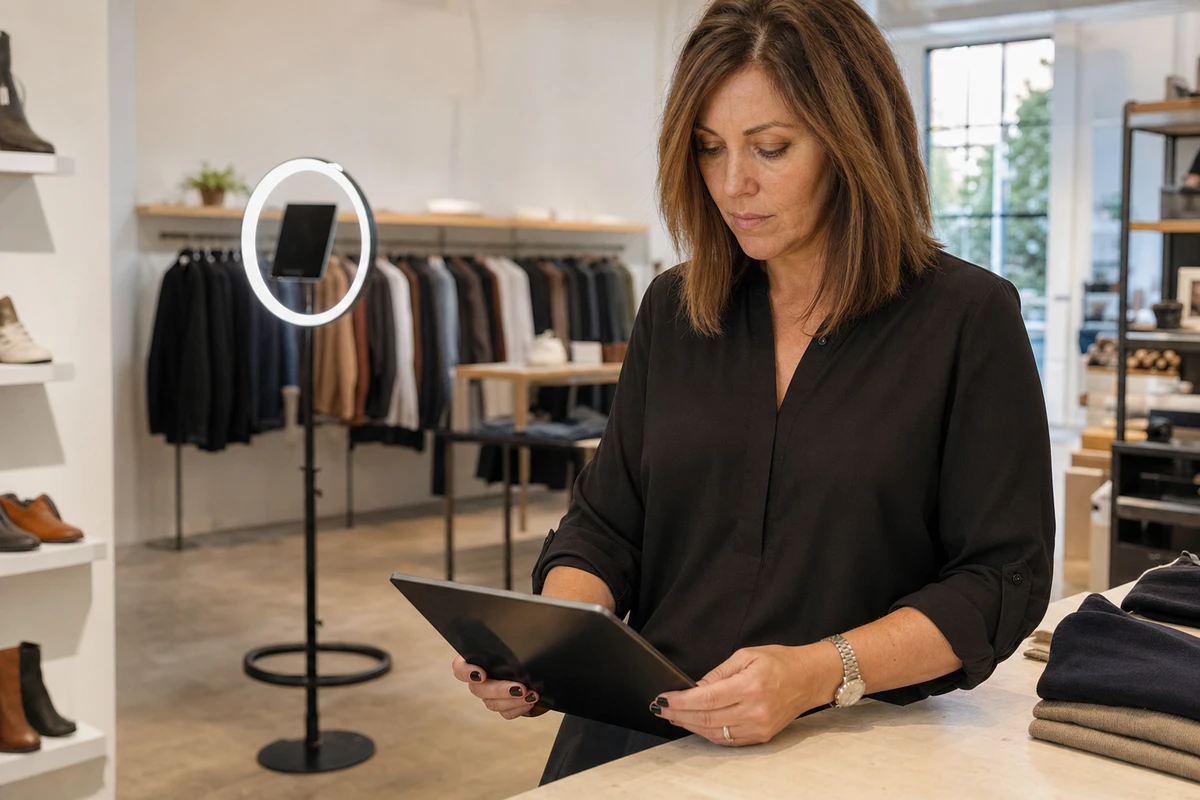
For the branded-photo format specifically, Simple Booth’s HALO kit is one installation built this way: a shopper takes a photo at the iPad station, HALO sends it by email or text, and the captured contact exports to the store’s email or SMS platform rather than staying in a vendor dashboard. The entertainment-venue chain Treetop Golf used that lead capture to build a list of 150,000 email addresses across its locations.
Turning captured data into repeat foot traffic
A retailer ends a strong month with 1,350 new contacts in an export file and does nothing with them. That is the “one-and-done” outcome Adam Salacuse warns about, the activation that creates a moment and no relationship. The capture only becomes foot traffic if the data moves and triggers something.
Trigger the follow-up while the visit is warm
The contact should land in the CRM or email and SMS platform automatically, segmented by the experiential signal: the shade tested, the quiz result, the product tried. Then the store sends a follow-up while the visit is still recent. Timing and relevance are not small details. Klaviyo’s data shows automated, triggered messages earn far more than broadcasts, $1.94 per send against $0.11, and that automated flows produce 41 percent of email revenue from 5.3 percent of sends. A follow-up triggered by what a specific shopper did in the store, and sent within days, is the kind of message that performs. A monthly newsletter to an unsorted list is not.
Attribution is what makes the channel defensible
This is also the answer to the oldest objection to experiential retail: that it is brand fluff nobody can measure. That objection holds only when the experience produces no data. When every engagement leaves a timestamped, tagged, opted-in contact, the installation becomes one of the most measurable things on the floor. A store can count opt-ins per day, watch which follow-up messages drive a return visit, and tie a second purchase back to the activation that started it. Event Marketer’s EventTrack 2025 found 34 percent of marketers track marketing opt-ins as a success metric for experiential campaigns, which means measurement is real but still far from standard. The operators who do it can prove the channel. The ones who don’t are the reason the “unmeasurable” reputation survives.
The structural case is simple enough to act on. In a store where four of every five visitors browse and leave without buying, the register can only ever talk to the fifth. An experiential installation in a dwell zone is the one channel that can turn the other four, the anonymous majority of the foot traffic, into named, segmented contacts the store can invite back. The retailer that builds that channel is not running a nicer in-store experience. It is collecting the customer data its competitors let walk out the door.
Sources
- TruRating (2026). “Retail Conversion Rate – Definition, Formula, Benchmarks & Fixes.” https://trurating.com/reports/retail-conversion-analysis/
- The Philadelphia Inquirer (2018). “Retail workers say they’re under pressure to get your emails.” https://www.inquirer.com/philly/news/retail-workers-say-theyre-under-pressure-to-get-your-emails-20180621.html
- Data Ladder (n.d.). “Common Data Quality Issues in the Retail Industry and How to Fix Them.” https://dataladder.com/common-data-quality-issues-in-the-retail-industry-and-how-to-fix-them/
- National Retail Federation (2024). “Capturing the right data to fuel retail success.” https://nrf.com/blog/capturing-right-data-fuel-retail-success
- Marketing Brew (2023). “Tips to incorporate first-party data collection into experiential marketing.” https://www.marketingbrew.com/stories/2023/02/24/incorporating-first-party-data-collection-into-experiential-marketing
- McKinsey & Company (2021). “The value of getting personalization right—or wrong—is multiplying.” https://www.mckinsey.com/capabilities/growth-marketing-and-sales/our-insights/the-value-of-getting-personalization-right-or-wrong-is-multiplying
- Klaviyo (2024). “Email Benchmarks by Industry 2024.” https://www.klaviyo.com/marketing-resources/email-benchmarks-by-industry-2024
- Litmus (2025). “Infographic: The ROI of Email Marketing.” https://www.litmus.com/blog/infographic-the-roi-of-email-marketing
- Salesforce (2024). “State of Commerce, Third Edition.” https://www.salesforce.com/content/dam/web/en_us/www/documents/commerce-cloud/salesforce-state-of-commerce-third-edition.pdf
- Event Marketer (2025). “EventTrack 2025.” https://www.eventmarketer.com/article/eventtrack25/