
A four-top by the window orders dessert, and when the plate arrives with a lit candle, three phones come up at once. Two tables over, a server closes out the final check and the guest taps a card to pay. Both moments are worth money to the restaurant. Both usually pass with nothing captured: no photo saved, no review requested, no permission on file.
Restaurants automate user-generated content and reviews by wiring three things to moments guests are already living: a trigger (a check closing in the POS, a table QR scan, a photo moment in the room), a request (a timed text or an on-site prompt), and curation (watching for mentions, drafting replies, and reposting content the restaurant has permission to use). Automation handles timing, consistency, and volume. It answers the operator who has been told to post daily, reply to every review, and send a newsletter, and who either burns out trying or lets the marketing slide.
One line has to hold, though. Automation should never decide which feedback the public gets to see. That distinction separates a system worth building from one that can draw a fine.
What restaurant UGC automation actually covers
Most restaurants already run a version of this by hand. A manager asks a regular for a Google review at the register. A server screenshots a guest’s Instagram story, and the owner reposts it three days later during a quiet stretch. Neither habit runs reliably, because both depend on a person remembering during service.
Restaurant UGC automation covers two streams the rest of the internet keeps apart. The first is review automation: ratings on Google, Yelp, TripAdvisor, OpenTable, and the delivery platforms. The second is content automation: guest photos, videos, tagged posts, and stories. Both are user-generated content. Both can be systematized, and a restaurant gains more by treating them as one system than as two projects.
“Automate” here has a narrow meaning. It means putting the ask, the monitoring, and the reposting on a system instead of leaving them to whoever remembers. It does not mean generating fake content, and it does not mean filtering real content. Those two exclusions are the whole reason the system stays defensible.
Why timing is the mechanism
The reason automation beats a diligent server is timing, not effort. A dining experience is freshest in the hour or two after the guest leaves, while the meal, the room, and the service are still vivid. A request wired to the POS check close fires within minutes, before the experience fades and before any other brand has reached the guest’s phone. A manager sending a follow-up “when there’s time” hits that window almost never. Automation’s job is to hit it every time.
The review-gating trap built into most automation tools
A guest leaves a restaurant, and twenty minutes later a text arrives: “How was your visit?” She taps four stars and gets a link straight to the restaurant’s Google listing. Her friend, who sat through a cold appetizer and a slow server the next night, taps two stars and gets a different screen: a private feedback form that goes only to the manager.
Most “automate restaurant reviews” tools sell this as a feature. The marketing copy calls it sentiment routing or smart filtering and promises something like “4x more positive reviews.” The honest name for it is review gating, and it works by quietly steering negative feedback away from the public record while sending positive feedback toward it.
What gating costs in fines and lost listings
The FTC’s 2024 rule on consumer reviews (16 CFR Part 465, effective October 21, 2024) makes suppressing reviews on a business’s own site a fineable offense, with civil penalties of up to $51,744 per violation. Gating is a related but distinct practice: it routes guests toward or away from a third-party platform like Google rather than editing a business’s own review widget, so the 2024 rule does not name it directly. The FTC has instead treated gating-style suppression as a deceptive act under Section 5 of the FTC Act.
The FTC’s action against Fashion Nova, reported as roughly $4.2 million in January 2022 (FTC case 192-3016), targeted a review platform that withheld sub-four-star reviews from the company’s own site, and it landed before the 2024 rule existed. The rule simply adds a clearer penalty structure on top of ground the FTC was already enforcing.
The platforms are blunter than the regulator. Google’s Maps content policy tells businesses not to “discourage or prohibit negative reviews or selectively solicit positive reviews,” and Google can remove reviews or suspend a listing for it. Yelp goes further still. Its content guidelines state that “businesses should never ask customers to write reviews” at all, because Yelp’s algorithm is built to filter solicited reviews regardless of how good they are.
Routing complaints without hiding the public door
The fix is not to stop collecting private feedback. A “tell us what went wrong” channel that reaches the manager fast is genuinely useful, and dissatisfied guests deserve a direct line. The fix is to send that private channel in addition to the public review link, never instead of it. Every guest, satisfied or not, sees the same path to Google. An unhappy guest can take the private route, the public route, or both. What a compliant system never does is decide, on the guest’s behalf, that the public should not hear from her.
Building a review request engine that stays legal
Strip the gating out, and the rest of the review machine is worth building. It has four parts, and only the third one is where most tools go wrong.
The trigger: a closed check
The cleanest trigger is a check closing in the point-of-sale system. The moment a guest pays, the POS knows a visit happened and can fire the workflow. Major restaurant platforms (Toast, Square, Clover, and Lightspeed are the common examples) support this either natively or through an integration, though a restaurant should confirm what its specific vendor offers rather than assume. For reservations or delivery, the completed booking or fulfilled order is the equivalent trigger.
The delivery: one timed message per visit
The request goes out as a short message in that receptive window after the visit. SMS consistently outperforms email for review requests, mostly because a text arrives and gets read while the meal is still fresh, and an email waits in an inbox until the feeling has cooled. Operators worry that automated requests make a restaurant look pushy. The answer is a hard frequency cap: one ask per visit, with a cooldown so a regular who eats there weekly is not texted weekly. Catch a guest once, at the right moment, and stop.
The ask: the same link for everyone
The message points to the restaurant’s Google listing and invites an honest account of the visit. It does not pre-screen sentiment, and it does not branch. Every guest gets the same link. This is the step that separates a legal engine from a gated one, and it is one line of configuration.
Google is the right destination because its policy permits asking, as long as the ask is not selective. Yelp is the exception. Its guidelines bar businesses from soliciting reviews at all, and its filter demotes reviews that look solicited, so an automated request should never point there. Yelp reviews are built a different way: respond to the ones that already exist, display the “Find us on Yelp” window sticker Yelp supplies, and let discovery happen on its own.
Monitoring and the human reply
Reviews from Google, Yelp, TripAdvisor, and the delivery platforms feed into one dashboard so nothing is missed. AI can draft replies, but a person edits each one to name the guest and reference a specific detail before it posts. The payoff for responding is concrete: ReviewTrackers (2023) found the average restaurant location collects about 16 new reviews a month, carries a 3.8-star average, and takes 10 days to respond, and that replying to a one- or two-star review within 24 hours makes the reviewer 33 percent more likely to come back and raise the score, by as much as three stars.
Systematizing the ask also raises volume. BrightLocal’s 2026 Local Consumer Review Survey found that 83 percent of consumers who were asked to leave a review went on to leave one. One agency that tracks restaurant clients reports single locations moving from three or four new reviews a month to 15 or 20 after the ask is automated, and a 12-location group climbing from 180 to more than 700 monthly reviews. Those are practitioner figures, not benchmarks, but the direction is what matters, and the same trigger logic runs per location with no extra staff load.

Automating content capture: wire the ask to the table
A restaurant has something an ecommerce store will never have: a physical moment of peak satisfaction with the guest’s phone already in hand. The plated dish, the full table, the room at golden hour. Generalist UGC advice (“run a contest,” “use a hashtag”) depends on the guest choosing to act later, from home, unprompted. The operator-grade move is to put the prompt at the moment, in the room.
Why the table beats the contest
A contest reaches the guests who already follow the restaurant and already feel like posting. The table reaches everyone, including the quiet four-top that would never enter a contest but will happily scan a code while waiting for the check. The capture point is the visit itself, which is the one moment a restaurant fully controls and a contest does not.
Prompts that run without staff effort
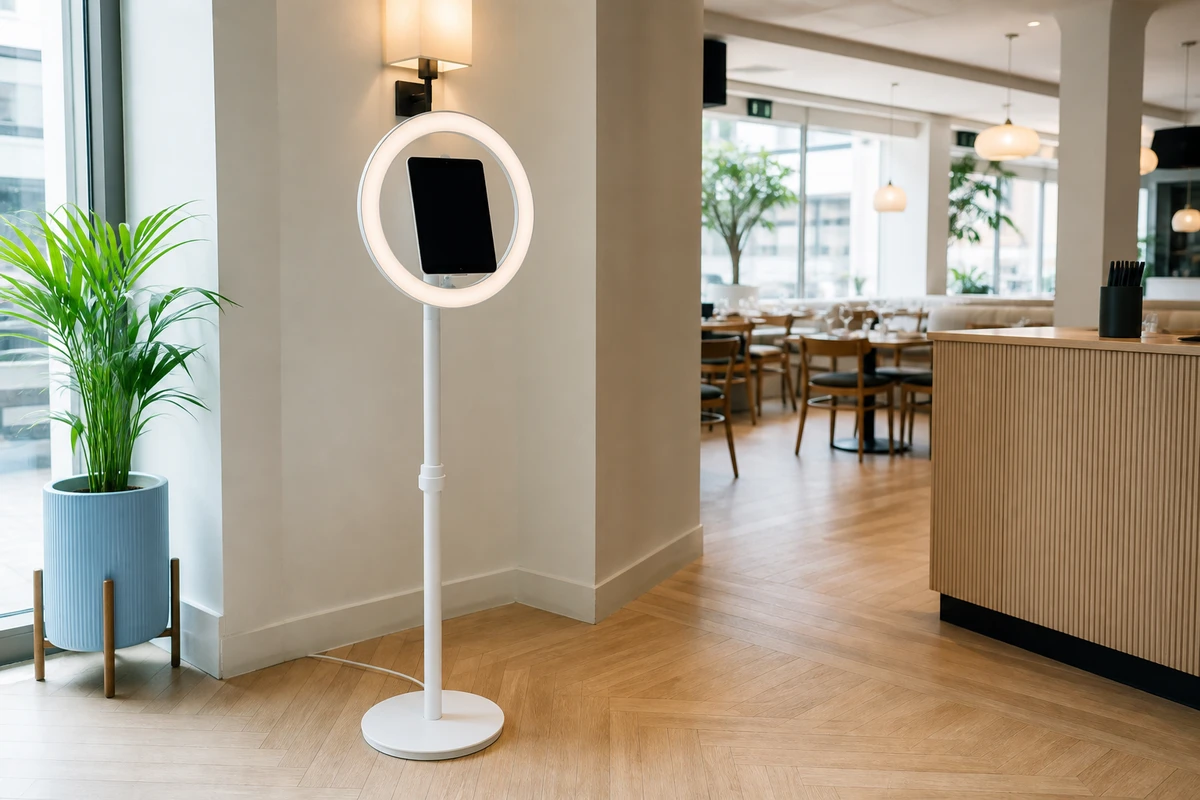
Three prompts scale without adding to a server’s job. A branded QR code on the check presenter or table tent can open a share-and-tag flow. Signage at the most photogenic spot in the room can name the handle and hashtag where guests will actually see it. And a dedicated in-venue capture moment, a branded backdrop or a designed corner, can turn an ordinary visit into a taggable photo. The strongest version is an on-site capture experience that prompts a tagged share and records a marketing opt-in in the same step, so a single guest interaction produces both the content and the permission to use it. Simple Booth’s HALO kit is one concrete version of that on-site capture moment: an iPad photo station where a guest takes a photo, has it texted or emailed to their own phone, and ticks a marketing opt-in box in the same few seconds. One ongoing HALO install at the W Hotel Austin has recorded 12,765 photos from 31,730 participants, the kind of guest-content volume a restaurant would never reach by asking servers to screenshot stories during service.

From a tag to usable content
A guest tag is only raw material. It becomes usable content when a monitoring rule catches it and routes it to someone who can ask permission and repost it, which is the loop the next section covers. What makes that content worth the trouble is trust: guests who see a real table photo or a genuine diner tag believe it in a way brand photography rarely earns, because it was made by someone with no incentive to flatter the restaurant.
Closing the loop: monitoring, permission, and reposting
A guest tags the restaurant in a story at 9 p.m. on a Saturday. The story vanishes in 24 hours. If no one on staff happens to see it, the content is gone, and so is the chance to ask whether the restaurant can keep it. Automation’s third job is making sure collected content actually becomes published marketing.
Listening so nothing slips by
Automated alerts watch for the restaurant’s name, handle, and branded hashtag across platforms. Google Alerts is the free floor; reputation software is the option for a group that needs scale. The point is that a mention surfaces in a queue instead of depending on a manager’s spare attention.
Permission is not optional
A guest who photographs her meal owns the copyright to that photo the instant she takes it. The U.S. Copyright Office is clear that using a copyrighted work without authorization exposes the user to an infringement claim, and that the clean path is to ask the owner directly. Reposting a guest’s photo to the restaurant’s feed without permission is a real exposure, not a courtesy step. The permission ask can be semi-automated (a templated, friendly reply or DM requesting the right to reuse the photo), but it has to actually happen, and the yes has to be logged.

Incentives carry their own rule. A free dessert offered in exchange for a tagged post is allowed, with one condition the FTC enforces: the incentive must be disclosed by the guest, and it must never be conditioned on the content being positive.
Reposting on a calendar, not a whim
Curated content should publish on a recurring schedule (a weekly guest-photo feature, a standing rule to re-share approved stories) so it goes out consistently instead of whenever someone finds a free hour. The schedule also feeds the mechanism that makes UGC compound: a guest who gets reposted feels recognized, and a recognized guest posts again. The loop tightens itself once it runs.
What an automated system is worth
Every part of this system costs something to set up, and an owner weighing that cost wants a figure, not a promise. Two arithmetic models supply it, one for reviews and one for content.
Reviews into revenue
Take an independent full-service location doing $1.2 million a year. Harvard Business School economist Michael Luca’s study Reviews, Reputation, and Revenue (2011, revised 2016) found that for independent restaurants, a one-star rating increase drove revenue up 5 to 9 percent. Chains showed no effect, since diners already know what to expect from them, which means the finding applies squarely to the operators reading this.
On $1.2 million, a full star is worth $60,000 to $108,000. A full star is a large move. A half-star is the realistic first-year target for a location that simply starts asking every guest, and it is worth roughly half that, $30,000 to $54,000. Berkeley economists Anderson and Magruder, in research cited by ReviewTrackers (2023), found a half-star Yelp gain makes a restaurant 30 to 49 percent more likely to sell out its seats at peak dinner hours, so even the modest target changes the room on a Friday night.
Content into reach
Take a restaurant serving 600 covers a week with a branded capture moment near the entrance. If 15 percent of covers produce a tagged share, that is 90 shares a week. Each share lands in front of that guest’s own network, and the size of that network is the one figure an operator should supply from their own crowd rather than borrow, because a downtown lunch counter and a destination steakhouse draw different rooms. Even a conservative few hundred people per share puts weekly reach into the tens of thousands, all of it authentic, all of it at no media cost, and each share also carrying the marketing opt-in captured in the same flow.
What the models do and do not promise
Both models rest on averages measured across many restaurants, not guarantees for any single one. A restaurant in a saturated market, or one with a genuine service problem the reviews are correctly reporting, will not see these numbers. The value is the structure. It ties an automated habit to a dollar figure, which is what makes the case for funding the system properly instead of leaving it to whoever has a spare hour.
What not to automate
A one-star review lands on a Tuesday, and an auto-responder fires back a templated “We’re sorry to hear about your experience” within the minute. The guest who wrote it, and everyone reading the listing later, can tell. Three things have to stay human.
Negative-review replies
The first is the negative-review reply. Automation can alert a manager the instant a low rating posts, and it should. The reply itself, signed, naming the specific problem and what the restaurant is doing about it, has to be written by a person. An auto-reply to a one-star review reads as contempt.
Gating decisions
The second is the gating decision, stated once more because it is the article’s spine. A tool may request reviews, monitor them, and route a complaint to a private channel. It must never decide which honest feedback the public is allowed to see.
Fake enthusiasm and hidden incentives
The third is authenticity itself. A restaurant must never automate the generation of reviews or content, and never run an incentive that hides its strings. Fake and undisclosed-incentive reviews are exactly what the FTC rule was written to catch, and a single penalty erases years of saved time.
The goal of automation is not to do the marketing for the operator. It is to make sure the genuine enthusiasm guests already feel reaches the people deciding where to eat tonight.
Sources
- Harvard Business School (2016). “Reviews, Reputation, and Revenue: The Case of Yelp.com.” Michael Luca, HBS Working Paper 12-016. https://www.hbs.edu/ris/Publication%20Files/12-016_a7e4a5a2-03f9-490d-b093-8f951238dba2.pdf
- U.S. Federal Trade Commission (2024). “Trade Regulation Rule on the Use of Consumer Reviews and Testimonials, 16 CFR Part 465.” https://www.ecfr.gov/current/title-16/chapter-I/subchapter-B/part-465
- Google (2024). “Prohibited and restricted content: Maps user-contributed content policy.” https://support.google.com/contributionpolicy/answer/7400114
- Yelp (2024). “Content Guidelines.” https://www.yelp.com/guidelines
- BrightLocal (2026). “Local Consumer Review Survey 2026.” https://www.brightlocal.com/research/local-consumer-review-survey/
- ReviewTrackers (2023). “Reputation Management for Restaurants.” https://www.reviewtrackers.com/reports/reputation-management-for-restaurants/
- ReviewTrackers (2023). “Online Reviews Statistics and Trends Report.” https://www.reviewtrackers.com/reports/customer-reviews-stats/
- U.S. Copyright Office (2024). “Fair Use Frequently Asked Questions.” https://www.copyright.gov/help/faq/faq-fairuse.html