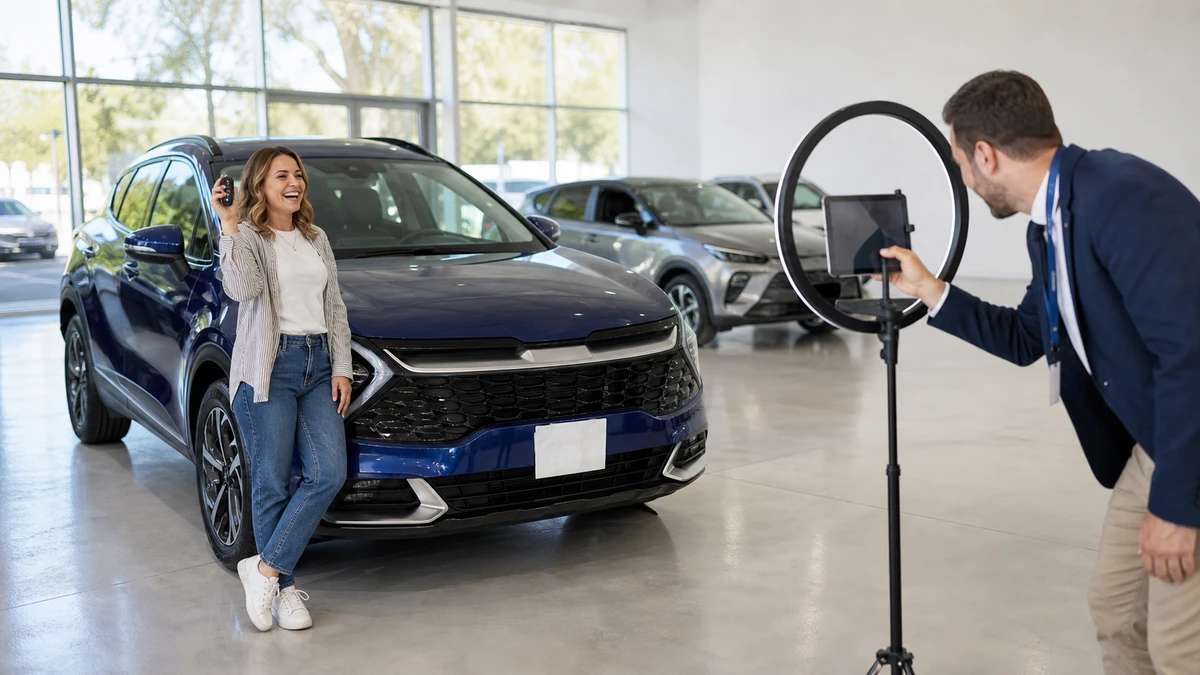
A new SUV sits in the showroom with a temporary plate on the back. The customer has signed everything and shaken hands with the finance manager, and a salesperson is walking them toward the door. In the next ninety seconds, one of two things happens. Someone asks the customer to stand by the car for a photo, or nobody does, and the most persuasive social post that store could publish all day never gets taken.
Most dealerships already know the delivery photo outperforms almost everything else they post. Knowing it is not the problem. The problem is that the photo only happens when a salesperson remembers it, at the end of a long transaction, when the customer wants to leave. Run car dealership delivery photos as a loose content idea and a store catches a fraction of its deliveries. Run them as a fixed step in the process and it catches almost all of them.
The delivery photo is the highest-return post a dealership can make
Scroll any dealership’s feed and the pattern repeats: a stock shot of a trim level, a service reminder, a staff introduction, a Monday meme. It fills a calendar. It rarely moves a car. The delivery photo is the exception, and it is worth being precise about why.
A real buyer is proof a competitor cannot copy
An inventory photo of a new pickup is interchangeable with the same truck on every other lot and on the manufacturer’s page. It tells a shopper the vehicle exists and nothing about the store. A delivery photo says what no competitor can pull from a stock library: a named, local person stood in this showroom, trusted the store with a major purchase, and left happy enough to be photographed about it.
Trust, not information, is the scarce thing in car buying. Nielsen’s Global Trust in Advertising research has held for over a decade that recommendations from people a buyer knows are the most trusted advertising there is; its 2015 edition put that at 83% of respondents, far ahead of any paid channel. A delivery photo is the closest a dealership can honestly get to manufacturing that signal.
The follower who recognizes the face
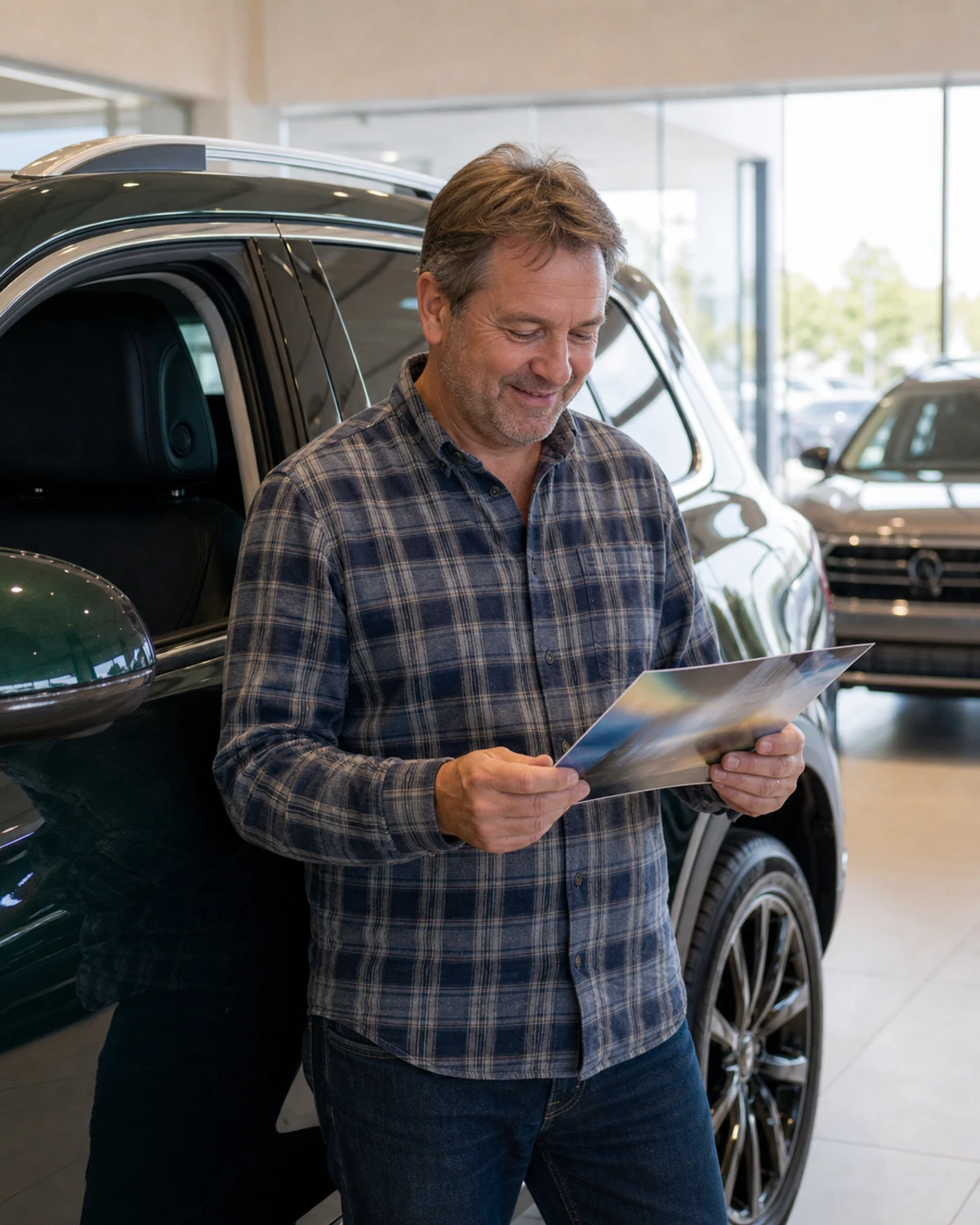
The signal sharpens when the audience is local, and a dealership’s following almost always is: past customers, service customers, their friends and neighbors. When one of them recognizes the face in a delivery photo, a coworker or a parent from the same school, the post stops being an ad and becomes a fact about a person they trust. The path from there to a showroom visit is short and warm.
That matters more every year, because buyers decide so much before they arrive. They spend close to 14 hours researching online during a purchase, by Cox Automotive’s Car Buyer Journey research, and CDK Global’s Ease of Purchase data shows 41% of buyers visited just one dealership before purchase in 2025, up from 32% in 2023. The decision is made in the feed now, well before the visit, so that is where a store has to win it.
Why dealerships capture only a fraction of the photos they should
Ask a sales manager whether the store posts delivery photos and the answer is yes. Ask what share of last month’s deliveries became a post and the answer is a shrug. Both are honest: the store does post delivery photos, and it also misses most of them. The reason is structural, not a matter of effort.
An unowned step loses every time
The delivery photo is a ritual nobody owns. It has no fixed time, no checklist line, no person whose job it is. In the last ten minutes of a delivery it competes against paperwork corrections, the temporary plate, a gas top-off, pairing a phone, a feature walk-through, and the customer’s plain wish to leave. An optional task against that list loses, not occasionally, but as a rule.
The salesperson is the wrong owner
When the photo does happen, it falls to the selling salesperson, the worst-placed person to do it reliably. They have just spent hours closing, the commission is booked, the next up is waiting. Asking them to also remember a marketing task, frame it well, and route the file somewhere useful is asking memory to do a system’s job. In an r/askcarsales thread about a delivery photo request, a salesperson with four years on the floor called the practice something he had simply never seen. A step that depends entirely on the individual is inconsistent by design.
Ad-hoc photos look ad-hoc
Memory-driven capture also produces photos that show it. The ad-hoc delivery photo happens wherever the car is parked: flat midday light blowing out the windshield, a row of trade-ins behind, the customer squinting. The file lands in a personal camera roll, one image among thousands, gone for good when that employee changes jobs.
Each of those is a small reason the photo never gets used, and they compound. The advice everywhere is take the delivery photo. The harder question, the one the listicles skip, is what makes it happen reliably and well, on a store’s hundredth delivery as much as its first.
Track one number: the delivery photo capture rate
Capture rate, defined
One number makes the problem visible, and almost no store tracks it. Call it the delivery photo capture rate: delivery posts published divided by vehicles delivered, measured monthly. A store that delivers 120 cars and publishes 24 delivery posts has a capture rate of 20%. It is easy to calculate and uncomfortable to read. A problem nobody measures stays a problem nobody fixes.
A worked example: 120 deliveries in a month
Take a franchised store delivering 120 vehicles in a month, new and used combined. NADA’s 2025 dealer data puts the average franchised dealer near 80 new vehicles a month, and used volume brings a busy store into this range.
Run the photo as a favor and the math is unforgiving. Salespeople remember to ask on maybe one delivery in three, and most of those customers say yes, so about 40 get photographed. Of those, perhaps 60% are usable and actually reach whoever runs the page; the rest are too rough to post or never leave a personal phone. That is about 24 posts, a 20% capture rate.
Run it as a fixed station instead. A photo bound to the key handover, with one owner and one spot, catches around 85% of deliveries, near 102. Roughly three in four customers consent, and because the handoff is built in, the usable photos reach the page. That is about 75 posts, a 63% capture rate. Same 120 cars, same budget, same staff: the store tripled the volume of its most persuasive content type by changing only whether the photo was optional. Every extra post is reach, and fifty more a month, each seen by a few hundred locals, puts tens of thousands of extra impressions of a real buyer in front of the people deciding where to buy.
Make the photo a station, not a favor
Automating the delivery photo does not mean buying software. It means taking human discretion out of whether the photo happens. A favor is something a busy person may or may not do; a station is something the process does on its own. Three changes turn one into the other.
One owner
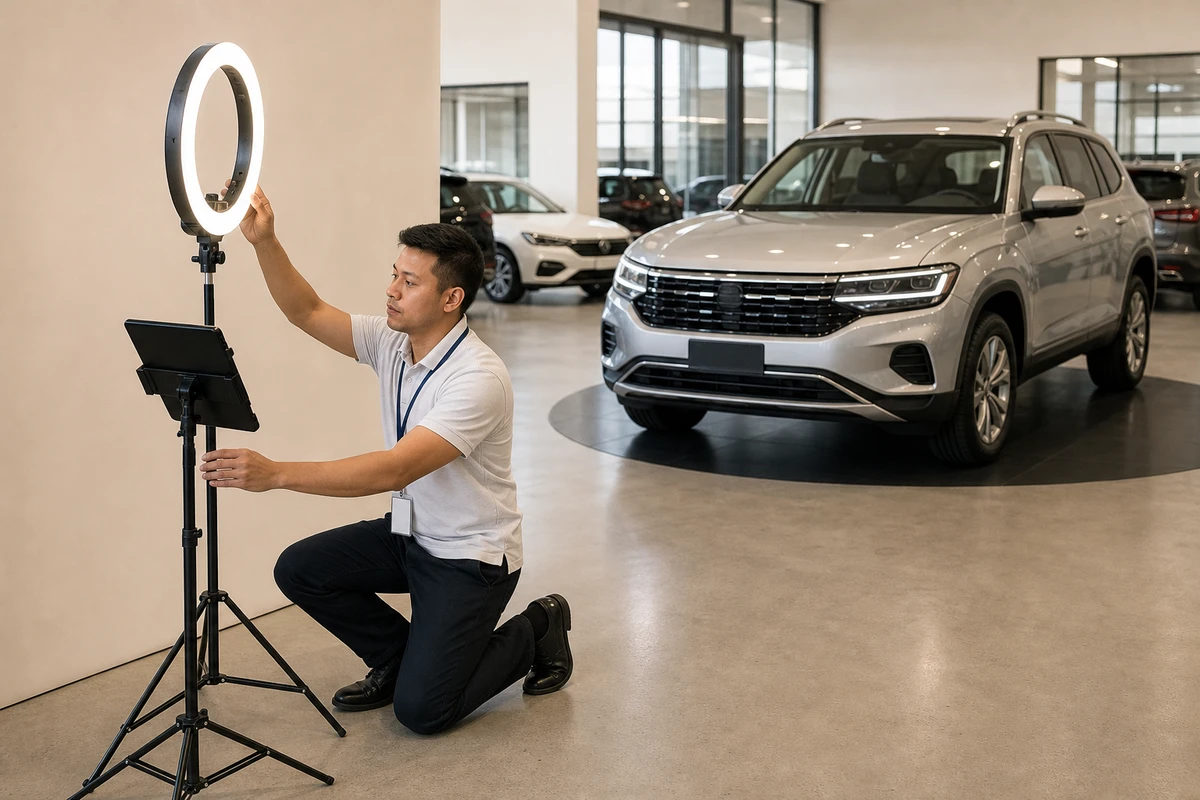
The photo needs a name attached, and not the selling salesperson’s. The natural owner is the delivery coordinator, a role that already exists at many stores and whose whole job is the handover. Where there is no coordinator, the photo attaches to whoever runs the final walk-through. One specific person is accountable on every delivery, so a missed photo has an address.
One trigger
An owner without a trigger still relies on memory. The photo has to bind to a fixed, unmissable moment, and the key handover is the obvious one: celebratory, photogenic, present at every delivery. Make it a literal line on the delivery checklist or board. One sales manager in that r/askcarsales community described tracking deliveries on an Outlook calendar; most stores have some version of that board already. The fix is small: add the photo to it, so an unphotographed delivery reads as an incomplete one.
One spot
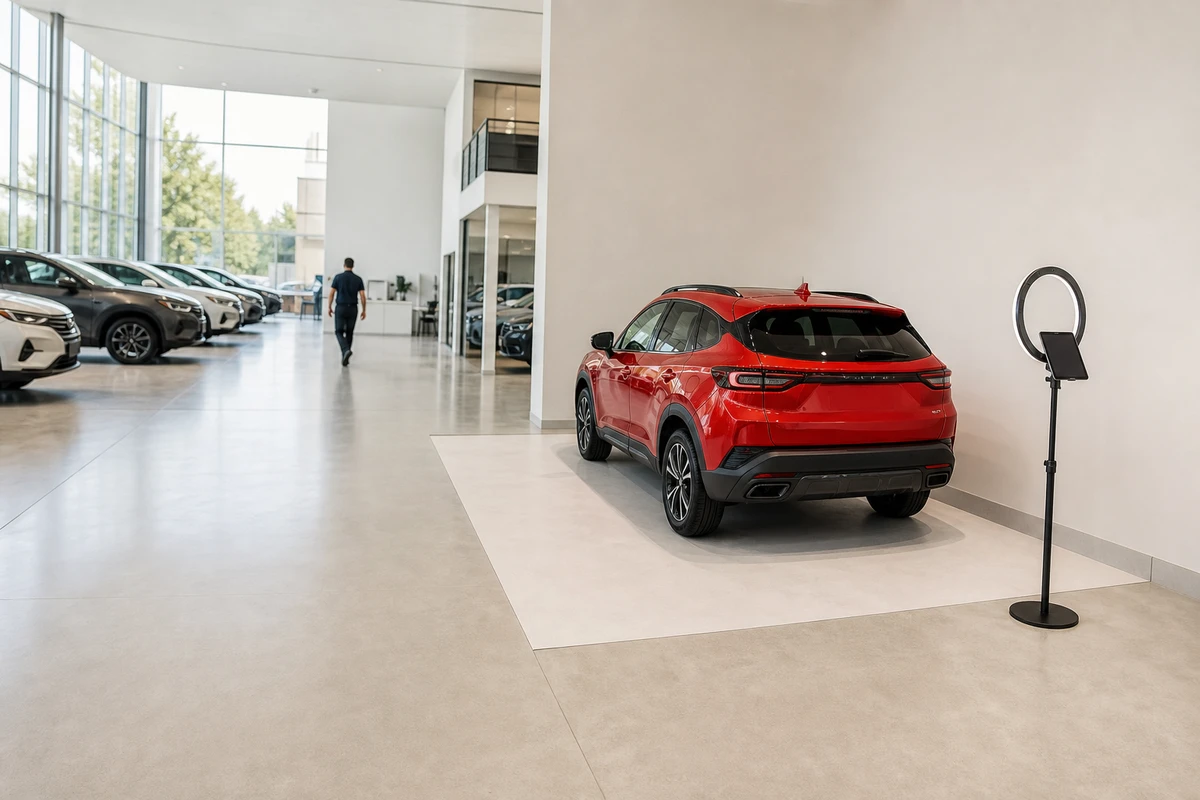
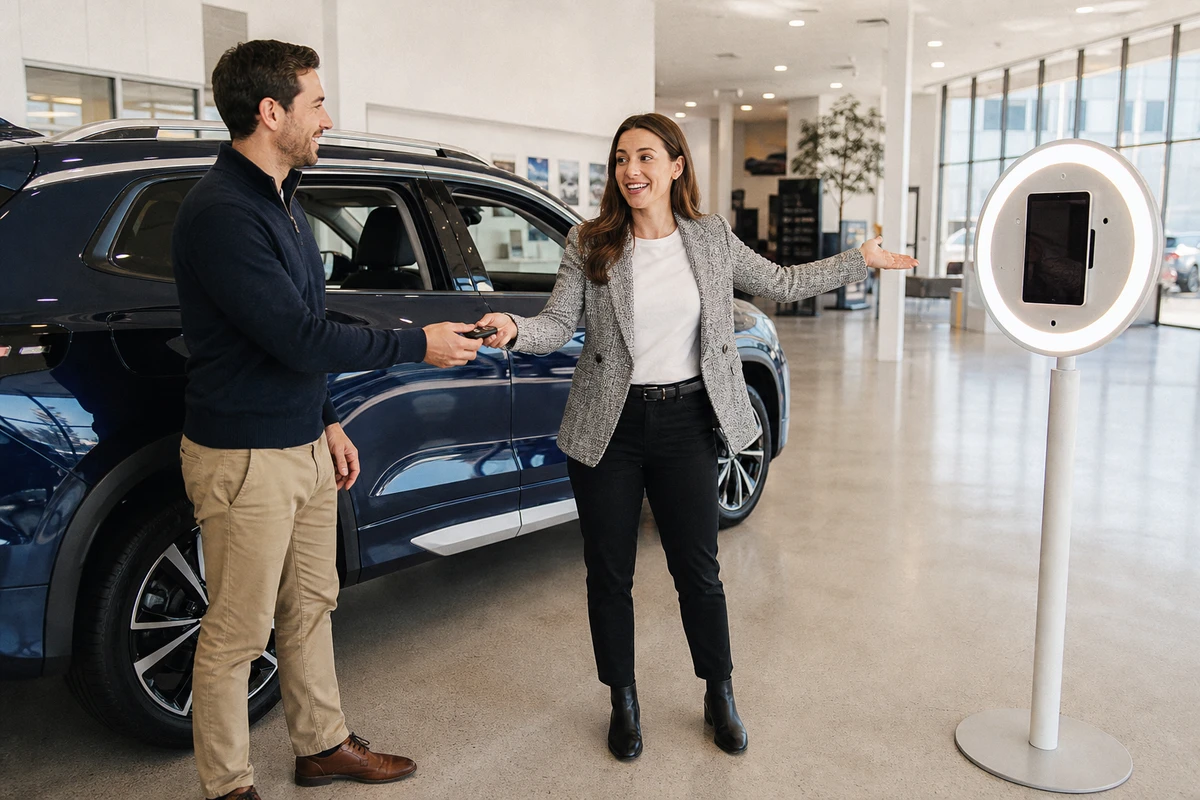
The last variable is location. Ad-hoc photos happen wherever the car sits, which is why their quality swings. A station has one repeatable spot: a consistent backdrop, even light, a branded element in frame, ideally indoors in the showroom rather than out on the lot. A fixed spot kills quality variance and makes the photo fast, and fast is what makes it happen. A thirty-second photo at a marked spot gets taken; one that needs someone to hunt for good light does not.
That spot can be as simple as a taped floor mark, a phone, and a checklist, or as built-out as a permanent station that prompts the customer, takes the shot, and handles consent and sharing in one motion. Simple Booth’s HALO kit is one built-out version of that spot: an iPad station with a 2,100-lumen ring light, so the delivery coordinator gets the same even light on every customer rather than whatever the showroom windows happen to be doing. The right level depends on delivery volume. A store weighing a permanent setup should read our guide to choosing a photo booth for dealerships and showrooms before buying hardware.
Ask for consent the right way, and most customers say yes
The most common objection to systematizing delivery photos is that customers find them tacky and refuse. There is a kernel of truth wrapped around a wrong conclusion. Customers do refuse delivery photos. What they refuse is a bad ask, not the photo.
What a bad ask looks like
The r/askcarsales thread running through this article is a clean specimen. A buyer posted that a salesperson called them at home, hours after the sale, asking for a photo of the car parked in front of their house, with “tax purposes” offered as the reason. Buyers and industry professionals in the thread read it the same way: a salesperson who forgot the photo and invented a pretext to get it later.
Every element of that ask is a mistake. It came hours late and by phone, detached from any celebration. It used a reason that was not true. It never plainly said the photo was for social media. It put the customer’s home in the frame. As one commenter flatly noted, buyers know “it’s a marketing thing, always.” A pretext does not hide the marketing; it just adds a reason to distrust the person asking.
What a good ask looks like
A good ask inverts each mistake. It happens in the moment, at the car, as the keys change hands, framed as what it honestly is: a celebration of the new vehicle, not a favor to the marketing department. It is direct about where the photo goes, something near “we’d love to feature you on our page.” Honesty is not the risk here; it is what earns the yes. Most customers agree to a clear, in-the-moment, celebratory ask.
Put the release in the paperwork
Consent should be captured in writing, and the clean way is to fold a short media-release line into the delivery paperwork the customer is already signing, rather than chasing a signature afterward. This is a real legal point. The Digital Media Law Project, a legal-education resource from Harvard’s Berkman Klein Center, explains that commercial use of an identifiable person’s image can trigger a right-of-publicity or misappropriation claim, and that consent is a complete defense; it advises getting consent in writing whenever possible. State laws vary and this is general information rather than legal advice, but the operating point is settled: a signed release, gathered at delivery, keeps a customer’s photo usable.
Two rules finish it. A no is logged once and never re-asked, so no customer is pestered about it twice. And a customer who consents and is handed their own copy, by text or email, will often post it themselves, which is reach the store never had to create.
Close the second gap: from camera roll to posted
Capturing the photo is the first bottleneck. Getting it from a phone to whoever runs the page is the second, and it quietly kills as many posts as poor capture does. A store can fix everything upstream and still publish nothing if the photos pile up where the social manager never sees them.

Get the photo off the personal phone
A delivery photo in a salesperson’s camera roll is, in practice, lost. It has to land somewhere shared the moment it is taken: a shared album, a drive folder marketing checks, or a direct handoff to whoever posts. The destination matters less than the rule: the photo never depends on one person remembering to forward it, and never disappears when that person leaves. Hand the customer their copy in the same step; it costs nothing and gives them a reason to think well of the store.
Write the caption around the backstory
A delivery photo with no story is a stranger holding keys. The caption turns it into proof. The useful version names the customer’s first name, the vehicle, and one specific line about why they chose this store or what they were upgrading from. “Maria picked up her Forester today, trading up from a sedan that finally gave out at 200,000 miles” is a post. “Congrats to our valued customer” is wallpaper. The backstory is free, because the salesperson already heard it during the sale. A fill-in template keeps it consistent no matter who writes it.
Pace the posts
A store that fixes its capture rate will suddenly have 75 delivery photos in a month, and posting them all at once turns the feed into a wall of strangers. Pace them: a steady drip of a few a week, a standing delivery album on the store’s Facebook page, and an optional monthly recap. The recap is a supporting tactic. The steady drip is the strategy, because consistency is what trains a local audience to expect, and trust, the stream of real buyers.
A one-week rollout
None of this needs a budget cycle. It is five decisions a sales manager can make in a week.
- Name the owner. Hand the delivery photo to the delivery coordinator, or to whoever runs the final walk-through. One name, every delivery.
- Mark the spot. Pick one indoor location with a clean backdrop, good light, and a branded element in frame. Tape the floor if that is what it takes.
- Add the trigger. Put the photo on the delivery checklist or board and bind it to the key handover, so a delivery without a photo reads as unfinished.
- Fix the ask and the release. Brief the team on the honest, in-the-moment ask, and add a one-line media release to the delivery paperwork so consent is captured in writing, with every no logged and respected.
- Set the handoff. Route every photo to one shared destination and send the customer their copy in the same step.
Then start counting. Log the capture rate every week: delivery posts published over vehicles delivered. Expect it to start near a guessed 20% and climb past 60% as the five steps settle. When it stalls, the number points to the leaking step, the owner, the spot, the trigger, the ask, or the handoff, and tells the manager which one to revisit. The dealership already sells the cars. This is the work of making sure each sale is also seen.
Sources
- National Automobile Dealers Association (2026). “NADA Data 2025 Full-Year Report.” https://www.nada.org/nada/nada-data/
- CDK Global (2026). “Visiting 1 Store a Key Factor in Buyer Satisfaction.” https://www.cdkglobal.com/insights/visiting-1-store-key-factor-buyer-satisfaction
- Nielsen (2012, 2015 update). “Global Trust in Advertising.” https://www.nielsen.com/insights/2012/global-trust-in-advertising-and-brand-messages-2/
- Cox Automotive (2022). “2021 Car Buyer Journey Study.” https://www.coxautoinc.com/insights/2021-car-buyer-journey-study/
- Digital Media Law Project, Berkman Klein Center for Internet & Society (2014). “Using the Name or Likeness of Another.” https://www.dmlp.org/legal-guide/using-name-or-likeness-another
- r/askcarsales (2024). “Dealer is asking for picture of car in front of my house after the sale?” https://reddit.com/r/askcarsales/comments/1gfnzkq/dealer_is_asking_for_picture_of_car_in_front_of/