A coffee shop fills up at 8 a.m. Forty people order, pay, and leave inside the hour. The owner knows most of the faces and could name what half of them usually drink. By 9:15 the rush is over, the revenue is in the till, and not one of those forty customers can be reached again unless they decide, on their own, to walk back through the door.
Closing that gap is what phygital marketing is for. A phygital moment is a single customer interaction that is physical and digital at the same time: the customer is standing in the business, and the same action that completes the visit also produces something digital the business gets to keep. It is not a digital campaign running alongside a physical one. It is one moment, both at once.
What “phygital” actually means, and why it is not omnichannel
A customer gets a promotional email from a store on Monday and walks into that store on Thursday. Two channels, one brand, three days apart. A second customer scans a code at the checkout counter and lands on the store’s email list before the receipt finishes printing. One action, one place, one moment.
Omnichannel
The first is omnichannel. The second is phygital. Most trade coverage uses the two words as if they mean the same thing, and the blur leaves operators without a definition they can act on. Omnichannel is about breadth: one brand spread across a store, a website, an app, and an inbox, working to keep the experience consistent as the customer moves between them. Phygital is about fusion: a single interaction in which the physical and the digital are not adjacent but the same event.
The term is older than the current wave of interest. According to Amazon Ads’ guide to the concept, it was coined in 2007 by Chris Weil, then CEO of the experiential agency Momentum Worldwide, which matters mainly as a reminder that phygital is not a pandemic-era invention.

The distinction is not academic
The distinction is not academic. It tells an operator where to spend effort. Chasing omnichannel means running more channels and working to keep them aligned, which is expensive and never finished. Chasing phygital means finding the seams in a physical visit that already happens, where a small addition produces a digital result. One is a breadth problem. The other is a design problem, and design problems are cheaper to solve.
Why the physical-to-digital gap quietly costs operators money
A customer buys a $90 pair of shoes from an online store. The store now holds an email address, a purchase record, and a tracking pixel that will recognize the same person on other sites next week. The relationship has a memory. A second customer buys the same $90 pair in a physical shop, pays at the counter, and leaves. The shop has $90 and nothing else. The next morning that customer is, as far as the business systems are concerned, a stranger again.
Anonymous Visits Are Expensive
That is the mechanism, stated plainly. A physical visit reliably produces revenue and, by default, produces no record of who showed up. Every visit ends with the customer relationship reset to zero. The operator can often describe a regular’s face and order in detail and still has no way to send that person a message tomorrow.
The cost does not appear as a line item, which is why it goes unnoticed. It shows up as opportunity cost. Every visit that ends without a captured contact is a customer the business will later have to pay to acquire all over again, through ads or promotions or sheer luck. Harvard Business Review, summarizing research by Bain & Company’s Frederick Reichheld, reports that acquiring a new customer costs five to twenty-five times more than keeping an existing one, and that lifting retention by 5% can raise profits by 25 to 95% (Gallo, 2014). Re-acquisition is the most expensive growth a business can buy.
This is not a niche concern. The US Census Bureau reported that e-commerce accounted for 16.6% of total US retail sales in the fourth quarter of 2025, which leaves roughly 83% of retail still happening in physical locations. The physical-to-digital gap sits underneath the large majority of commerce. Closing it does not mean rebuilding the business as a digital one. It means building a single bridge well.
The two directions of the bridge, and which one to build first
The phygital examples that reach headlines tend to be expensive ones. A luxury label installs augmented-reality mirrors. A grocery chain builds scan-and-go checkout. A coffee giant routes a large share of its orders through a proprietary app. An operator running one location, or a handful, reads those examples and reasonably concludes that phygital is a budget the business does not have.
Those examples share a direction
Those examples share a direction. Call it digital to physical: a digital tool pulls a customer toward a physical action. App-based ordering, click-and-collect, “check stock at your nearest store,” geo-targeted offers, in-store screens. Nearly every ranking article on the subject, and nearly every brand case study, describes this direction.
The other direction runs the opposite way. Physical to digital: a physical moment produces a digital asset the business owns. An email opt-in captured at the point of experience. A photo or short piece of content created during the visit. A first-party data point. A review left on the spot, while the experience is still fresh.
For most operators the physical-to-digital direction is the better first investment, for three reasons. It is cheaper, because it needs no app build and no commerce-platform integration. It directly repairs the “no memory” gap rather than working around it. And the asset it produces, an owned contact or a piece of owned content, compounds over time, while an augmented-reality mirror is a fixed cost that only depreciates.
This is also where the enterprise-budget misconception breaks down. The intimidating examples are all digital-to-physical, and that direction is capital-intensive by its nature; it requires software platforms and connected hardware. The physical-to-digital bridge does not. It runs on equipment an operator likely already owns, or can buy for the price of a tablet.
The phygital touchpoint most operators can build this quarter
Picture the counter of a small store at the moment a sale closes. The customer is satisfied, present, and about to leave. That five-second window, repeated across every visit of the week, is the cheapest phygital bridge a business can build.
The Phygital Capture Loop
It has a simple shape: one well-placed capture moment, at the point of experience, built on a genuine value exchange. The customer hands over a digital identifier or creates a piece of digital content, and the business gives back something the customer actually wants. Strip out the value exchange and nothing else in the design matters.
The most common form is the QR-to-opt-in: a code positioned at a moment of attention that does one job and offers one clear reward. The underlying behavior is already in place. Bitly’s 2025 QR Code Statistics report, citing 1WorldSync’s 2024 Consumer Product Content Benchmark, found that 64% of consumers have scanned a QR code while shopping in a store and 61% have scanned one on packaging after a purchase. Customers know how to scan. What they will not do is scan a code that promises nothing. A QR sticker with a vague “Scan Me” and no reward behind it is wallpaper.
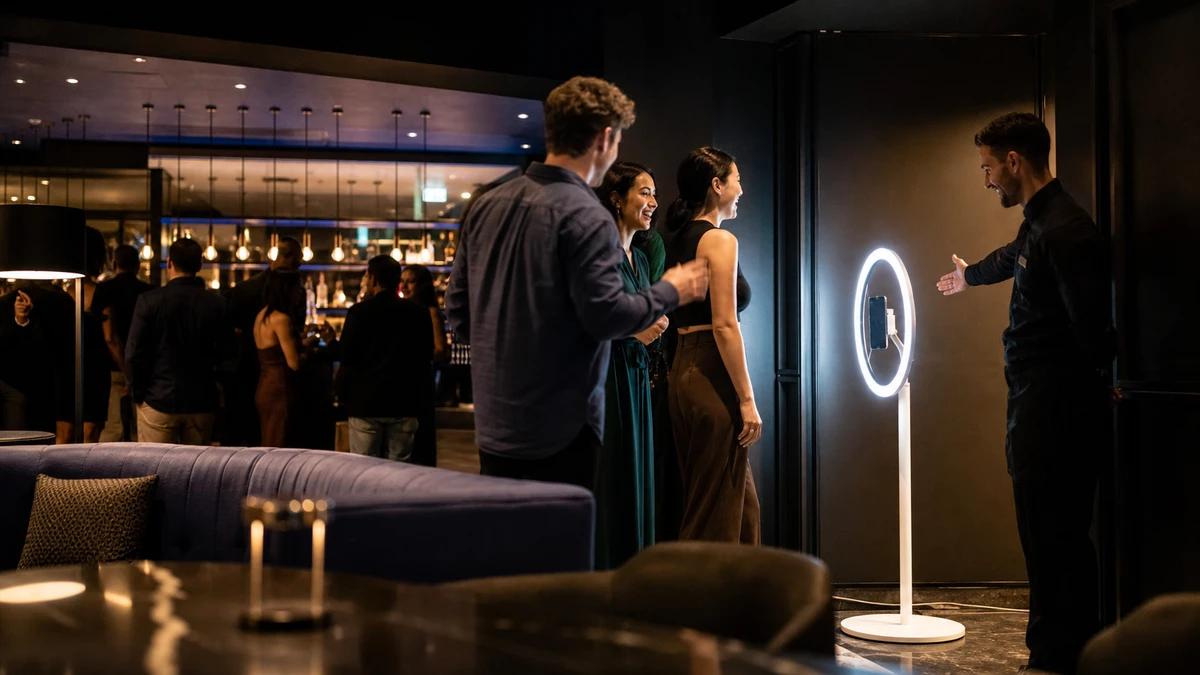
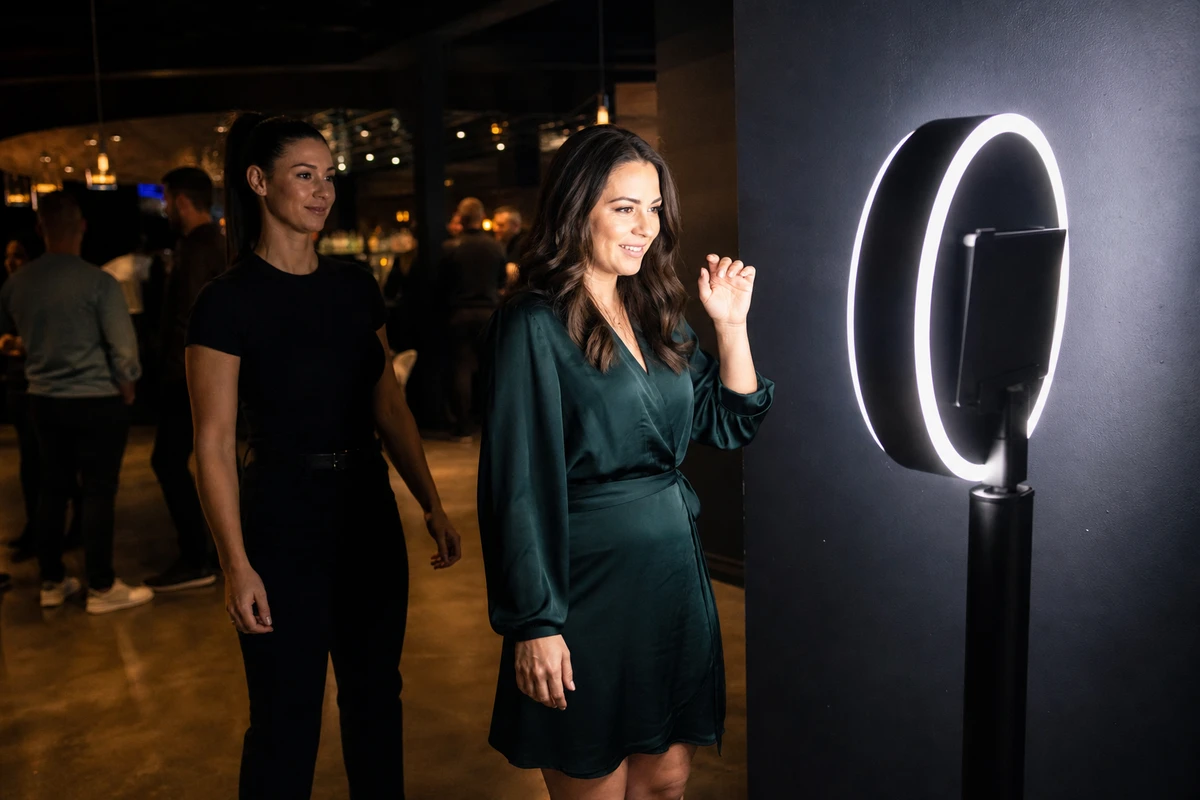
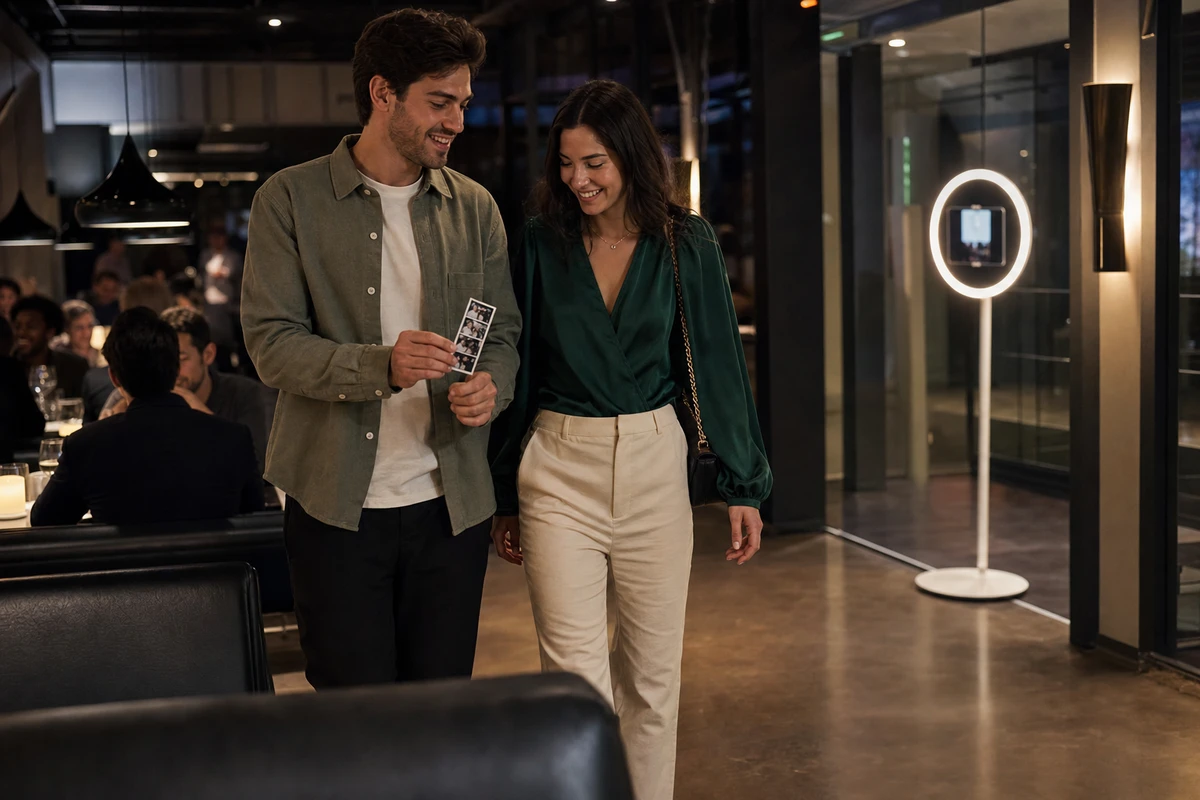
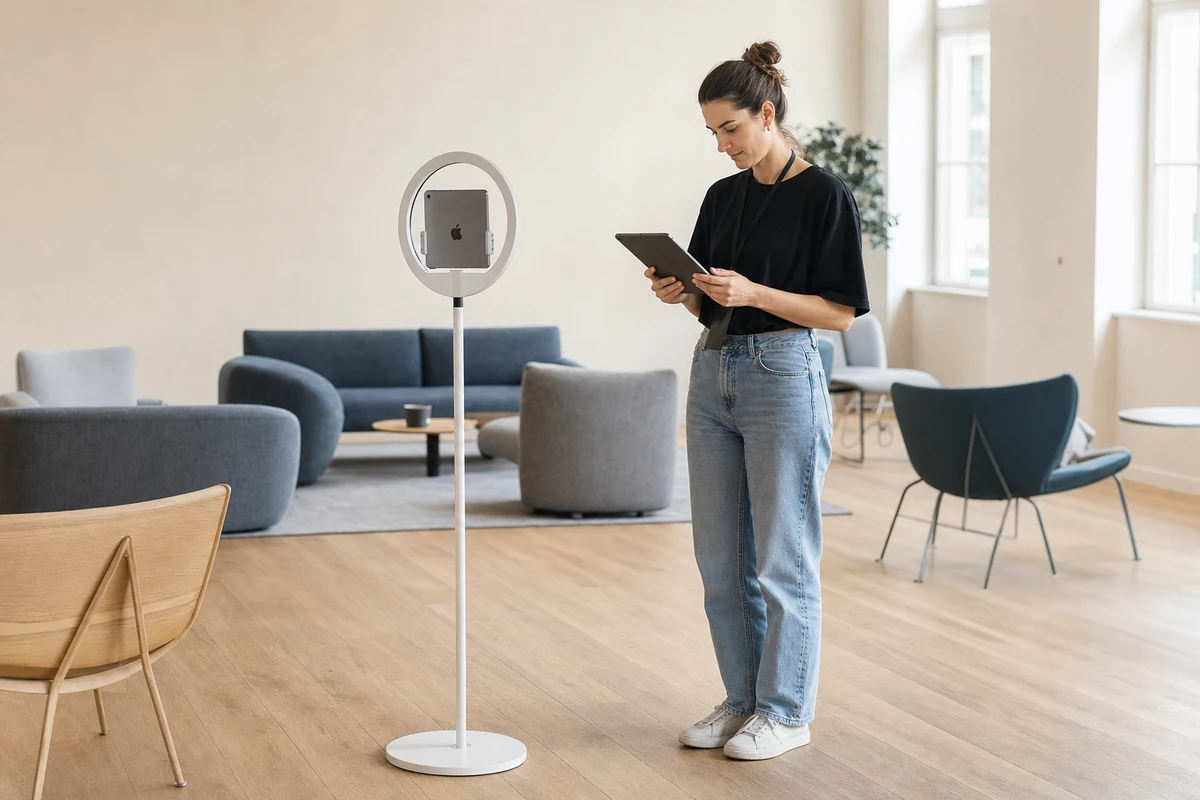
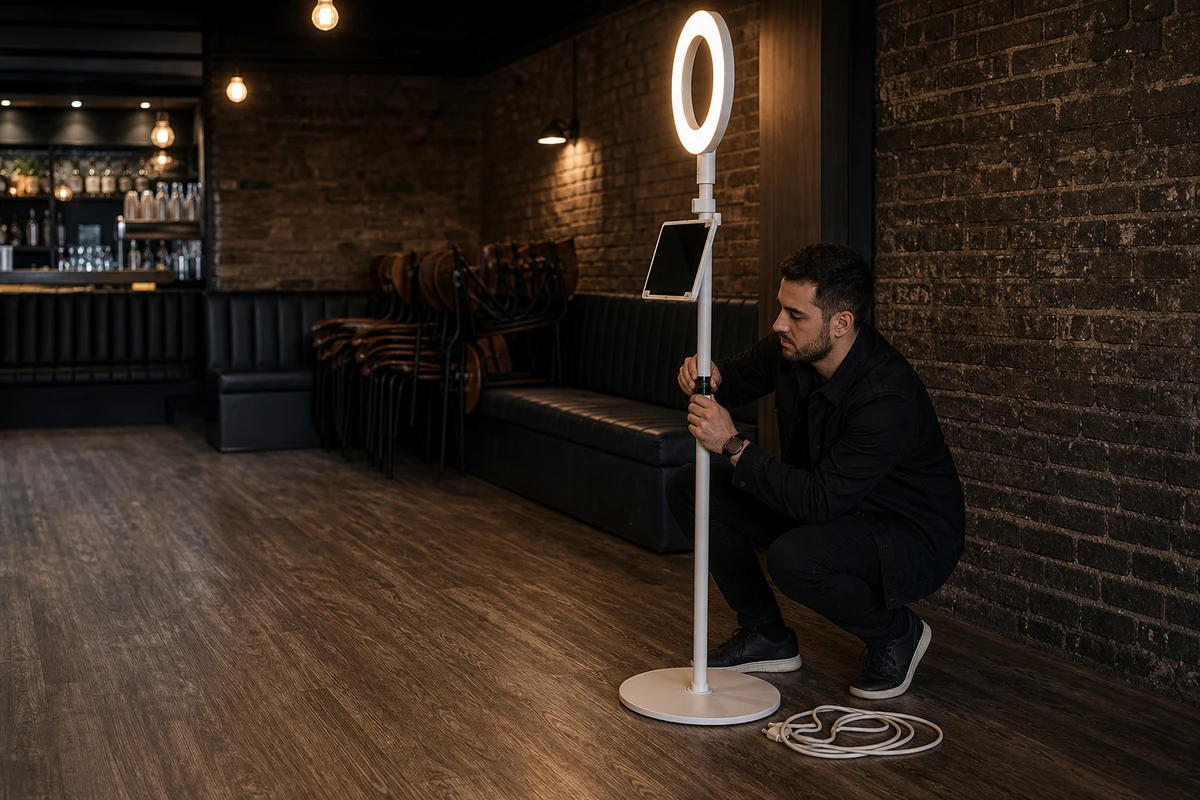
The other forms follow the same logic. A point-of-sale prompt can capture an email or phone number when it is tied to the receipt or to a concrete benefit, such as a digital warranty or a member price. A content-capture moment can turn part of the visit into something the customer wants to keep and show other people, a photo or a personalized result, which then doubles as marketing the customer distributes on the business’s behalf. A photo station like Simple Booth’s HALO kit is one off-the-shelf version of that moment: the customer poses, the booth sends the photo to them by text or email, and the same screen records an opt-in in the same step, which is how the entertainment chain Treetop Golf built a list of 150,000 unique email addresses across its locations. An on-the-spot rating prompt can convert a satisfied visit into public proof while the customer still feels good about it.
Two rules separate a working bridge from decoration. First, no value exchange, no scans: the reward has to be worth a moment of the customer’s attention, or the touchpoint sits idle. Second, the asset has to be owned, not rented. A new follower on a third-party platform is rented reach; the platform decides who sees the next post and can change that rule overnight. An email address, an SMS opt-in, or a piece of first-party content is an asset the operator controls outright. A bridge worth building ends in something owned.
What the bridge is worth: a worked example
Take a store that serves 100 customers in a typical week. A well-designed capture moment, meaning a real reward and a single quick action, converts 30% of them to an owned email or SMS opt-in. That is 30 new contacts a week, around 1,560 in a year, every one of them a person who has already paid the business at least once.
Those contacts have value because email remains the highest-return owned channel a business has. Benchmark figures compiled by Omnisend (2026) put email marketing’s return at roughly $36 to $40 for every $1 spent. Suppose the operator works the list modestly: a monthly note, an occasional offer. Assume, conservatively, that this brings even 15% of the 1,560 subscribers back for one extra visit across the year, and that the average transaction is $40. The arithmetic is 1,560 × 15% × $40, or $9,360 in incremental revenue in the first year, produced by one tablet at one counter. The 15% reactivation rate is an assumption, not a measured fact; it is a figure the operator should treat as a starting estimate and then check against real list behavior.
The number is sensitive to one variable, and it is worth seeing which. At a 10% opt-in rate the same store captures 520 contacts and roughly $3,120 of incremental revenue. At 40%, it captures 2,080 contacts and roughly $12,480. The hardware did not change between those three cases. The value exchange did. Touchpoint design, not the gear, is the lever that moves the result.
The second half of “worth” is measurement
The second half of “worth” is measurement. A physical visit is normally invisible to analytics; the operator knows the day’s total and little else. A phygital touchpoint makes the visit countable. Scan rate, opt-in rate, and redemption rate become numbers an operator can watch and improve week over week. Phygital does not only capture customers. It makes a physical location legible the way a website already is, which is the precondition for improving anything. McKinsey research, cited across industry coverage including TruRating (2024), estimates that personalization can raise revenue by 5 to 15% and lift marketing efficiency by 10 to 30%, and personalization is only possible once the business knows who its customers are. A Harvard Business Review study of 46,000 shoppers (Sopadjieva, Dholakia, and Benjamin, 2017) found that customers who engaged with a retailer across both physical and digital channels spent more than single-channel customers.
Designing a phygital moment customers actually use
The most common phygital failure is a touchpoint that sits there unused: a QR code taped to a counter, scanned by nobody, quietly confirming that the technology was never the strategy. A handful of design rules, applied in order, separate a touchpoint customers use from one they walk past.
- Value exchange first. Decide what the customer gets before deciding what the business gets. If the reward is weak, no amount of placement or wording will rescue the touchpoint.
- One moment, low friction. Pick the single best point in the visit, the peak of satisfaction, the wait, or the checkout, and make the digital action take seconds. A long form at the counter kills the moment.
- Consent that is clear. A phygital opt-in is a permission, not a trick. Plain language about what the business will send protects both the brand and the quality of the list. Data rules vary by region, and operators should confirm the specifics that apply to them.
- End in an owned asset. Email, SMS, or first-party content, not rented reach on a platform the operator does not control.
- Close the loop. A captured contact is worth nothing until the first message arrives, and it should arrive while the visit is still warm in the customer’s memory.
A practical way to begin is to keep the scope small. Pick one moment in the visit, one digital outcome, and one metric. Run it for a quarter. Watch the opt-in rate, and when it disappoints, improve the reward before touching anything else. Phygital is not a transformation program and does not need to be treated as one. It is one bridge between a physical visit and a digital record, built well, measured honestly, then widened. The operators who win at this are not the ones with the largest technology budget; they are the ones who stopped letting paying customers walk out as strangers. Sources
- US Census Bureau (2026). “Quarterly Retail E-Commerce Sales, 4th Quarter 2025.” https://www.census.gov/retail/ecommerce.html
- Gallo, Amy (2014). “The Value of Keeping the Right Customers.” Harvard Business Review. https://hbr.org/2014/10/the-value-of-keeping-the-right-customers
- Sopadjieva, Emma, Utpal Dholakia, and Beth Benjamin (2017). “A Study of 46,000 Shoppers Shows That Omnichannel Retailing Works.” Harvard Business Review. https://hbr.org/2017/01/a-study-of-46000-shoppers-shows-that-omnichannel-retailing-works
- Bitly (2025). “QR Code Statistics 2025,” citing 1WorldSync, “2024 Consumer Product Content Benchmark.” https://bitly.com/blog/qr-code-statistics/
- Omnisend (2026). “Email Marketing Statistics: Key Data Points for 2026.” https://www.omnisend.com/blog/email-marketing-statistics/
- Amazon Ads (2024). “What Is Phygital?” Amazon Advertising Library. https://advertising.amazon.com/library/guides/phygital
- TruRating (2024). “Phygital Retail” (citing McKinsey & Company, “The Future of Personalization”). https://trurating.com/blog/phygital-retail/