
A current member brings a friend in on a Tuesday evening. The friend signs a waiver at the front desk, gets a wristband, trains for forty-five minutes, and leaves. The gym now has a signed sheet of paper in a drawer with the guest’s name on it. Three weeks later, nobody has called, and the gym could not say what the guest came in to work on or whether texting that guest is even allowed.
A guest pass works only if that single visit ends with a lead record, not a signed waiver. The pass already did the expensive part: it put a self-identified prospect inside the building, on the floor, trying the product. What gets written down during that one visit decides whether follow-up converts or fizzles. Most gyms believe a signed waiver means they captured the guest. It does not. The waiver captures legal coverage. Gym guest pass lead capture is a separate job, and it has one short window to get done.
The Guest Pass Is the Warmest Free Lead a Gym Gets
A gym pays for most of its leads. An ad click costs money and shows up as a name with no context attached. A guest pass shows up the opposite way: the person is already inside the building, already changed, already on the floor. They got there one of two ways, and both ways filter for intent.
Intent arrives pre-qualified
Either the guest asked for the pass, which means they were already shopping for a gym, or a current member brought them, which means a paying customer vouched for the place to a friend. A cold ad audience contains people who clicked by reflex. A guest pass audience does not. By the time the guest is doing a workout, the hardest part of lead generation (getting a qualified prospect to show genuine interest) is already finished.
That matters more in a crowded market than a quiet one. The Health & Fitness Association’s 2026 consumer report found a record 81 million Americans belonged to a gym, studio, or fitness facility in 2025, about 26.1% of the population age six and up. More members in the market also means more competition for the next one. A prospect standing on the floor has already chosen to spend an hour somewhere; the only open question is whether they choose this gym.

The visit is perishable
fitDEGREE, a studio software company, notes from its work with operators that single-session passes rarely convert, partly because the guest never gets past the “new kid” discomfort of a first visit. If a single visit seldom converts on its own, that visit has to do double duty. When the one window closes with nothing recorded, there is no second window to fix it in.
The pass creates an entry point, not a member
This is the mental-model correction the rest of this article runs on. The guest pass converts no one. It creates an entry point. What gets recorded during the visit is what converts, because follow-up can only work with what it has to say. A pass that produces a great workout and an empty record produces a friendly stranger the gym cannot reach.
Why the Liability Waiver Is Not Lead Capture
Every gym already collects a signed waiver from a guest pass user. The front desk hands over a tablet or a clipboard, the guest signs, and the gym files it. Operators look at that signed form, a completed document with the guest’s real name on it, and feel like they captured the guest. They captured a waiver. A waiver and a lead record are different documents doing different jobs.
What the waiver actually collects
A fitness liability waiver exists to protect the gym in the event of injury. It typically gathers the guest’s name, date of birth, an emergency contact, an acknowledgment of physical risk, and a signature. Every field on it serves a legal purpose. None of it was designed to help anyone sell a membership.
What follow-up needs and the waiver lacks
Look at what the waiver does not contain: no reason for the visit, no fitness goal in the guest’s own words, no preferred contact channel, no record of what the guest actually did in the building, no marketing consent. A gym working only from waivers has a name, maybe an emergency phone number that belongs to someone else, and a signature. It does not have a lead. SmartHealthClubs, a gym-management software company, names “no tracking of outcomes” as a core guest-pass mistake in a January 2026 operator guide: a gym that cannot say who used a pass or what happened next has no way to improve. The waiver is exactly that blind spot wearing a signature.
A signature is not marketing consent
The legal edge is sharper than most operators assume. A waiver signature gives the gym no permission to market. Under the US CAN-SPAM Act, commercial email runs on an opt-out basis: a business may email a contact it lawfully holds, but every message needs honest headers, a valid physical address, and a working unsubscribe (FTC compliance guide). Marketing texts are stricter. The Telephone Consumer Protection Act requires prior express written consent before a business sends marketing SMS. A guest who signed a waiver never gave that consent. The fix is small: one plain opt-in line, kept separate from the waiver, asking whether the guest wants to hear from the gym and on which channel. That line is both the lawful practice and the transparent one.
The Two Kinds of Guest Pass, and What Each One Should Tell You
A current member brings a friend in on Tuesday. The next morning, a stranger fills out the same online pass form from a phone. Both will train on a guest pass this week, and treating them as the same lead is why most capture forms are generic. SmartHealthClubs puts the distinction plainly: member referrals come with higher intent because the guest already has context through the member, while walk-ins are usually earlier in the decision.
The member-referred guest
A current member brings a friend. This guest is warm and, more importantly, attributed. The single most valuable field to record is who referred them. That one entry converts an anonymous visitor into a referral tied to a named, currently-happy member. It also flags the referring member for a thank-you and, where the gym runs one, a referral reward. fitDEGREE notes that free passes otherwise tend to attract prospects with no skin in the game; a member referral is the built-in filter a plain walk-in lacks. For this guest, capture the referral source first.
The prospect-initiated guest
A walk-in or an online pass request is self-identified but cold on context. Nobody vouched, and the gym knows nothing about why they came. Here the most valuable field is the reason for the visit, in the guest’s own words: training for an event, back after an injury, following a doctor’s instruction, a reunion on the calendar. fitDEGREE treats “what brought you in today?” as the essential first question, and it is, but asked out loud it evaporates the moment the conversation moves on. Written down, it survives the visit. For this guest, capture the stated reason first.
The shared core
Both paths still need the same short core: an explicit marketing opt-in, a preferred contact channel, and a note of what the guest did today, which class, which trainer, which part of the floor. The practical rule is that the capture prompt should branch by entry path rather than ask everyone the same flat set of questions.
Capturing the Visit Without Killing It
A long clipboard form at a busy front desk kills the visit. The guest came to train, not to fill out a sales intake. The mistake is letting that be the reason a gym captures nothing at all.
The field set that earns its place
Because a guest pass gives one window and often no second visit, the field set has to be ruthless. Five entries earn their place: the stated goal or reason, an explicit marketing opt-in, the referral source where there is one, a contact-channel preference, and what the guest used today. Everything else comes off the list. If follow-up will not open the record to read a field, that field is costing friction and buying nothing.
Capture as an exchange, not an intake
The mechanism that makes a short form painless is reframing it. A guest will resist “join our mailing list” and readily accept something they actually want: a booking link for their next session, a short summary of the workout they just did, a photo from their first visit. The fields the gym needs, a name, an email or phone number, a consent box, ride along with something the guest wants to receive. ClubRight, a gym software company, makes the related point that follow-up lands better when it references the specific class a guest attended; the exchange framing captures exactly the detail that makes that possible. The ask should feel like a service delivered at a natural moment, not a desk to clear before leaving.
Two low-friction surfaces
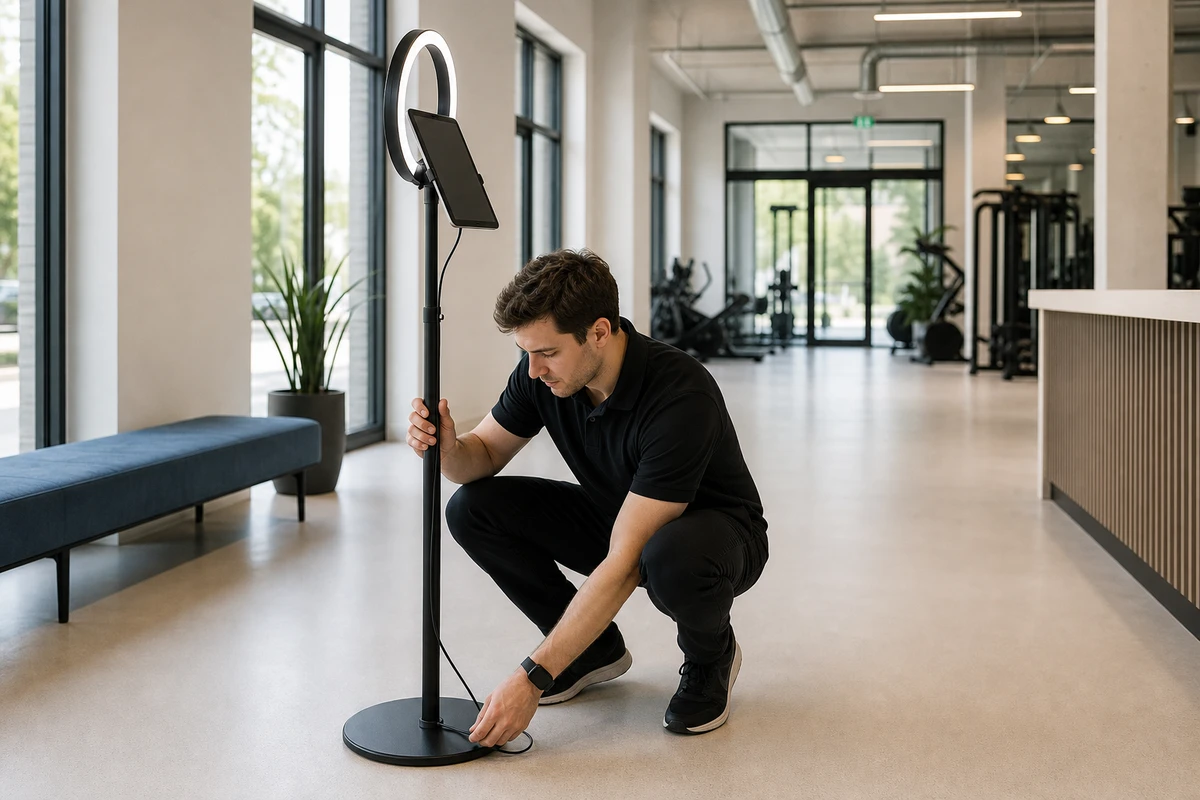
There are two places to put the ask where it does not interrupt a workout. The first is the online pass-request form. It captures the reason for the visit and marketing consent before the guest ever arrives, and it quietly sets expectations for what the visit will involve. The second is a single moment inside the gym the guest already wants: a photo at the end of a first class, a written summary of the workout a trainer just ran them through, a link to book the next session. Each of those is something the guest is glad to receive, and each can be built so that handing it over also records the email, the channel preference, and the opt-in. Of those three, the photo is the surface a single device can run on its own: a tablet photo booth takes the picture, sends it to the guest by email or text, and writes the address, channel, and opt-in into one record as it goes. Simple Booth’s HALO kit is one such station, with custom data fields and exportable capture built in; the entertainment chain Treetop Golf built a list of 150,000 unique email addresses across its locations using HALO’s photo lead capture. The form disappears into a moment the guest values instead of standing between the guest and the door.

Routing the Pass Into Follow-Up Before It Goes Cold
A complete guest record can sit untouched in a gym’s system for a week while the guest, still deciding, signs up at the place down the street. Captured data is inert until someone acts on it. A perfect record with no follow-up converts exactly as well as no record at all. Three levers move the pass from a filed form to a conversation.
Speed
The visit is the peak of intent, and intent decays from there. The classic evidence is the Harvard Business Review study by Oldroyd and colleagues, “The Short Life of Online Sales Leads” (2011), built on more than 15,000 leads. The associated Lead Response Management analysis found the odds of contacting a lead drop roughly tenfold once an hour passes, and the odds of qualifying one fall about sixfold. Those were online sales inquiries rather than gym visits, but the decay principle travels: interest peaks when the prospect acts and falls away fast. Gyms feel it directly. KeepMe, a fitness software vendor, messaged 45 North American clubs in July 2024 and found more than half of email inquiries went unanswered, with replies that did arrive averaging about four hours. An in-person guest who leaves with no system behind them is the same leak, worse, because there was never even a message to ignore.
Ownership
The most common guest-pass failure is not slow follow-up, it is no follow-up. SmartHealthClubs names it exactly: everyone assumes someone else will follow up with the guest, so no one actually does. That is a clarity problem, not a staffing one. The fix is a named owner and a defined trigger: one person responsible for guest follow-up, one rule, such as contact within 24 hours of the visit. Capture without an owner produces a tidy record nobody opens.
Relevance
This is the payoff of recording the goal. A gym that wrote down why the guest came can follow up about that: a guest rebuilding after an injury hears about the beginner-friendly block, not a generic “ready to join?” Glofox, a fitness software company, observes that the dominant post-trial objection, “I need to think about it,” is almost never a soft no; it signals something specific went unaddressed. A gym that recorded the guest’s goal has something specific to address. A gym working from a waiver has nothing, and “I need to think about it” wins by default.
What Structured Guest Pass Capture Is Worth: A Numbers Scenario
Take a mid-priced gym that issues 60 guest passes a month. Under the status quo, it gets a real lead record on only some of them, follow-up is unstructured, and conversion sits near 20%, in the range fitDEGREE describes as the industry-wide ceiling for intro offers. That is about 12 new members a month.
Now hold the pass volume identical and change only the process: every guest leaves a complete record, one owner follows up within a day, and the message references the recorded goal. No published study pins the exact lift from structured guest-pass capture, so the figures below are a worked illustration, not a benchmark. Conversion does not need to double to matter. Move it to roughly a third, call it 32%, and the same 60 passes produce about 19 members. The delta is 7 additional members a month from passes the gym was already issuing.
Put a value on it. RunRepeat’s analysis of 16 US gym chains found an average membership of about $38 a month; adjusted for several years of inflation since that data, $45 is conservative. Seven additional members is roughly $315 in new monthly recurring revenue, near $3,800 across a year, with no extra marketing spend. A gym that issues 100 passes, or charges $60, scales the same arithmetic upward.

The referral multiplier
Recording the referral source adds a second return the status quo never books. Every referred guest who is tagged also points back to a current member, which gives the gym a reason to thank that member and, where it runs a reward, to pay it. The same field that attributes the guest re-engages the person already happy enough to bring friends.
Capture is not conversion
One caveat keeps the math honest: capture is worth nothing on its own. The data converts no one. It makes conversion possible by giving follow-up something true and specific to say. A gym that records five clean fields and never calls has spent friction for nothing. The gyms that win the guest pass are the ones that treat the single visit as what it is, one short window to turn a stranger on the floor into a record worth following up, and then actually follow up.
Sources
- Federal Trade Commission (2023). “CAN-SPAM Act: A Compliance Guide for Business.” https://www.ftc.gov/business-guidance/resources/can-spam-act-compliance-guide-business
- Health & Fitness Association (2026). “2026 US Health & Fitness Consumer Report: Headline Trends.” https://www.healthandfitness.org/2026-us-health-fitness-consumer-report-headline-trends/
- Oldroyd, J.B., McElheran, K., & Elkington, D. (2011). “The Short Life of Online Sales Leads.” Harvard Business Review. https://hbr.org/2011/03/the-short-life-of-online-sales-leads
- Lead Response Management (n.d.). “The Lead Response Management Study: Strategies for Success.” https://www.leadresponsemanagement.org/lrm_study
- KeepMe (2024). “We Tested 45 North American Fitness Brands’ Lead Response Times. Here’s What We Learned.” https://www.keepme.ai/case-studies/north-america-fitness-industry-study
- RunRepeat (2023). “Average Gym Membership Cost [Gym Price Analysis].” https://runrepeat.com/gym-membership-cost
- SmartHealthClubs (2026). “Gym Guest Passes Explained: A Practical Guide for Gym Owners.” https://smarthealthclubs.com/blog/gym-guest-passes-explained-a-practical-guide-for-gym-owners/
- fitDEGREE (2022, updated 2025). “8 Reasons Why Your Intro Offer Isn’t Converting Into Long-Term Memberships.” https://www.fitdegree.com/post/8-reasons-why-your-intro-offer-isnt-converting-into-long-term-memberships-
- ABC Glofox (2026). “How to Improve Gym Trial Conversion Rates.” https://www.glofox.com/blog/gym-trial-conversion-rates/
- ClubRight (2024). “From Day Pass to Membership: How to Convert Gym Visitors into Loyal Members.” https://www.clubright.co.uk/blog/from-day-pass-to-membership-how-to-convert-gym-visitors-into-loyal-members/