
A customer reaches the counter, pays, and tells the staff it was the best visit they have had in months. Everyone smiles. The customer walks out. And then, for most businesses, nothing happens. No photo gets posted. No friend gets a text. No review appears that night or the next morning. A week later the business has no trace that the visit went well, and not one new customer walked in because of it.
That silent, satisfied customer is the core problem of word-of-mouth marketing for a physical-location business. Ask local operators where their customers come from and many name word of mouth first, then add, in the same breath, that they cannot control it. It runs slow, it runs unpredictably, and it leans on the personal networks of a few people. Both halves are true. Word of mouth is the most trusted and lowest-cost channel a local business has, and it is also the one most operators steer the least, because they treat it as weather rather than as a system. It is a system. It fails in two predictable places: satisfied customers stay quiet, and the talking that does happen runs through private channels no tracking link will ever see. The first failure is a problem of design. The second is a problem of measurement. Both are fixable.
Why Word of Mouth Beats Paid Channels for a Local Business
Picture the other side of that quiet customer. Someone asks a friend where to go for a specific thing, and the friend names a place. The person does not compare options, does not read a page of reviews, does not weigh the decision. They go. The recommendation did in four seconds what a paid ad spends weeks and a budget trying to do.
That speed is the mechanism, and it is worth
That speed is the mechanism, and it is worth naming plainly: trust transfers. A recommendation from a friend arrives pre-vetted. The listener already believes the person talking, so the business inherits that belief without having to earn it from a standing start. A cold ad has the opposite problem. It has to overcome skepticism before it can deliver its message at all, and that skepticism is expensive to clear.
The numbers behind this are not subtle. Nielsen’s 2021 Trust in Advertising study, which surveyed more than 40,000 consumers across 56 countries, found that 88 percent of people trust recommendations from those they know more than any other channel, and that recommendations are trusted by 50 percent more people than lower-ranked formats such as online banner ads, mobile ads, SMS messages, and search ads. Word of mouth is also the most common way people find businesses in the first place. In a 2023 survey of US internet users, word of mouth ranked as the leading source of new brand discovery, named by 36 percent of respondents, ahead of social media advertising at 32 percent.
For a physical-location business, this advantage compounds in a way a national ad buy cannot. A storefront draws most of its customers from a small local catchment. Every customer who talks is talking to other people who live, work, or commute within reach of the same location. A national campaign sprays its budget across people who will never visit. A local recommendation lands almost entirely on people who could.
Referred customers are also better customers, and the gap widens over time. A 2024 study published in Harvard Business Review, drawing on data from more than 41 million customers of a cashback app, found that customers acquired through a referral went on to refer 30 to 57 percent more new customers than customers acquired through other channels. The earlier academic record points the same way: a 2011 study in the Journal of Marketing that tracked a bank’s referral program found referred customers were more profitable and stayed longer than customers from other channels. A word-of-mouth customer is not a single sale. It is an asset that keeps producing more word of mouth for as long as it stays.
The Mistake That Quietly Kills Word of Mouth
Most operators carry a quiet assumption: do excellent work, and word of mouth takes care of itself. It is an attractive belief because it asks nothing new of the business. It is also wrong, and the silent customer at the counter is the proof.
Satisfaction is necessary for word of mouth
Satisfaction is necessary for word of mouth. It is not sufficient. A satisfied customer’s default state is not advocacy; it is silence. If a friend happens to ask, they will recommend the business warmly. But “would recommend if asked” and “actually mentioned it to someone this week” describe two different populations, and the second is far smaller than the first. A smooth, pleasant visit gives the customer no reason and no moment to bring the business up unprompted. Nothing went wrong, so there is no story.
What actually moves a person to talk is more specific than satisfaction. It is a peak: a moment in the visit that was better, odder, or more memorable than expected. It is an easy story, something that can be retold in one sentence without the listener needing context. And it is a reason the business’s name travels attached to the story rather than falling off it. Absent those three things, good service does one job only. It keeps the business from generating negative word of mouth, which is real and costly: BrightLocal’s 2026 Local Consumer Review Survey found 85 percent of consumers are more likely to use a business after reading positive reviews, and 77 percent less likely after negative ones. Good service buys a business out of that penalty. On its own, it does not buy advocacy.
The useful shift is in the question an operator asks. Not “is the service good enough?” but “does a visit give the customer something to say, something to show, or something to do?” The first question is about the floor. The second is about whether word of mouth has any fuel at all.
Engineer the Talkable Moment
An operator who accepts that wants to know what to build. The instinct is to make the whole visit better across the board: faster service, friendlier staff, a nicer space. That helps satisfaction, but it rarely produces a story, because people do not retell averages. They retell peaks. A visit that was uniformly pleasant from start to finish gives the customer nothing to single out. A visit with one sharp, deliberate high point gives them a sentence.
So the work is to design one peak, on purpose, and make it repeatable. Not a better visit overall, but a specific moment that is reliably worth mentioning. The hard constraint is that it has to happen every time, for every customer, without depending on a particular employee being in a good mood.
Three properties make a moment travel
Three properties make a moment travel. First, it should give the customer something to show, not only something to say. A photo, a short clip, or any small artifact from the visit carries further than a verbal description, because the person passing it along does not have to find the words. Second, the business’s name has to be inseparable from the moment. A memorable experience attached to a forgettable business name is word of mouth that leaks: the listener remembers the thing and not where to get it. Tie the moment to the name, the location, or something branded the customer physically carries out the door. Third, the ask comes at the peak, not at checkout. The minutes right after the best part of a visit are when a customer is most willing to act, whether that means leaving a review, taking a photo, or making an introduction. A request for a review printed at the bottom of a receipt is an ask delivered after the moment has already cooled.
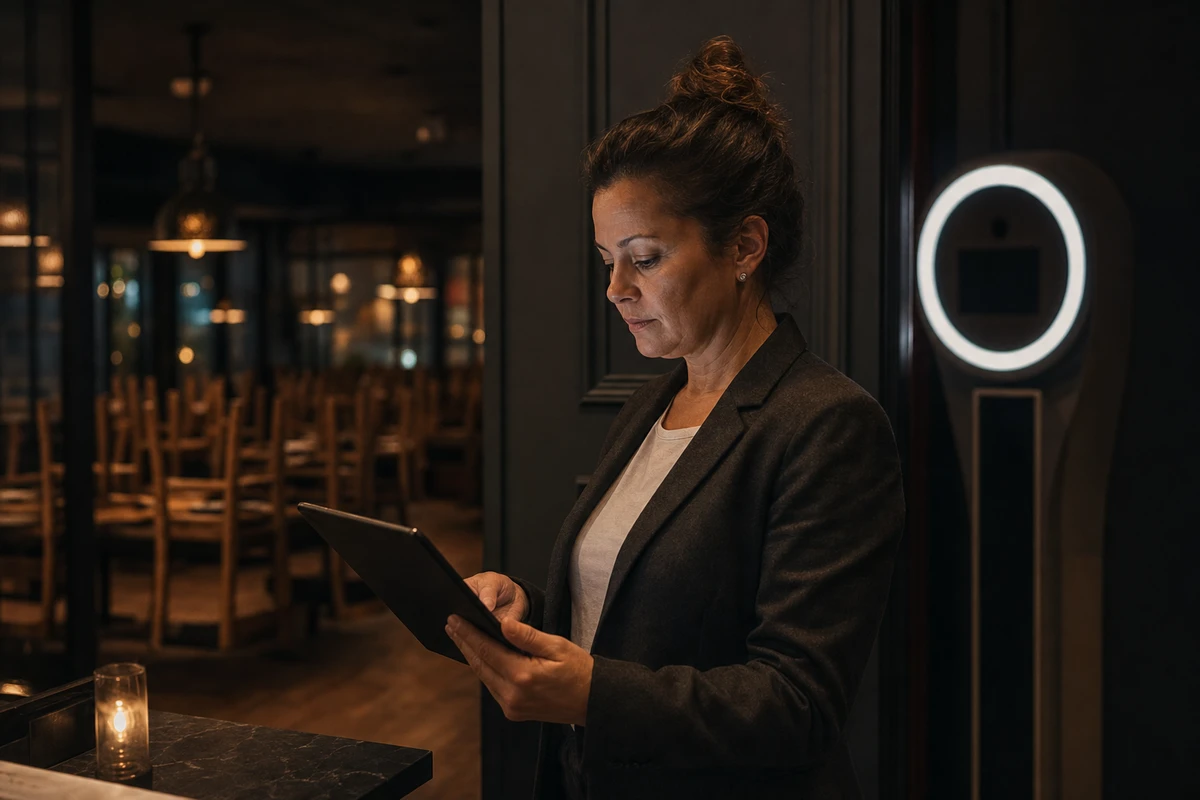
A branded photo station is one way to meet all three conditions with a single device: an iPad booth like Simple Booth’s HALO kit puts the business’s branding on every photo and sends it to the customer by QR code, email, or text on the spot, so the artifact leaves with them while the visit is still at its peak.

Make Sharing Easier Than Not Sharing
Suppose the moment is designed and the customer is genuinely willing to share it. There is still a gap between willing and done. To post about the visit, the customer has to open an app, remember the business’s handle, decide what to write, and attach something. Each of those steps is a place the intention quietly dies. The customer means to do it later, and later does not come.
A customer shares when sharing is easier than staying quiet. Every step removed from that path raises the share rate, so the work is to remove steps. Ask in the moment, while the customer is still on-site and still near the peak, rather than hoping for action after they leave. Hand them the content: if the visit produced a photo, a clip, or a link, give it to them directly so they have something to post or forward without creating anything themselves. Pre-write the parts that cause hesitation, the suggested caption, the business handle, a short link, so the customer can share by tapping rather than composing.
There is one more reality to design around. Most sharing is not public. It does not happen in a feed where it can be seen and counted; it happens in direct messages, group chats, and messaging apps. SparkToro’s 2023 attribution research found that clicks from WhatsApp, Slack, and Discord were recorded as untraceable “direct” traffic 100 percent of the time, and that three-quarters of Facebook Messenger clicks carried no source data at all. Researchers call this private, invisible sharing dark social. The practical instruction that follows from it: optimize for content that forwards cleanly inside a private message, a saved photo, a tidy link, rather than only chasing public tags and posts. The private share is the bigger channel, and it is the one most marketing advice ignores.

Referral Programs and Partnerships: Incentives Done Right
At some point an operator looks at all of this and reaches for a referral program, usually a discount or a credit for sending a friend. Before setting one up, it helps to be precise about what it does, because a referral program and organic word of mouth are not the same tactic. Organic word of mouth is unprompted: the customer talks because the visit gave them a reason. A referral program pays for the nudge. They work well together, but they are not interchangeable, and treating them as one thing is how operators get incentives wrong.

Incentives earn their place by closing a specific gap. Plenty of customers would happily recommend a business and simply never get around to it. A modest reward gives them a reason to act now instead of eventually. That is the legitimate job of a referral program: convert latent goodwill into a dated action.
Incentives backfire when they grow large enough to change why the recommendation is being made. The value of word of mouth comes from the listener believing the recommendation is sincere. A referral that is obviously bought reads as a transaction, and the trust signal that made it worth anything weakens. Two guardrails keep a program on the right side of that line. Keep the reward modest and tied to something the customer genuinely values rather than a cash-like bounty. And make it two-sided, rewarding both the existing customer and the new one, so the exchange feels like the advocate handing a friend a gift rather than collecting a finder’s fee.
Partnerships work by a related logic
Partnerships work by a related logic. A coffee shop and the bookstore next door draw the same morning customers without competing for them. A non-competing business nearby, one whose customer base overlaps with the operator’s own, is a source of borrowed trust, and a cross-promotion, a shared offer, or a joint event lets each business recommend the other to an audience that already trusts the recommender. It is word of mouth at the level of the business rather than the individual customer, and it reaches people the operator’s own customers may never talk to.
How to Measure Word of Mouth Without a Link for Every Share
An operator who sets up a referral code and watches the redemptions roll in will usually conclude that word of mouth is small. That conclusion is almost always wrong, and the reason is the dark-social problem from the previous section. The conversation that brings in a new customer happens in person and in private messages. It never touches a code. Counting only code redemptions measures the narrow, trackable sliver of word of mouth and misses the bulk of it.
A physical-location business cannot get a tracking link on every share, so it measures word of mouth with a stack of imperfect signals instead, each one catching part of what the others miss.
Start with eligible moments
The first and most useful is point-of-sale capture: ask every new customer how they heard about the business, and log the answer. It is a thirty-second question, the data is rough, and it is still the single best signal a local operator has, because it catches the untracked recommendation directly at the source. The second is name-based attribution: when a customer names the person who sent them, record both. Over months, that record shows which advocates actually drive volume rather than which ones the operator assumes do. The third is review velocity.
The rate at which new reviews arrive is a leading indicator of word-of-mouth health, because reviews and conversations come from the same group: satisfied customers who were given a reason and a moment to speak. Recency matters here. The same BrightLocal 2026 survey found 74 percent of consumers care only about reviews written in the last three months, so a business that earned a wave of reviews two years ago and then stopped prompting is, for measurement purposes, flying blind. The fourth signal is the volume of customer photos, tags, and posts that mention the business, which is the direct, countable output of the talkable-moment work.
None of these is precise
None of these is precise. Together they tell an operator whether word of mouth is growing or shrinking, which is the question that matters.
The signals show direction
The signals show direction. A short piece of arithmetic shows size. Consider a business that serves 400 customers in a month. Suppose 15 percent of them mention it to someone, and each mention reaches, on average, 20 people. That is 1,200 people who heard the business named by someone they know. If 5 percent of them visit as a result, that is 60 new customers in a month from word of mouth alone. At an average ticket of 40 dollars, the channel is worth 2,400 dollars that month, before any of those 60 return a second time and before they refer anyone themselves.
The figures here are illustrative, and a given location will have its own share rate, reach, and average ticket. The point is not the total. It is that once word of mouth is written as a line of arithmetic, every term in it becomes something an operator can work on. A better talkable moment raises the share rate. Content built to forward cleanly raises reach. The number stops being a vague hope and becomes a quantity with named inputs, each one improvable on purpose.
Where to Start: A Simple Sequence
The tactics above are not a menu to pick from. They are a sequence, and the order is the part most advice leaves out.
Start by fixing anything that produces negative word of mouth. A single recurring complaint will outrun any amount of advocacy, and there is no sense amplifying a business that has a leak. Next, design one talkable moment, a single repeatable peak worth mentioning. Third, remove the friction from sharing it, and move the ask to the peak instead of the receipt. Fourth, turn on measurement, the point-of-sale question and the review-velocity check, so the effort becomes visible and the operator can see what is working. Only then add a referral incentive or a partnership.
The order matters because incentives and partnerships are amplifiers. Pointed at a business that already has a designed moment, low sharing friction, and a way to measure, they multiply something real. Pointed at a business that still sends out silent, satisfied customers, they spend money making a quiet channel slightly louder. Build the engine first. The amplifier is worth buying only once there is something to amplify.
Sources
- Nielsen (2021). “Beyond Martech: Building Trust With Consumers and Engaging Where Sentiment Is High.” https://www.nielsen.com/insights/2021/beyond-martech-building-trust-with-consumers-and-engaging-where-sentiment-is-high/
- Statista / DataReportal (2023). “Most Common Sources of New Brand, Product, and Service Discovery Among Internet Users in the United States.” https://www.statista.com/statistics/1371122/main-channels-of-new-brand-discovery-usa/
- Harvard Business Review (2024). “Research: Customer Referrals Are Contagious.” https://hbr.org/2024/06/research-customer-referrals-are-contagious
- Journal of Marketing (2011). Schmitt, Philipp; Skiera, Bernd; Van den Bulte, Christophe. “Referral Programs and Customer Value.” https://journals.sagepub.com/doi/10.1509/jmkg.75.1.046
- BrightLocal (2026). “Local Consumer Review Survey 2026.” https://brightlocal.com/research/local-consumer-review-survey/
- SparkToro (2023). “New Research: Dark Social Falsely Attributes Significant Percentages of Web Traffic as ‘Direct’.” https://sparktoro.com/blog/new-research-dark-social-falsely-attributes-significant-percentages-of-web-traffic-as-direct/