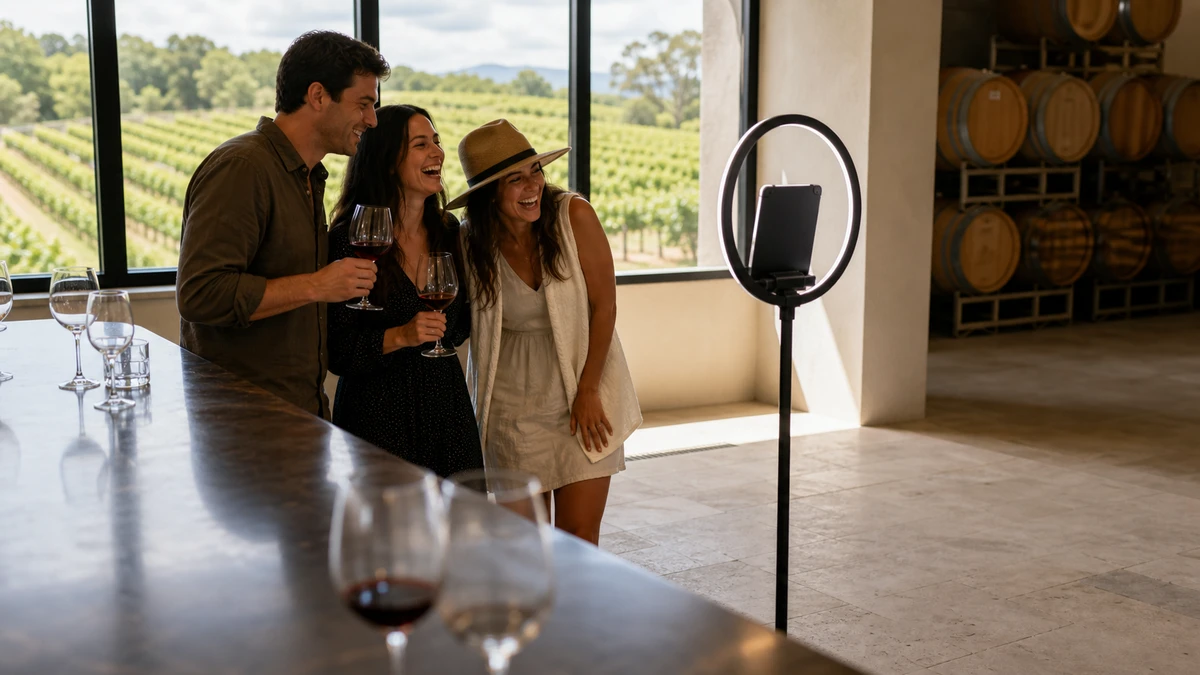
On a Saturday afternoon in a full tasting room, a guest lifts a glass of the estate Cabernet against the window, lines up the vineyard rows behind it, and takes a photo. Two tables over, a group hands a phone to a staff member and asks for one shot of all six of them against the barrel wall. Those photos are good. Almost none of them do the winery any measurable good. They leave on the guests’ phones, get posted or not posted without a tag, and carry the guests’ email addresses out the door.
The best photo booth for a winery is the fixture that closes that gap. Not the booth a rental company wheels in for one private event, but an owned, app-based open-air booth that does three jobs in a single tasting-room day: it sends or prints a branded photo, it captures the guest’s email and phone number at the moment the photo is shared, and it runs unattended while staff pour. Search that exact question and the results sell event rentals. This guide is written for the operator instead, the tasting-room manager or direct-to-consumer marketer choosing a permanent asset.
Why the event-rental answer is wrong for a winery
Type “best photo booth for wineries” into a search engine and the first page is a list of event-rental companies: Liveimage in Napa, TapSnap, Pixster, and a handful of others. Read past the headlines and every one of them sells the same thing, a booth that arrives for a single private event and leaves the next morning, with the winery itself cast as a scenic backdrop. That is a correct answer to a different question. A host booking a one-night event at the vineyard genuinely does want a booth for that night and nothing after it.
The common mistake
A tasting-room manager wants something else, and the difference is not cosmetic. A rental solves “we need a booth for one event.” An owned booth solves “we need every tasting-room visit to leave behind a branded photo and a contact.” Those are two purchases. A winery that searched expecting the first usually wants the second once the question is put plainly. The rental disappears with the guests’ data still on it. The owned booth keeps the data and keeps working the next weekend.
The operator’s real job is not entertainment. A winery does not need a novelty in the corner. It needs the tasting room to convert traffic it already paid to attract, through events, advertising, signage, and word of mouth, into shareable content and a usable contact list. Highway 29 Creative, a winery-marketing agency, advises wineries to design their rooms to be shareable and to incentivize sharing through contests and discounts. The advice is sound and incomplete. It tells operators to make sharing happen and hands them no instrument to make it reliable, or to capture the guest once it does. The agency puts the cost of that gap bluntly: failing to follow up on a guest who tagged the winery is like someone calling the winery to say they want to buy wine and never being called back.
That gap is more expensive than it used to be. Average tasting-room visitation fell roughly 8% in 2024 against 2023, according to the Silicon Valley Bank 2025 Direct-to-Consumer Wine Report (recapped by Lithica Wine Marketing). Enolytics’ April 2026 industry snapshot shows the slide continuing, with tasting-room visits down another 5.1% year over year. The same SVB report found that wine clubs now account for about 39% of all direct-to-consumer sales, and that roughly 75% of wineries still source their club members from the tasting room. Fewer people walk in, and the club still depends on the ones who do. Each remaining visit is worth more than it was two years ago, which is exactly why letting one walk out uncaptured costs more.
What “best” actually means: the five criteria a winery should judge on
Ask a rental vendor what makes a booth “best” and the answer is usually about spectacle: a sparkly backdrop, GIF animations, a glam filter. That answer is built for a party planner scoring a one-night impression. An operator buying a fixture needs “best” turned into something a budget can defend. Five criteria do that, and a winery can score any booth or vendor against them.
Contact capture comes first
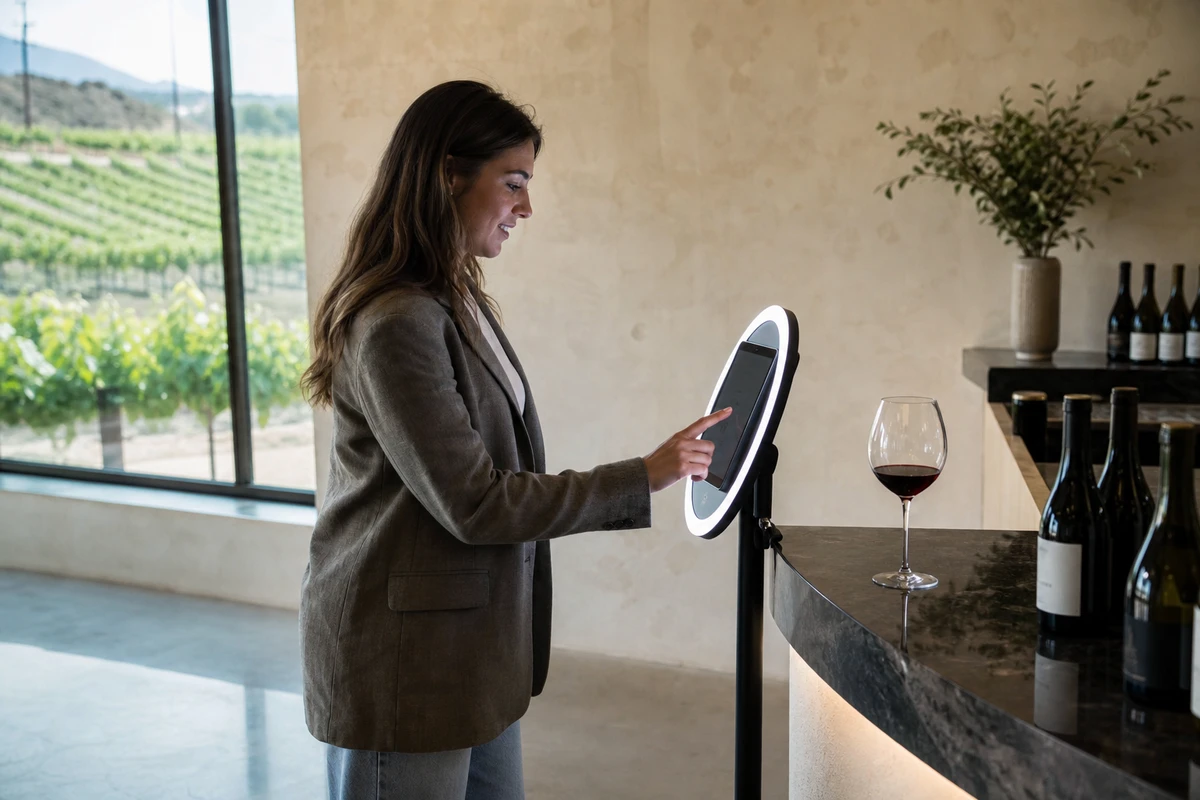
Contact capture comes first. The booth has to collect an email address and an SMS opt-in as part of sending the photo, not as a separate clipboard at the bar that staff forget to offer. The guest wants their picture; the trade for it is a tap on a keyboard. This is the one feature event-rental booths are not built around, because the host of a private event already owns the guest list. For a winery, the contact list is the entire point.
Branding control comes second
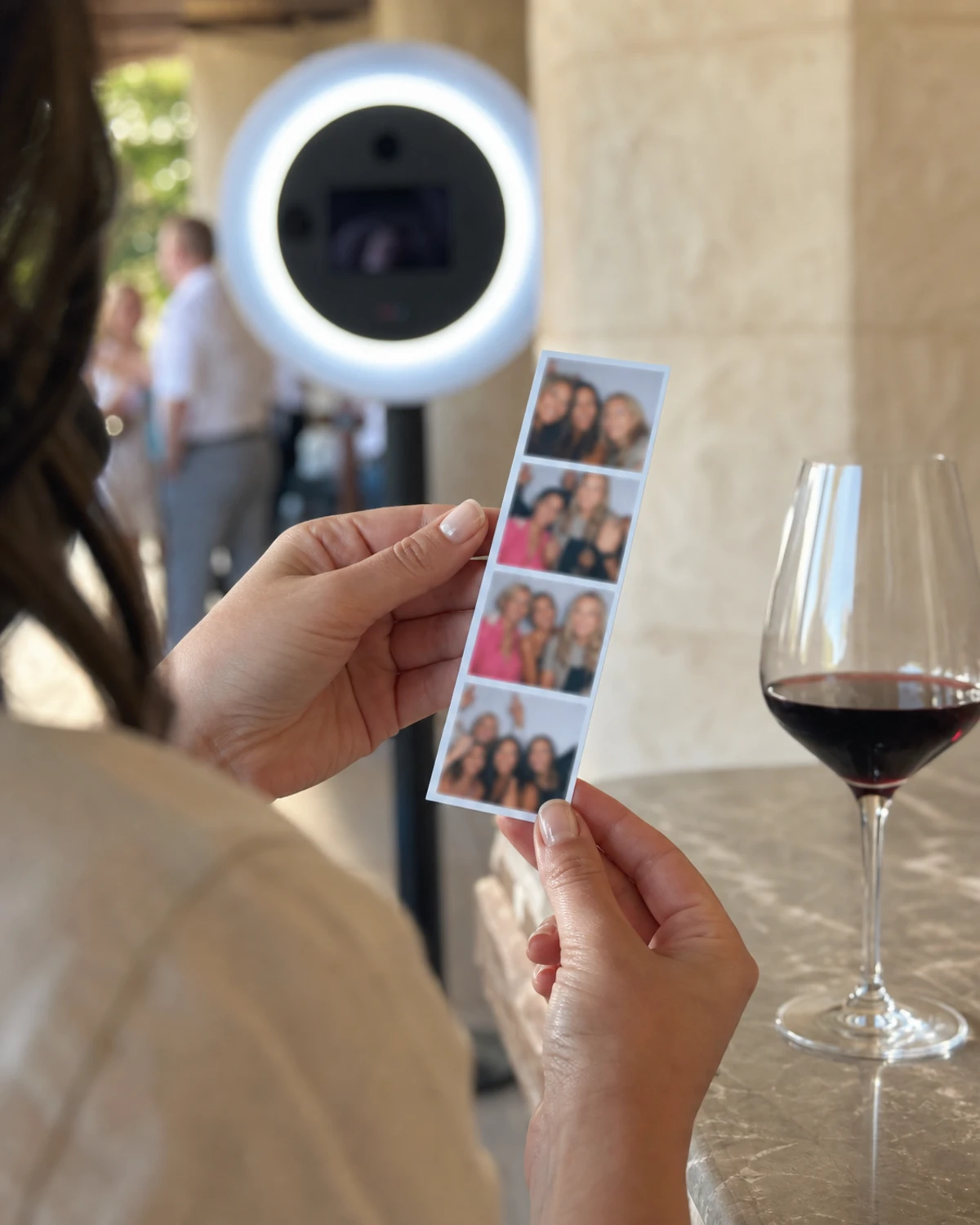
Branding control comes second. The photo has to leave as a winery asset, not a generic strip. That means a custom overlay with the winery logo, room for a varietal or vintage tag, and frames that can change by occasion: harvest, a release weekend, a club pickup. A photo with the estate name on it works as advertising every time it is posted. A plain strip works for no one.
Tasting-room fit comes third
Tasting-room fit comes third. The booth shares a floor with stone, oak barrels, and a view, and it sits inside an upscale brand. A garish enclosure undercuts the room. The footprint has to tuck into a corner of the bar or sit out on the crush pad without blocking the flow of guests and staff.
Unattended reliability comes fourth
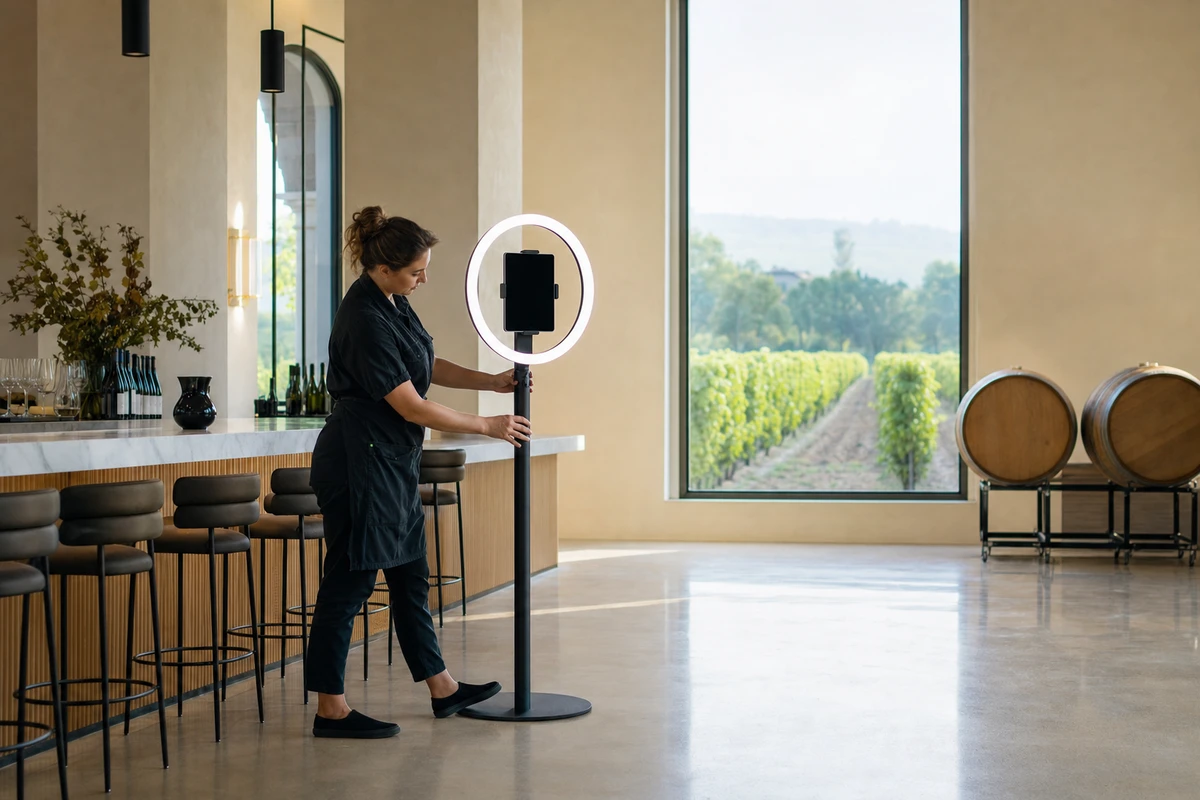
Unattended reliability comes fourth. Tasting-room staff are pouring, describing the wines, and closing club sign-ups. They cannot also operate a machine. The booth has to run an entire day on its own, from the first pour to close, with no one assigned to babysit it.
Sharing speed and analytics come fifth
Sharing speed and analytics come fifth. Delivery has to be instant, by text or email, so the guest posts before leaving the property rather than forgetting by the drive home. Behind that, the operator needs a dashboard: opt-ins captured, photos shared, reach generated. What separates the best photo booth for a winery from a merely fun one is that it produces numbers, not just impressions. These five criteria become the scorecard for the rest of this guide, and the format comparison below weighs each booth type against them.
Photo booth formats compared for a tasting room
Walk an operator past the options with the five criteria in hand, and the formats sort quickly.
The open-air, app or tablet-based booth is a tablet on a stand, open on all sides, usually with a simple backdrop. Its footprint is roughly that of a small café table. It is strong where a winery needs strength: contact capture and instant sharing are native to the app, the look is clean enough for an upscale room, and it is built to run unattended. This is the recommended default for a permanent tasting-room fixture. Simple Booth’s HALO kit is one open-air booth built this way: an iPad on a slim stand that asks for the guest’s email and phone number as the step that texts or emails their photo. The entertainment chain Treetop Golf used that lead capture to build a list of 150,000 unique email addresses across its venues, the same mechanism a tasting room would run at smaller scale.
The enclosed or curtain booth is the format most people picture from event rentals, a draped structure guests step inside. It needs something closer to 40 to 60 square feet once curtain and entry clearance are counted, and it reads as event furniture parked on the floor. On a tasting-room patio or beside a barrel wall it looks like what it is, a rental, and it earns a low score on fit.
The 360 video booth puts a guest on a small platform while a camera arm spins around them. It is genuine spectacle, and guests love it. It also needs a full open corner, on the order of 100 to 150 square feet with a safety perimeter, and it usually needs an attendant to run it and keep guests safe. That makes it a poor daily fixture and a good occasional one. A winery is better off renting a 360 booth for a club party or a release weekend than installing one next to the bar.
The magic-mirror booth, a full-length reflective surface that doubles as a touchscreen, takes up roughly the footprint of a large appliance and carries a dated look. Its data capture is generally weaker than an app-based booth’s. For a winery choosing a long-term fixture, it does not beat the open-air option on any of the five criteria. A roaming setup, an iPad carried on a monopod or handed around by staff, is inexpensive and flexible, but it loses the framed, stand-still moment that makes a booth photo feel like a keepsake, and capture depends on whoever is holding it. It is a reasonable supplement for an outdoor event, not a substitute for a fixed booth.
The verdict is straightforward
The verdict is straightforward. An owned, open-air, app-based booth belongs in the everyday tasting room, and a 360 booth is worth renting for a marquee event if the calendar and budget call for one. The formats below the open-air option are built for parties, and a winery is not running a party. It is running a room.
Buy vs rent: the operator’s real decision
A rental invoice and a purchase invoice look comparable on the day they are signed. They are not the same decision. A rental is a per-event fee that covers delivery, setup, an attendant, and teardown, and then the booth and everything captured on it leaves. The winery owns no photos, no contact list, and no branding continuity from one event to the next. An owned booth is an upfront cost, sometimes with an annual software subscription, that is then spread across every weekend the room is open: every walk-in tasting, every club pickup, every harvest and release.
The mechanism that decides this is amortization. A rental’s cost per captured contact stays roughly flat, because each event is a fresh fee. An owned booth’s cost per captured contact falls every weekend it operates, because the hardware is already paid for and the only thing being added is more contacts. The booth runs on traffic the winery already has, so once the purchase price is recovered, the marginal cost of the next captured email approaches zero. A booth used four times a year as a rental never reaches that point. A booth running every weekend reaches it fast.
Renting still makes sense in two cases. A winery that hosts only a few large events a year, and runs a quiet room the rest of the time, may never put enough weekends on a booth to justify owning one. And any winery can rent first to trial the format, confirm that guests use it and staff like it, then buy. For the economics that follow, the assumption is an owned booth in a room open most weekends, because that is where the math turns decisively.
The numbers: how a photo booth pays for itself through the wine club
Picture a mid-size tasting room that sees about 800 visitors a month. Without a booth, those 800 visits produce a scatter of phone photos and no list. With a booth positioned well, a share of those guests opt in by email and SMS to receive their picture. A well-placed open-air booth commonly converts something in the range of 35% to 45% of guests into opt-ins. Take the middle of that range, 40%, and the room produces 320 new contacts a month that did not exist before.
Those 320 contacts feed the wine club
Those 320 contacts feed the wine club. Industry-wide, club conversion runs near 6% of tasting-room visitors, according to Enolytics’ April 2026 snapshot, which aggregates transaction data from hundreds of direct-to-consumer wineries. Apply that 6% rate to the 320 captured contacts and the room adds roughly 19 new club members a month. That is a deliberately conservative move: the 6% industry average is dragged down by rooms that capture nothing and follow up with no one, so applying it to a warm, opted-in list understates the result rather than flattering it. Even so, 19 members a month is 228 a year.
The value of those members depends on the club tier. Take a club that ships four times a year, three bottles a shipment, at around $45 a bottle. That comes to roughly $540 a year per member. Run 228 new members against $540 and the booth has fed about $123,000 in new annual club revenue into the funnel. A winery with a $200 tier and a winery with an $800 tier will land far apart, but the structure holds at every price point.
Set that against what the booth costs. Even a generous estimate for an owned open-air booth is a small fraction of a single year’s new-member pipeline at this scale. The number that matters is not the booth’s sticker price; it is the gap between that price and the pipeline the booth feeds.
Two honest caveats keep the figure defensible. Members do not all stay a full year, and club attrition is real: the same Enolytics snapshot reported club membership declining 0.7% in April 2026, with cancellations outpacing sign-ups. The 228-member figure is gross new pipeline, not net club growth, and a winery should model its own retention against it. The second caveat is that the 6% rate assumes the winery actually follows up. The booth builds the list; it does not work it. A captured contact converts because someone reaches out, and the Silicon Valley Bank report, in Lithica’s recap, found that younger members in particular join and quit clubs faster and reward fast outreach soon after a sign-up.
Here is the line that separates the two purchases. Without contact capture, the same 800 visits a month still produce photos, and the winery can measure none of it. With capture, those visits produce 320 names, 19 members, and a figure an operator can carry into a budget meeting. The difference between a rental booth and an owned, data-capturing booth is that figure.
Where to place it and when to run it
A booth shoved against a back wall by the restrooms gets ignored. The placement that works sits where guests already pause and the light is already good: the end of the tasting bar, where a flight has just been poured and the group is relaxed; the patio or crush pad with the vineyard behind it; a barrel wall that photographs well. The booth should sit in the path guests already walk, not down a detour they have to choose.
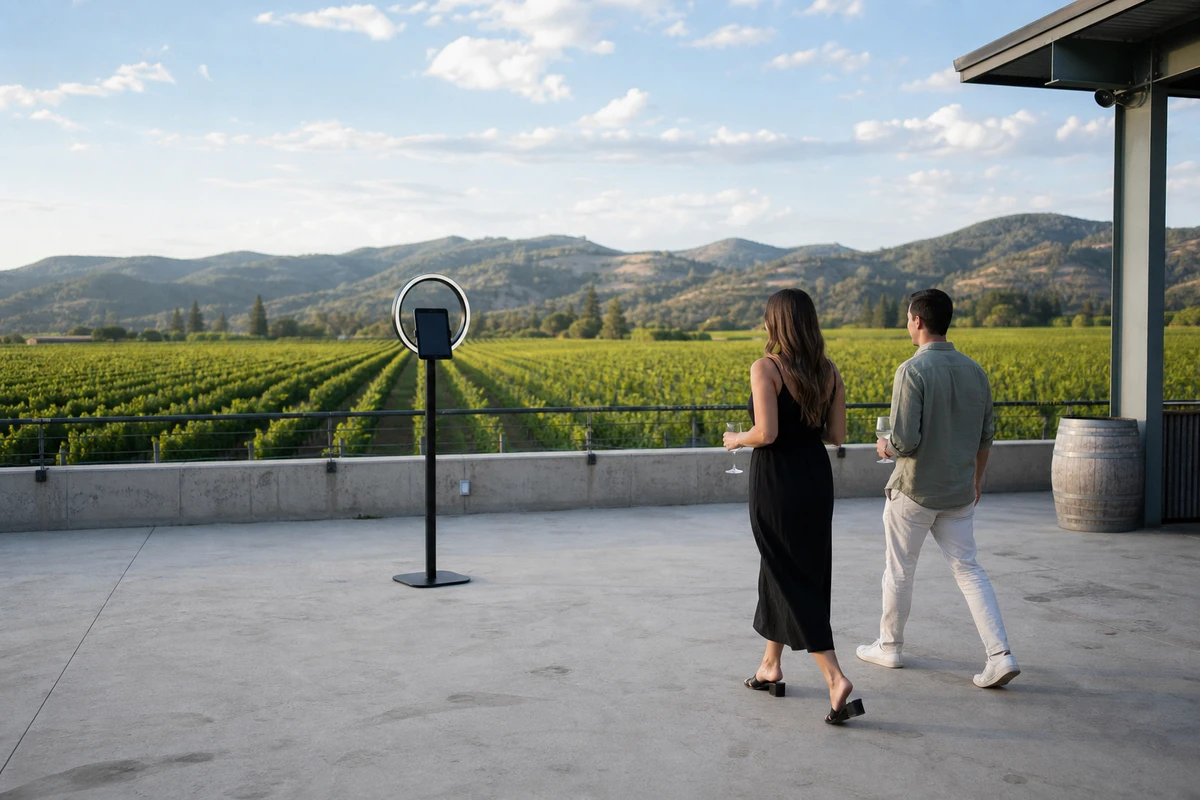
Everyday use is the baseline. During ordinary walk-in tastings, the booth carries a frame tagged to the current flight or the release on pour, so every photo that leaves is dated and tied to a specific wine. That turns a routine Tuesday tasting into captured content without any extra work from staff.
Events are where the booth earns its keep a second time. Club pickup parties, release weekends, harvest and crush events, member-appreciation days, and winery-hosted private events all concentrate exactly the guests a winery most wants on its list. Rotating the branded overlay for each occasion, a harvest frame in September, a pickup-party frame in spring, means the captured photos are not just content, they are campaign-attributable: the winery can later see which event produced which contacts and which members. The cadence follows the calendar the winery already runs. Lean the booth into harvest and release season, refresh the overlay per event, and the room generates a steady, dated stream of branded content and contacts across the year rather than a spike at one party and silence afterward.
What to measure once it is running
A booth that cannot be measured cannot be defended when the budget is reviewed. Wine Industry Sales Education organizes tasting-room performance around three numbers it calls the Triple Score: the share of visitors who buy wine, the share who join the club, and the share whose contact data is captured. A booth touches all three, and four numbers turn it from a nice gesture into a reportable line item.
Opt-in rate
The first is opt-in rate: of the guests who used the booth, how many gave an email address and SMS permission. The second is share or post rate: how many of those photos actually went out to social feeds. The third is the one that pays the bills, club sign-ups traced back to booth-captured contacts. The fourth is cost per captured contact, the booth’s total cost divided by the contacts it brings in, a figure that falls every month the booth runs.
Track the full funnel
The third number depends on attribution, and attribution is simpler than it sounds. Standard direct-to-consumer wine platforms (Commerce7, WineDirect, OrderPort, eCellar, and others) let a winery tag a contact’s acquisition source on the customer profile. WISE’s own guest-count methodology walks through building that tracking into the point of sale so every guest’s source is recorded at the transaction. The operating step is to give booth-captured contacts their own source tag the day the booth goes live. Once that tag exists, a club sign-up six weeks later can be traced to the booth instead of guessed at.
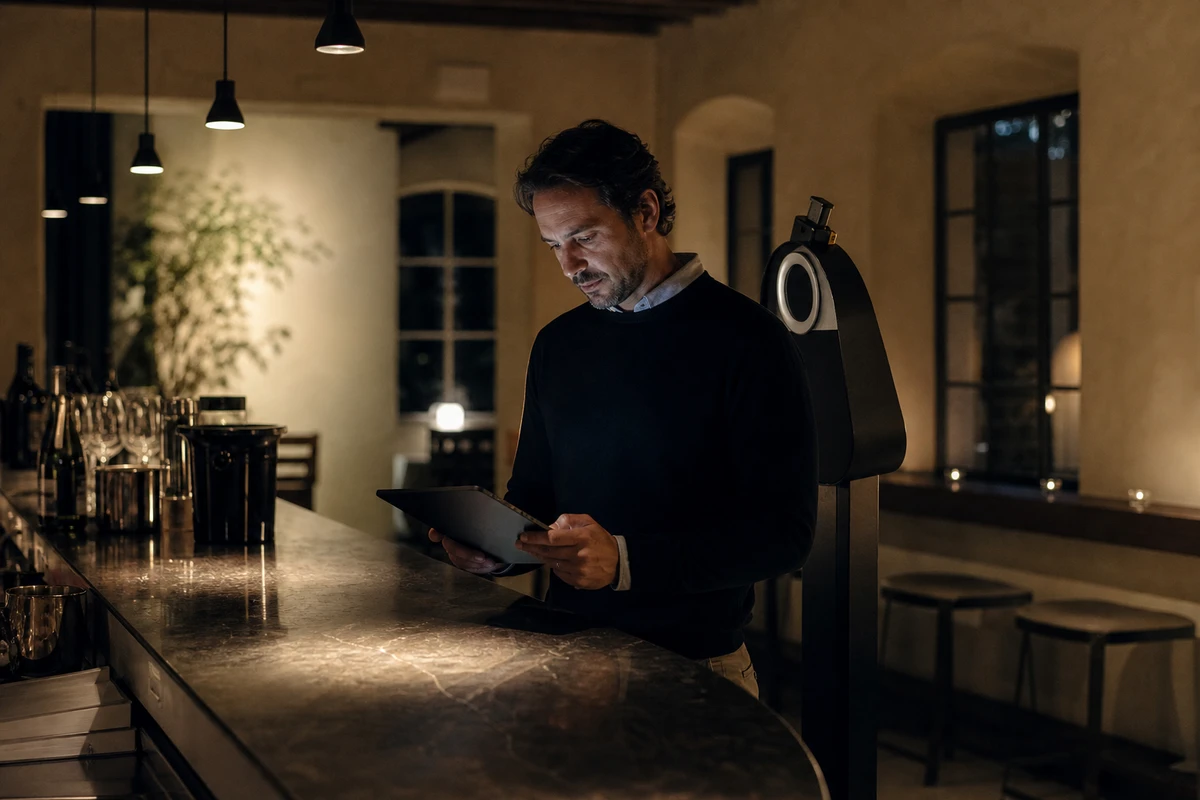
This reframes the buying decision one last time. The best photo booth for a winery is not the one with the most filters; it is the one that makes those four numbers visible. A booth that produces photos and no data leaves an operator with a vibe. A booth that produces opt-ins, shares, attributed sign-ups, and a falling cost per contact leaves an operator with a case.
Frequently Asked Questions
How much does a photo booth for a winery cost? There are two cost shapes. A rental is a per-event fee covering delivery, setup, an attendant, and teardown, paid again every event. An owned app-based booth is a one-time hardware cost, sometimes with an annual software subscription. Booth pricing changes often, so check two or three current vendor pages when you buy. The figure that matters is the booth’s cost against the club pipeline it captures, not the sticker alone.
Do we need a staff member to run it? Not for an open-air, app-based booth. That format is built to run unattended for a full day, so your staff stay on pouring and selling. A 360 video booth is different: it generally needs an attendant for guest flow and safety, which is one reason it works better as an occasional event rental than as a daily tasting-room fixture.
Will a photo booth look out of place in an upscale tasting room? It depends entirely on the format. A draped enclosure or a magic-mirror unit reads as event furniture and can undercut the room. An open-air booth is a tablet on a slim stand with a small footprint, closer to a piece of furniture than a machine. With a custom overlay carrying your estate name and branding, the photo that leaves looks like a winery asset, not a generic strip.
Can a photo booth capture emails for our wine club? Yes, and that is the main reason a winery buys one rather than rents. The booth asks for an email address and an SMS opt-in as the step that delivers the guest’s photo, so capture happens in the natural flow instead of as a separate ask. Those contacts export into standard wine CRM and point-of-sale platforms, tagged as their own acquisition source.
Should a winery rent or buy? Buy if the tasting room is open most weekends, because the booth’s cost per captured contact falls every weekend it runs and the hardware pays back across walk-ins, pickups, and events. Rent if you host only a few large events a year, or if you want to trial the format before committing. For a working tasting room, owning is where the economics turn.
Is a 360 booth or an open-air booth better for a winery? They solve different problems. An open-air photo booth is the daily fixture: compact, unattended, strong on contact capture. A 360 booth is spectacle, and it needs floor space and an attendant. The practical answer for most wineries is an owned open-air booth for everyday use, with a 360 booth rented occasionally for a release party or club event.
Sources
- Silicon Valley Bank, Wine Division (2025). “2025 Direct-to-Consumer Wine Report.” Findings summarized in Lithica Wine Marketing’s recap. https://www.lithica.wine/insights/2025-direct-to-consumer-wine-report-recap
- Lithica Wine Marketing (2025). “2025 Direct-to-Consumer Wine Report: A Recap.” https://www.lithica.wine/insights/2025-direct-to-consumer-wine-report-recap
- Enolytics (2026). “DTC Wine Industry Monthly Snapshot, April 2026.” https://www.enolytics.com/snapshot
- Wine Industry Sales Education (2014). “What’s Your Score?” https://wineindustrysaleseducation.com/whats-your-score/
- Wine Industry Sales Education (2018). “Getting the Guest Count Right: WISE Best Practices.” https://wineindustrysaleseducation.com/getting-the-guest-count-right-wise-best-practices/
- Highway 29 Creative. “User-Generated Content for Wine Marketing.” https://www.hwy29creative.com/blog/user-generated-content-for-wine-marketing
- Sovos ShipCompliant (2026). “Direct-to-Consumer Wine Shipping Report.” https://www.sovos.com/shipcompliant/content-library/wine-dtc-report/