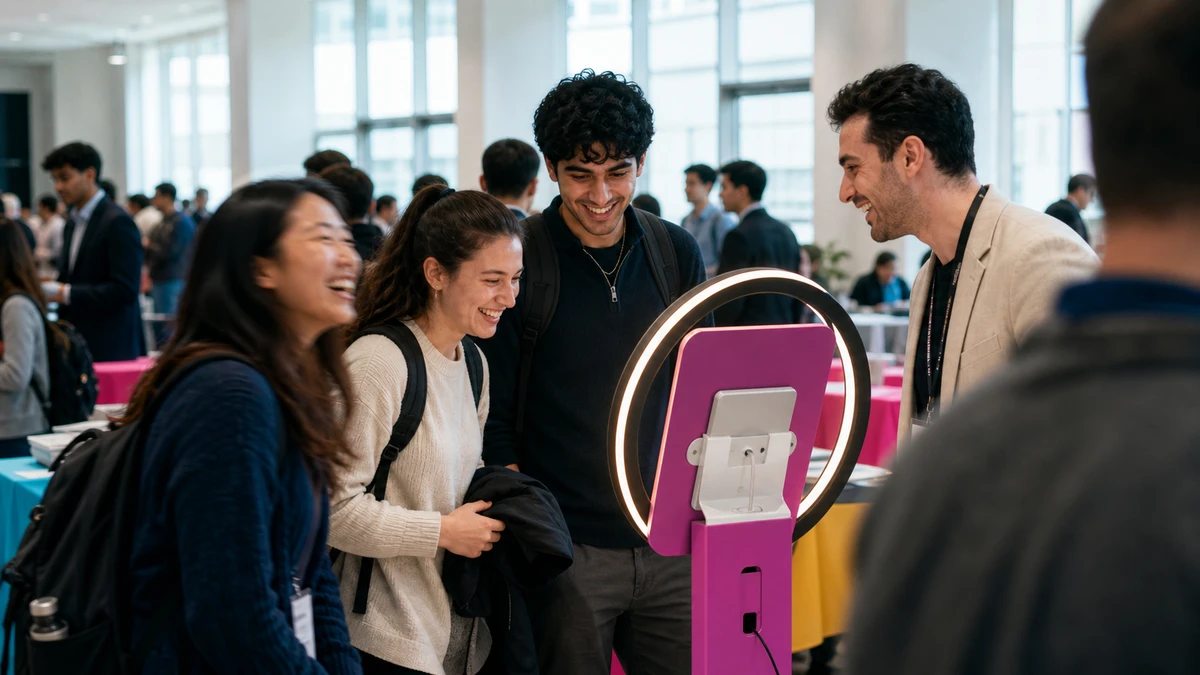
A talent-acquisition manager spends three weeks and a five-figure budget on a stand for a campus career fair. The booth gets a pull-up banner with the new tagline, a stack of culture flyers, a bowl of branded pens, and two recruiters with laptops. Over two days, around 300 students walk past. Most get a thirty-second pitch, a QR code, and a suggestion to apply online. By Monday the flyers are in recycling bins, the recruiters hold a pile of half-legible sign-up sheets, and nobody can say what the event returned.
That gap, between the brand a company designed and the moment a candidate actually experiences, is where employer branding activation lives. Activation is the rollout phase: the point where a defined employer value proposition (EVP) stops being a slide deck and becomes something a real person encounters and remembers. Experiential tech, meaning interactive photo and video capture, branded content stations, and instant-share kiosks, is one of the few tools built to do that work at the moment of contact. What follows maps where those tools fit across the talent lifecycle, how they build a first-party talent pipeline, and how to measure the result so the line item survives a budget review.
What “Employer Branding Activation” Actually Means, and Where It Stalls
Designing a brand and activating it are two different jobs
Most HR teams know how to design an employer brand. They run focus groups, commission an EVP, write brand guidelines, and produce a toolkit. The CIPD, working with talent consultancy Omni RMS, found that four in five organizations take some action to improve their employer brand. The harder phase comes next. Activation turns that EVP into messaging, experiences, and proof points a candidate or employee actually runs into. Designing the brand answers what the company stands for. Activating it answers where a person feels that, and what they do next.
Activation is the phase companies skip
Activation is also where the work quietly stops. “While attention is often given to designing an employer brand and building a comprehensive toolkit, the real value lies in activating that brand,” writes Katie Noble, Talent Strategy Director at Omni RMS, in CIPD’s 2025 analysis. “Yet, activation is frequently the most overlooked phase, despite being the most critical for achieving long-term impact.” The cost of skipping it is real. Harvard Business Review reported in 2016 that companies with a weak employer reputation must offer at least 10% more in salary per hire than companies with a strong one. A brand that never gets activated is paid for twice: once to design it, and again at every offer.
The measurement signature of a stalled activation
A stalled activation leaves a trace anyone can read. CIPD’s Resourcing and Talent Planning 2024 report found that only 14% of organizations take steps to measure the impact of their employer brand. The Conference Board puts a finer point on it: only 18% of companies can clearly communicate the ROI of employer branding to their leadership. Most invest, few measure, fewer still can defend the spend in a budget meeting. That combination is exactly what gets activation tools cut. The rest of this article treats measurement as a design requirement, because an experiential activation that cannot be counted will not survive its first review.
Experiential Tech Is Not the HR Software the Company Already Owns
When a finance lead hears “we need budget for employer-brand technology,” the reasonable reply is “we already bought that.” The company has an applicant tracking system, an onboarding platform, a LinkedIn and Glassdoor presence, a social scheduler, maybe an internal-comms tool. All of it touches the employer brand. None of it does what experiential tech does.
Two categories that share a word
HR SaaS is back-office and screen-based. An applicant tracking system routes applications. An onboarding platform pushes forms and training modules. Social schedulers post to feeds. These tools manage the employer brand asynchronously, mediated by a screen, usually after the candidate has already formed an impression somewhere else.
Experiential tech is physical and interactive, and it runs at the moment of in-person contact. The category includes interactive photo and video booths, branded content and animated-clip stations, green-screen and augmented-reality setups, video-confessional stations for recording employee stories, and kiosks that send a photo by text or email on the spot.
The difference that matters
The distinction is not hardware versus software. It is where the tool sits in the candidate’s attention. Experiential tech operates at the point of peak attention and goodwill, when a person is standing in front of a recruiter and choosing to engage. It does three things in one motion that screen-based tools cannot do together: it produces a tangible artifact the person keeps, it captures consented contact data in the same interaction, and it gives the person something worth showing other people.
This is also why the standard career-fair booth fails. Recruiters on forums like r/recruitinghell describe fairs where every booth blends together; candidates describe being shown a QR code and told to apply online. A QR code is screen-based tech transplanted onto a physical event. It collects nothing the candidate values and gives nothing memorable. Experiential tech is the part of the stack built for the room itself.
Why an Experiential Moment Changes Perception
A skeptical executive will call an interactive photo station a gimmick. The honest answer is that it works for three specific, documented reasons. Naming them is what separates a defensible activation from a fun extra.
People value what they help make
Norton, Mochon and Ariely (2012), publishing in the Journal of Consumer Psychology, ran experiments with self-assembled boxes, origami, and LEGO. People consistently assigned higher value to objects they built themselves than to identical objects made by someone else, and the effect held even when the labor was modest and the result imperfect. They named it the IKEA effect.

A culture flyer is handed to a candidate fully formed, and it gets thrown away. A branded photo or short clip the candidate posed for and chose to keep is something they had a hand in making. The same psychology that makes self-assembled furniture feel more valuable makes a co-created brand artifact stick.
The message lands harder through a person than a logo
LinkedIn Talent Solutions research, reported by AIHR, finds candidates are three times more likely to trust a company’s employees than the company itself when judging what it is like to work there, and that 52% check a company’s social channels before applying. When a candidate posts their own branded photo from a hiring event, the employer-brand message reaches that candidate’s network through a trusted peer rather than a corporate account. The company did not claim it was a good place to work. Someone the viewer knows implied it. CIPD’s analysis notes the same pattern: personal posts routinely outperform company-page content on engagement.
Consent given at peak goodwill, not chased later
The usual sequence runs backwards. The company meets a candidate at an event, collects nothing usable, then sends a cold email days later asking them to join a talent community. An experiential station inverts it. The candidate wants the photo, so they enter an email to receive it, and a marketing opt-in is offered in the same friendly moment, in exchange for something they already want. The contact data arrives at the point of highest goodwill instead of being chased down afterward. Opt-in quality tends to be higher and the consent trail is cleaner, which matters for the compliance discipline covered below.
Mapping Experiential Tech to the Talent Lifecycle
The biggest mistake with experiential tech is treating it as a career-fair object. A station bought for one fair and stored eleven months a year is hard to justify. The same hardware earns its cost when it runs across four stages of the talent lifecycle.

Attraction: career fairs, campus events, hiring days
At a crowded event, the first job of a booth is stopping power. An interactive station gives a candidate a reason to approach that is not “let me pitch you.” It lowers the barrier to a real recruiter conversation: the candidate steps up for the photo, and the recruiter has a natural opening. The branded content then travels on the candidate’s own feed, reaching people who were never at the event.
Candidate experience: open houses and interview days
Most candidates who enter a process do not get hired. How they are treated on the way out shapes what they tell other people. A branded capture moment at an open house or assessment day signals a modern, human culture and sends every candidate home with a positive artifact, whatever the outcome. That protects the brand among the majority who were not selected but will still talk about the experience.
Onboarding: a nervous first day made shareable
CIPD’s 2024 research found that 41% of employers who hired in the past year reported new recruits at least sometimes resigning within their first 12 weeks. Early attrition has many causes, and a flat, forms-heavy first day does not help. An experiential welcome moment, a new-hire photo with the team or a short clip on why the person joined, turns a nervous first day into something the hire wants to share. No primary source attaches a specific ROI figure to onboarding-stage capture, so this is a mechanism claim rather than a measured one: a welcome that feels designed signals that the culture invests in its people from day one.
Advocacy and retention: employees as the content engine
The strongest evidence here comes from named programs. In Rally Recruitment Marketing’s review of 2025’s best employer-brand launches, Verizon built its first-ever employer brand around a physical red chair and photographed more than 1,500 employees with it across offices and countries; the campaign drew 507 million impressions in three weeks and doubled career-site traffic. Vulcan Industrial launched its “Winning Big” EVP with an all-staff opening ceremony and a hands-on team challenge, reporting 100% participation and a 15% reduction in attrition. Both started with a physical, in-person experience and let employees carry it outward. That is experiential tech working as a retention and advocacy tool, not a recruiting prop.
From Activation to Talent Pipeline: Capturing First-Party Data
An experiential station’s most valuable output is not the photo. It is a list of consented contacts who have already had a positive in-person experience with the brand.
The first email is the first owned touchpoint
At the capture station, delivery of the photo or clip is gated on an email address the candidate enters on screen. That email is the first owned touchpoint in the relationship, a direct line the company controls, unlike a social follow or a job-board profile. It is also given willingly, because the candidate wants the thing on the other side of it.
Keep photo delivery and marketing consent separate
A photo-delivery email address is not permission to market. Those are two different purposes, and bundling them is both a compliance failure and a quality problem. The station should ask for the email to send the photo, then offer a separate, clearly worded checkbox to join a talent community or careers newsletter. Purpose-built photo-station apps make that split a setup option rather than a workaround: Simple Booth’s HALO app lets the team collect the photo-delivery email and a separate opt-in checkbox as two distinct on-screen fields. The entertainment chain Treetop Golf used the same lead-capture flow to build a list of 150,000 unique email addresses across its locations. Keeping the two apart means the talent-community list contains only people who genuinely chose it, which is a better list, and it satisfies the legal requirement that consent be specific to each use.
Notice at the point of collection
Both major privacy regimes converge on one point. Under the GDPR, consent must be freely given, specific, informed, and unambiguous; Recital 32 states plainly that “silence, pre-ticked boxes or inactivity” do not constitute consent, and separate consent is required for each processing purpose. California’s CCPA requires businesses to tell consumers what personal information they collect and why, at or before the point of collection. An experiential station suits both unusually well: the consent screen appears before the photo is taken, the candidate is physically present, and the company’s identity and purpose can be stated in plain language on the screen. HR data carries a higher trust bar than marketing data, and a clear, unhurried consent step tends to raise opt-in rather than suppress it. The result is a first-party talent pool built from people who met the brand in person and liked it, a warmer pipeline than a cold applicant list.
Measuring Activation ROI So It Survives a Budget Review
Recall the 18% figure: most companies cannot communicate the ROI of employer branding. That is why experiential tools get cut. An HR staffer on r/college, describing job-fair spending, called most of it “pointless crap” and noted that “budget is a concern.” An activation that is not measured is indistinguishable, in a budget meeting, from a bowl of branded pens. The fix is to count it from the first interaction.
The metrics that matter, mapped to the activation
AIHR’s framework lists 17 employer-branding metrics. An experiential activation maps onto a clear subset and connects upward to the rest:
- Event level: interactions, share rate, talent-community opt-in rate, and volume of user-generated content.
- Pipeline level: cost per consented contact, and source of hire tagged to the activation channel.
- Brand level: brand search volume and candidate net promoter score, where AIHR notes any positive score is good and 30 to 70 is strong.
- Business level: time to fill and new-hire turnover, watched for movement over later quarters.
The point of the cascade is that the event-level numbers are available the same week, while the business-level numbers take a quarter or two. Reporting both keeps the activation defensible before the slow metrics arrive.
A worked scenario
Take a two-day campus career fair with an all-in activation cost of roughly $2,500. Multi-day branded-capture costs vary widely by market and duration and are usually quoted rather than benchmarked, so treat that figure as illustrative. The station draws about 300 candidate interactions. If 60% of those candidates share their photo and opt into the talent community, the event produces 180 first-party contacts, which works out to about $14 per consented contact. Corporate job-board spend, by comparison, commonly runs $25 to $75 per application, a widely cited range that varies sharply by platform and role.

The reach math runs separately. If 30% of those 180 candidates post their branded photo to their own feed, that is 54 posts. At an average professional network of roughly 400 connections, the activation generates on the order of 21,600 organic impressions, carried by peers the company never paid media to reach.
From event cost to talent demand-gen channel
Set the cost per contact against an average cost per hire that SHRM benchmarks in the region of $4,000 to $4,700, a figure that varies by industry and organization size. A talent-community contact acquired for about $14, from someone who already had a positive in-person brand experience, is a different class of pipeline input than a cold job-board click. The same LinkedIn research reported by AIHR finds a strong employer brand can cut cost per hire by up to 50%. A pipeline of candidates who already had a good in-person experience with the brand is one of the mechanisms behind that kind of reduction.
Framed this way, an experiential activation is not an event cost. It is a measurable demand-generation channel for talent, reported in interactions, contacts, reach, and cost per contact. Given that only 18% of companies can articulate employer-brand ROI at all, an HR team that walks into a budget review with those numbers is already ahead of most of the field.
Running an Activation That Builds Brand Instead of Noise
The difference between an activation that builds the employer brand and one that just makes noise sits in the setup details, the part most career-fair checklists skip.
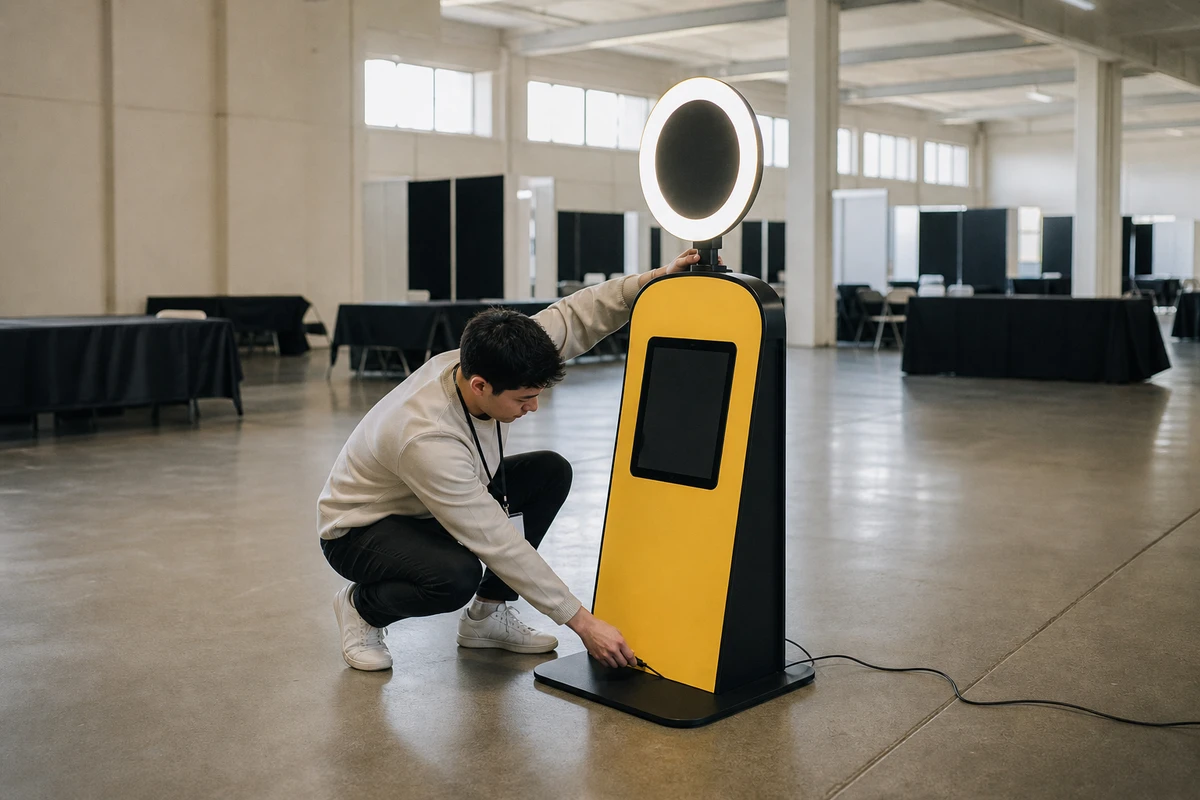
Make the hardware carry the brand
The station, the on-screen overlays, the digital frame, and the final shareable image should all carry the corporate identity. A generic booth produces generic content. When the branding is built into every digital layer, the fun the candidate has reinforces the employer brand instead of decorating a vendor’s template.
Choose props and backdrops that say something true
Props and backdrops should signal the actual work and culture, not novelty for its own sake. An engineering firm photographing candidates with role-relevant gear says something true about the job. A pile of inflatable costumes says nothing, and a candidate drawn in by a booth that misrepresents the role is the kind of expectations gap that ends in an early resignation.
Staff the station; the tech is the icebreaker
Experiential tech is the icebreaker, not the recruiter. Pair every station with a recruiter or brand ambassador. The technology lowers the barrier to a conversation; a person still has to have it. A station running unattended collects photos and misses the candidates.
Place it for traffic, and keep consent unhurried
The station should be visible without blocking the flow of the event, and the consent screen should be clear and unrushed. A candidate who feels hustled through a data-collection step remembers being hustled. One given a moment to read what they are agreeing to remembers a company that respected them.
The teams that win the activation phase are not the ones with the biggest career-fair budget. They are the ones who treated a photo station as a measurable channel, instrumented it from the first interaction, and showed up to the budget review with a cost per contact instead of a stack of sign-up sheets.
Sources
- CIPD and Omni RMS (2025). “Activating your employer brand.” https://www.cipd.org/en/views-and-insights/thought-leadership/insight/activating-employer-brand/
- CIPD (2024). “Resourcing and Talent Planning 2024.” https://www.cipd.org/en/knowledge/reports/resourcing-surveys/
- The Conference Board. “Show Me the ROI: Only 18% of Companies Communicate Impact of Employer Branding.” https://www.conference-board.org/press/roi-employer-branding
- Rally Recruitment Marketing (2025). “Best Employer Brand Launches of 2025: Activation, Engagement and Strategy.” https://rallyrecruitmentmarketing.com/2025/10/best-employer-brand-launches-of-2025-activation-engagement-strategy/
- AIHR (2026). “17 Employer Branding Metrics HR Should Track.” https://www.aihr.com/blog/employer-branding-metrics/
- LinkedIn Talent Solutions. “Ultimate List of Employer Brand Stats.” (Cited via AIHR, 2026.) https://business.linkedin.com/content/dam/business/talent-solutions/global/en_us/c/pdfs/ultimate-list-of-employer-brand-stats.pdf
- Harvard Business Review (2016). “A Bad Reputation Costs a Company at Least 10% More Per Hire.” https://hbr.org/2016/03/a-bad-reputation-costs-company-at-least-10-more-per-hire
- Norton, M.I., Mochon, D., and Ariely, D. (2012). “The IKEA Effect: When Labor Leads to Love.” Journal of Consumer Psychology, 22(3), 453-460. https://doi.org/10.1016/j.jcps.2011.08.002
- GDPR.eu. “What Are the GDPR Consent Requirements?” https://gdpr.eu/gdpr-consent-requirements/
- California Office of the Attorney General. “California Consumer Privacy Act (CCPA).” https://www.oag.ca.gov/privacy/ccpa
- SHRM. “Average Cost per Hire Is Just over $4,000, SHRM Reports.” https://www.shrm.org/topics-tools/news/talent-acquisition/average-cost-per-hire-just-over-4-000-shrm-reports