
A banquet hall’s events manager sits across the table from a client planning a 150-person company anniversary party. They have gone down the quote line by line: room rental, bar minimum, plated dinner, AV. Then the client points at the booth standing in the corner of the ballroom, the one the venue installed last quarter, and asks what it costs to add. The manager pauses, because nobody ever set a number.
Venues in that position usually land between $300 and $900 as a per-event add-on, or they fold the booth into a higher event-package tier so the price never appears on its own line. That is the going rate. It is also the wrong place to start.
The reason is cost structure. A venue that owns its booth carries almost none of the expenses a mobile rental company does, so pricing a photo booth as a venue service against rental-market rates means benchmarking against a business with the wrong economics. In many markets the right move is to price below the local rental rate on purpose. This article covers what venues actually charge, the four ways they package the offer, what an in-house booth really costs per event, and a model for setting the number that fits how a venue makes money.
What Venues Actually Charge for a Photo Booth Service
A hotel that prints its event packages on a glossy brochure and a brewery that quotes every booking by email will show the photo booth price in two different places. The hotel almost always buries it: the booth becomes a feature of the “premium” or “platinum” event tier, and the client sees a higher package total with no separate line. The brewery tends to quote it à la carte, a flat fee added to the booking, typically $300 to $900 depending on the market and the event length.
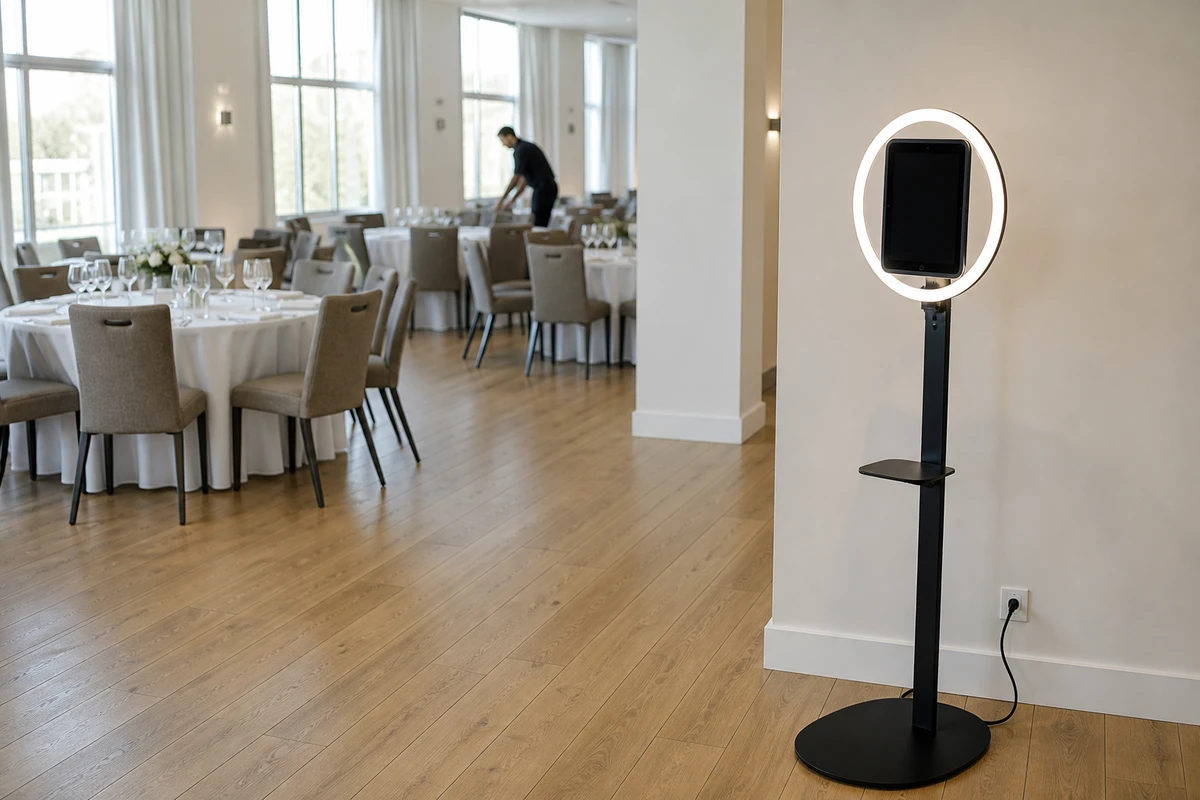
Those two patterns, an invisible uplift and a standalone add-on, cover most venue pricing, and setting either one starts with the market context.
The wider rental market sets the ceiling. Puddles Photo Booth’s 2025 study of 89 companies across 26 US cities found a selfie-style station rents for a national average of $556 for three hours, open-air booths for $870, and enclosed booths for $1,337. Event Brothers Co.’s rental cost guide corroborates the open-air range at $500 to $1,200 for three hours. Hourly extension rates run $150 to $250 beyond contract hours, and Feature Booth’s 2025 pricing guide notes weekday bookings priced 10 to 20% below weekend rates, with holiday weekends carrying a premium.
Geography matters
Geography matters. Puddles found a three-hour rental averages $975 in the Northeast and $768 in the Southwest, a 27% spread. A venue should benchmark locally, and it should benchmark against the right businesses. A venue add-on usually sits at or below the low end of the mobile-rental range, and that is correct pricing, not a discount, for reasons the next section explains.
There is no tidy “market price” to copy in any case. In a single r/photobooth disclosure thread, operators quoted the same three-hour event anywhere from $200 to $850 and up, with the scatter driven by local competition and experience rather than any shared formula.
One market force works in the venue’s favor. Consumer marketplaces (The Knot, Thumbtack, WeddingWire) surface $99 to $200 photo booth listings, and mobile operators say that anchor is hard to fight. In one r/photobooth thread, operators describe the constant work of explaining to clients why a sustainable booth costs more than the marketplace number. A venue selling an add-on at the moment of booking does not have that problem. The client has already committed to the room, the catering, and the date. The booth is a small yes on top of a large one, not a cold quote competing against a search results page.
Why a Venue Should Not Price Like a Rental Company
A mobile photo booth operator’s day starts hours before the event. Load the van, drive across the metro, find parking, carry the booth and printer inside, set up, staff the booth for the full event, tear down, drive home. Own Your Moment, an operator-education resource, estimates a two-hour event consumes roughly six hours of real labor once setup, teardown, and travel are counted, and treats any price under $300 as a loss after those hours are paid at a fair rate.
Staffing
That price has to absorb a long list of costs: round-trip fuel and travel-fee mileage, setup and teardown labor, an onsite attendant for the entire event, equipment that sits idle between gigs, insurance, and the marketing spend it took to win the booking. Strip the booth itself out of a rental price and most of what remains is logistics and customer acquisition.
A venue that owns its booth has already paid for all of it. The building is paid for. The power is on. The event staff are already on the clock. The guests arrived because the venue booked the event. The booth lives in one place, so there is no travel, no teardown, no idle-asset problem, and no separate cost to acquire the customer, because the customer is a client the venue already sold.
What is left is the venue’s marginal cost per event: consumables, a few minutes of staff time, and a small slice of a software subscription. As the cost section below shows, that figure usually lands between $25 and $75. The rental-market rate of $550 and up is therefore a ceiling, not a target. A venue that prices at the mobile-rental rate is not capturing a premium. It is suppressing how many of its events attach the booth at all, and leaving the value the booth creates beyond the fee untouched.
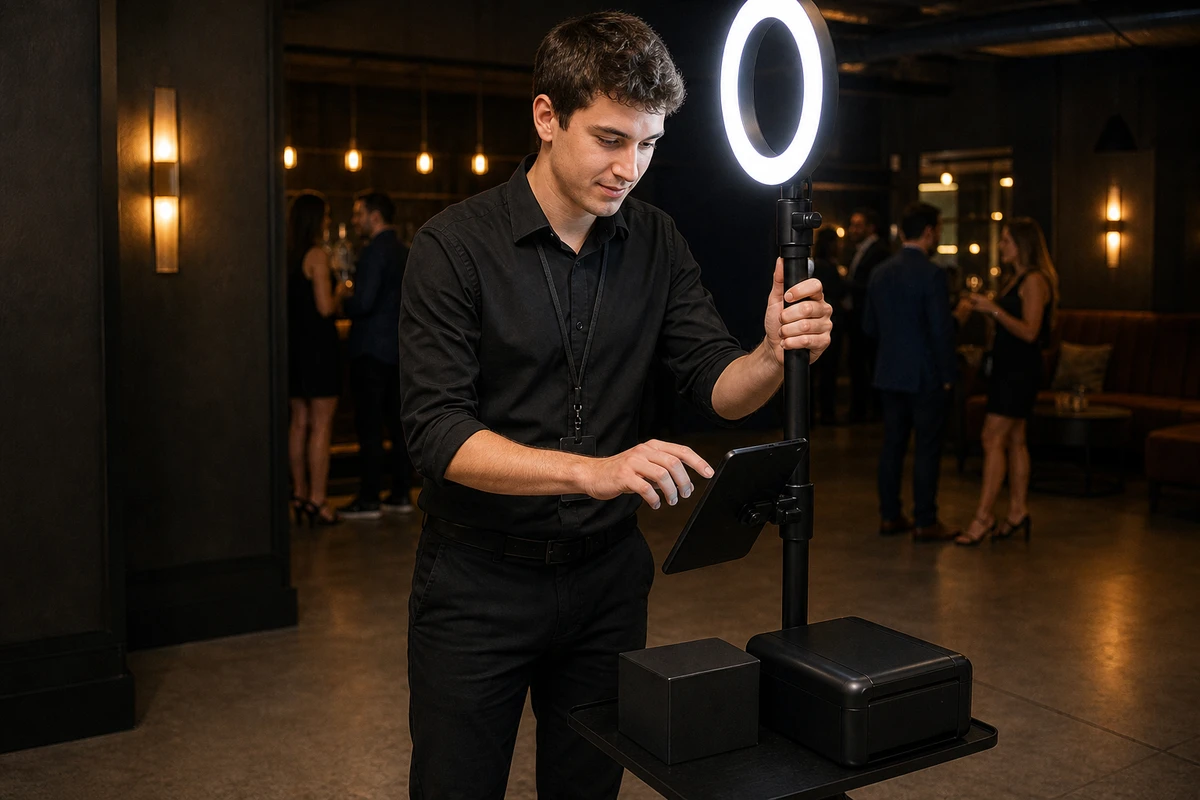
This is the misconception worth correcting. The venue’s pricing question is not “what does a photo booth cost.” It is “what price gets the booth onto the largest number of events at the highest total contribution.” Those are different questions with different answers.
Four Ways Venues Package Photo Booth Pricing
When a corporate client asks to add the booth to a 120-person holiday party, the venue can answer in four ways, and the wording of that answer changes how often clients say yes.
À la carte add-on
A flat per-event fee, presented at booking: “Add the photo booth for $450.” It is the easiest model to benchmark and the easiest to upsell. The price is visible, which means it competes with whatever number the client half-remembers from a consumer marketplace. Best for venues with healthy booking demand, where margin per event matters more than attach rate.
Bundled into a tiered package
The booth is included in the “premium” event or catering tier and never appears as a line item. The client compares a standard package against a premium one and reads the booth as a reason to trade up. This model has the highest margin capture and the lowest price resistance, because the client is choosing between packages, not scrutinizing an add-on.
Per-hour add-on matched to event length
The booth is billed by the hour, the same way the venue already bills the room. It is simple for clients who book by the hour and fits venues whose events vary widely in length. The catch is that a venue’s per-event cost barely moves with length, so hourly billing ties the fee to the clock rather than to what the booth is worth to the client, and it tends to leave margin unclaimed at longer events.
Free amenity
The booth is included at no charge and earns its keep indirectly, through the bookings it wins and the value it generates (the closing framework returns to when this is the right call). Best for venues in competitive markets where winning the booking, not pricing the booth, is the binding constraint.
Whichever model a venue picks, it should carry two or three tiers with a real upsell. A custom branded backdrop, branded photo overlays, green-screen, and guest data capture are the levers that move buyers, and the rental market prices each of those at $50 to $200 per event (Event Brothers Co.). For a venue, those features are sunk costs already covered by the software and the install, so an upsell tier is close to pure margin. One habit worth borrowing from operator forums: make the lower tier slightly worse on purpose (drop unlimited prints, for instance), and most clients pick the fuller tier on their own.
What an In-House Booth Actually Costs to Run
Ask a mobile operator what eats their margin and many say the same thing: the prints. For a venue, the honest accounting starts there and stays small.
Consumables
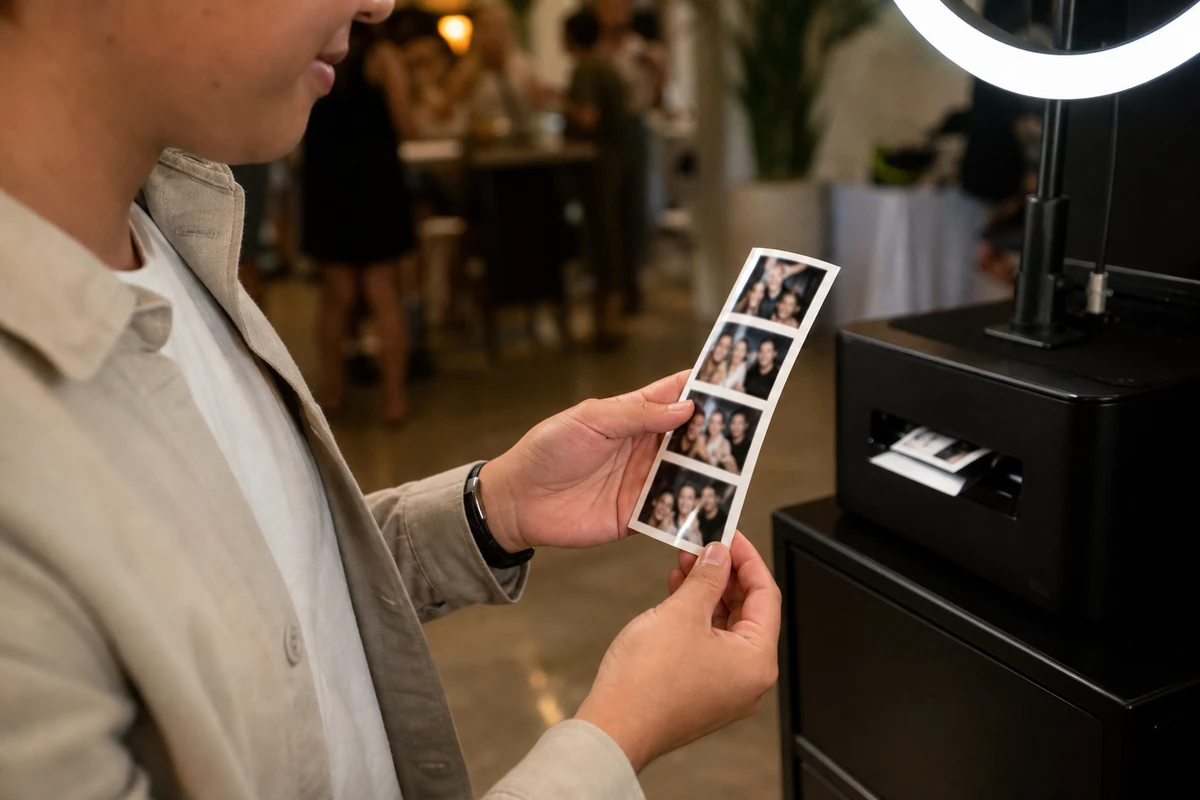
Dye-sublimation print media is the only true per-event cost. A DNP DS620A, the industry-standard 4×6 event printer, uses media that retails around $129 for an 800-print pack, about $0.16 a print (per-print cost across dye-sub formats runs roughly $0.15 to $0.22). A 100-guest event producing one print per guest costs $16 in media. A booth set to digital delivery by text or email instead of printing removes even that.
Hardware
This is a one-time capital cost, separate from the per-event math. RBA Photobooths lists booth shells from $1,900, DIY bundles around $2,200 to $3,000, and full professional packages near $4,800 (2026 pricing). Own Your Moment puts an all-in iPad booth near $3,000 and a camera-equipped enclosed booth near $8,000. A single-unit install for most venues lands around $3,000 to $5,000. (Whether to buy outright or finance the purchase is a separate decision this article does not cover.)
Software
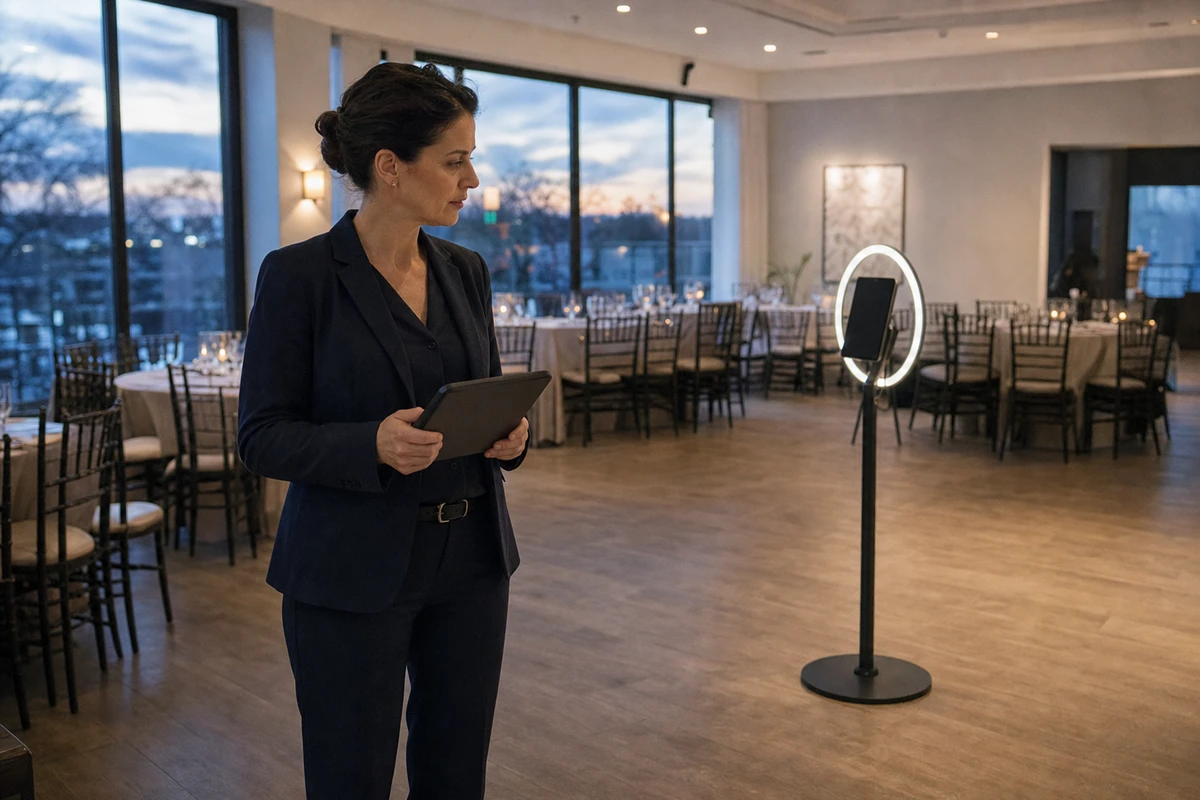
An iPad-app photo booth runs a subscription. Touchpix, one representative platform, prices a two-device plan around $726 semi-annually (2026 pricing); across the market, venue-grade software runs roughly $60 to $150 a month. For a venue doing a dozen or more events a month, that is a few dollars per event.
Staff
This is where a venue’s structure pays off. A mobile operator builds in a dedicated attendant, five to six hours at $20 to $35 an hour, $100 to $210 per event. A venue running the booth in self-service mode reassigns a few minutes of staff who are already on site, at no incremental labor cost.
Add the recurring lines and a venue’s marginal cost per event, the number that actually matters for pricing, lands between $25 and $75. Hardware is real money, but it is spent once. The decision below is built on the marginal figure.
The Attach-Rate Pricing Model
A venue manager has installed the booth and now has to pick a number. Set it at $600 and it matches the local rental market. Set it at $350 and it looks underpriced. The instinct is to go high. The arithmetic says otherwise.
Start with direct contribution
Start with direct contribution. A venue’s monthly photo booth income is the number of events it hosts, times the share that attach the booth, times the contribution per attached event (price minus marginal cost):
Monthly contribution = events × attach rate × (price − marginal cost)
Take a venue hosting 16 events a month with a marginal cost of $50 per event. Price the add-on at $600 and suppose a quarter of clients say yes: 16 × 25% × ($600 − $50) = $2,200 a month. Now price it at $350 and suppose the lower number and easier yes lift attachment to 55%: 16 × 55% × ($350 − $50) = $2,640 a month. The $350 price earns more, because attach rate moved further than price did. A venue should test its own attach rates at two or three price points rather than assume the highest price wins. That contribution also sets the hardware payback: a $5,000 install against $2,640 a month is recovered in under two months, after which the booth runs at near-pure margin.
Direct contribution is only the first layer. Every attached event produces two more things the mobile-rental model cannot bank.
Branded reach
The first is branded reach. Every print and every digital share carries the venue’s logo on the photo template. At a 100-guest event, if a third of guests post their photo and each reaches a few hundred followers, that is on the order of 10,000 branded impressions from a single event. Treat that figure as an estimate built on a venue’s own assumptions, not a measured number, but the direction holds, and it matters because guests put more weight on each other than on a venue’s own marketing: 66% of consumers lean on friends-and-family recommendations to keep up with trends (Sprout Social, 2025).
First-party data
The second is first-party data. A booth that delivers photos by email or text captures guest contact details, the attendees of a confirmed event, with permission recorded at the same time. A 100-guest event at a 40% opt-in rate yields 40 contacts the venue can invite to future bookings. With Simple Booth’s HALO app, a guest enters an email or phone number to receive their photo, and the app records that opt-in as it sends. The entertainment-venue chain Treetop Golf used that capture across its locations to build a list of 150,000 email addresses. Email remains one of the highest-return marketing channels, returning roughly $36 for every $1 spent (Litmus, 2025). One repeat booking pulled from that list, a company holiday party next December, dwarfs the booth’s add-on fee.
Layer-two value (reach and data) accrues to the venue on every attached event, no matter what the add-on costs. That is precisely why a venue can rationally price low, even at break-even, to drive attach rate up. It is the opposite of the mobile operator’s instinct to push price as high as the market will bear.
A Pricing Decision Framework
A venue manager still has to put a number in the events brochure. Six steps turn the analysis into that number.
Benchmark other venues, not rental companies
Find what comparable venues in the local market charge as an add-on or fold into a tier. Mobile-rental rates set the ceiling, not the target.
Calculate the true marginal cost
Consumables, the per-event slice of software, and any incremental staff time. For most venues this is $25 to $75 per event.
Pick a packaging model from the binding constraint
If bookings are scarce, bundle the booth into a premium tier or include it free and let it win bookings. If booking demand is healthy, an à la carte add-on captures more margin per event.
Set the price to maximize attach rate × contribution
Test two or three price points and watch which share of clients attach the booth. Total contribution, not the headline price, is the number to grow.
Build two or three tiers with a real upsell
Branded overlays, a custom backdrop, green-screen, guest data capture. For a venue those features are already paid for, so the upsell tier is close to pure margin.
Revisit the price every year
Operator forums are full of venues and vendors who set a number once and never touched it. Costs move, the local market moves, and a price set three years ago is almost certainly wrong now.
When booking volume, not per-event margin, is what limits a venue’s growth, the strongest move can be to stop charging for the booth at all. A free booth that wins even one extra booking a month, branded reach and a growing contact list included, can out-earn an add-on fee that clients keep declining. A venue’s photo booth is a marketing asset that happens to also bill an add-on fee. Price it like one.
Sources
- Puddles Photo Booth (2025). “2025 Photo Booth Rental Costs.” https://www.puddlesphotobooth.com/2025-photo-booth-rental-costs
- Event Brothers Co. (2026). “Photo Booth Rental Cost Guide.” https://www.eventbrothersco.com/photo-booth-rental-cost/
- Feature Booth (2025). “Photo Booth Rental Pricing Guide 2025: Costs & Packages.” https://www.featurebooth.com/post/photo-booth-rental-pricing-guide-2025-costs-packages
- Own Your Moment. “How to Price Your Photo Booth Business.” https://ownyourmoment.co/blogs/resources/how-to-price-your-photo-booth-busines
- Reddit, r/photobooth (2024). “Full disclosures: how much you guys charge per hour, per client, event?” https://old.reddit.com/r/photobooth/comments/1cbdy5k/full_disclosures_how_much_you_guys_charge_per/
- Reddit, r/photobooth (2024). “Maybe Karen’s saying your pricing is too expensive…” https://old.reddit.com/r/photobooth/comments/1gw0nw5/maybe_karens_saying_your_pricing_is_too_expensive/
- Touchpix (2026). “Pricing.” https://www.touchpix.com/pricing
- Litmus (2025). “Email Marketing ROI.” https://www.litmus.com/blog/email-marketing-roi/
- RBA Photobooths (2026). “Photo Booths for Sale.” https://www.rbaphotobooths.com/collections/photo-booth-for-sale
- Sprout Social (2025). “User-Generated Content (UGC): What It Is and Why It Matters.” https://sproutsocial.com/insights/user-generated-content/
- Amazon. “DNP DS620A 4×6 Print Media (800 prints).” https://www.amazon.com/dp/B082WNQQ7W