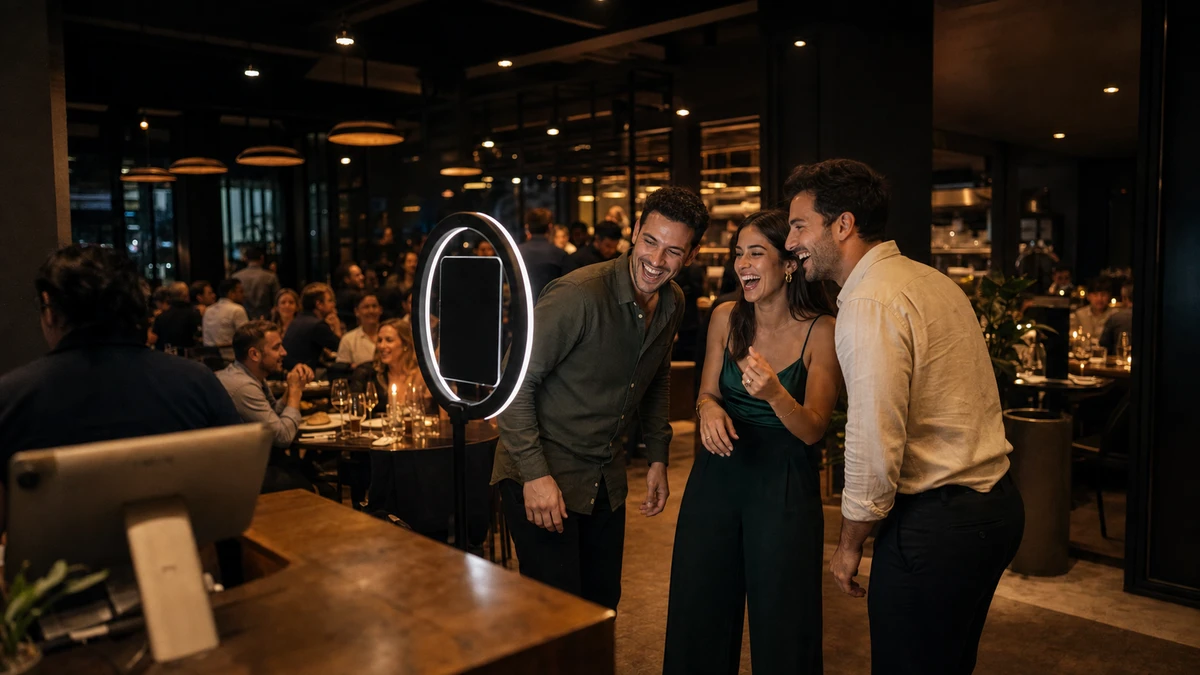
A restaurant owner clears a corner near the host stand, runs a power cord, and sets up a photo station for a Friday-night promotion. A retail chain’s field marketer unboxes the same hardware in three stores before a holiday campaign. In both cases someone has already decided the booth is worth having. The open question is the one on the invoice: a commercial photo booth runs roughly $3,000 to $9,000 depending on format, and that line item has to come from somewhere.
It does not have to come from cash. A commercial booth is capital equipment, and an operator has at least four sensible ways to pay for it. The catch is that the option most vendors put in front of the buyer at checkout, the one promising approval in seconds, is usually the most expensive way to pay. This guide compares photo booth financing by what each option actually costs, not by the monthly payment on the sticker.
A photo booth is capital equipment, not a startup cost
Search results for photo booth financing are written for one person: someone with no business yet, buying a booth to launch a rental operation. That buyer has no entity, no business credit, and no bank relationship, so the only question that matters is who will approve the application. The checkout pages answer that question and stop there.
A venue operator is not that buyer. Neither is a retail brand, a hotel group, or a franchise marketing director. They already run a business, with a bank, a business checking account, probably a business credit card, and a credit history a lender can underwrite. That changes the question. The aspiring rental operator asks who will say yes. The established operator should ask which yes is cheapest, because several lenders will say yes.
Size the decision first
Size the decision first. An iPad-based commercial kiosk runs about $3,000 to $5,000 before the iPad. A DSLR or mirrorless booth, with a real camera and lighting, runs roughly $6,000 to $9,000. A 360 booth ranges from around $2,000 for the spinning platform alone to well past $10,000 for a full bundle. This is a low-four-figure to low-five-figure purchase, not a mortgage, which means the instrument matters less than the price of the money.
Financing it is ordinary, not a sign of weakness. The Equipment Leasing and Finance Association’s 2024 industry data reports that 82% of U.S. companies use some form of financing (loans, leases, or lines of credit) when they acquire equipment. The question is not whether to finance, but which instrument at what cost. (Whether to buy a booth at all, rather than rent one per event, is a separate decision; this guide assumes the operator is buying.)
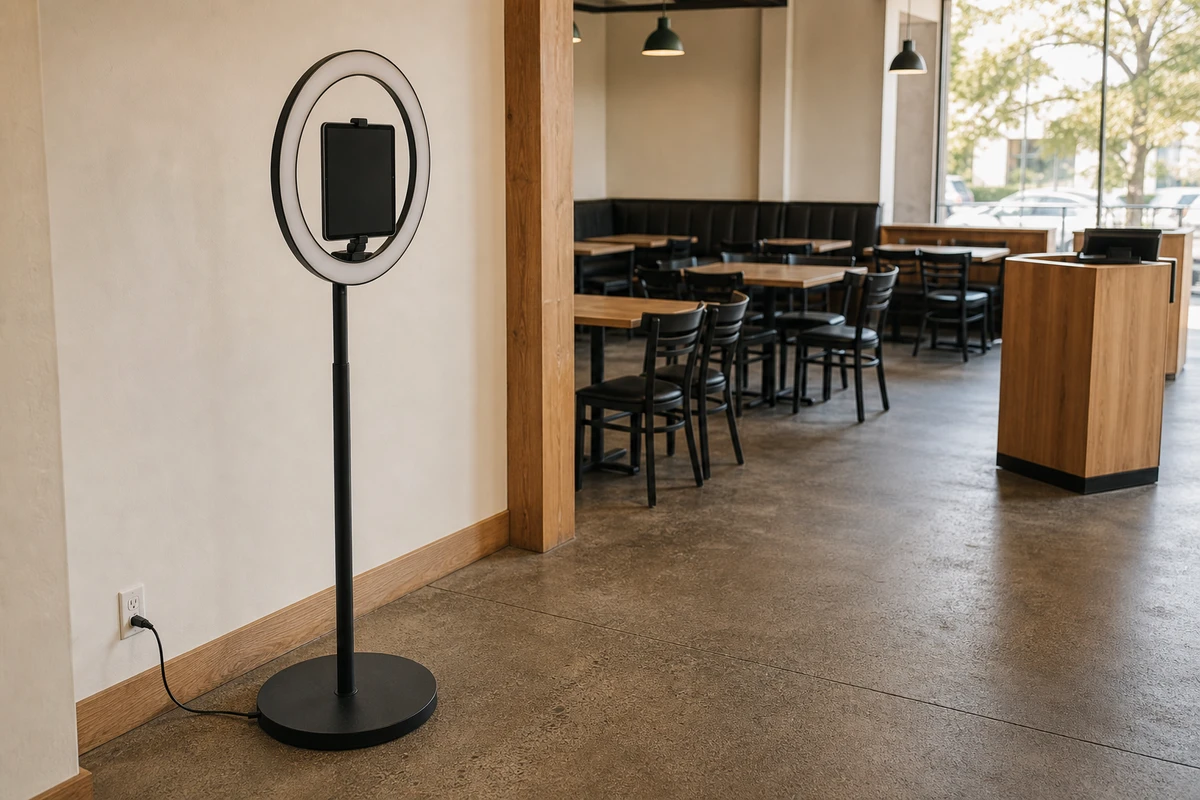
Four realistic ways to pay for a commercial photo booth
An operator who has decided to buy faces four practical instruments. They differ on a few things that matter: who owns the equipment, how fast the money arrives, whether it touches business credit, and what it costs.
Cash from the operating budget is simplest
Cash from the operating budget is simplest. The booth is owned outright on day one, with no application, no lien, no financing cost. The only real cost is opportunity: that cash is no longer available for inventory, payroll, or another project. Paying cash does not forfeit the tax deduction, a point the tax section returns to.
A business credit card is fast and familiar, and it is the right tool in exactly one case: a genuine 0% introductory offer that covers the full payoff period, cleared before the promo window closes. Outside that case it fits poorly. Ongoing business card rates commonly run from 15% to nearly 30%, and carrying a four-figure balance at those rates for a year or more turns a modest purchase into an expensive one.
An equipment financing loan is a true term loan from a bank, credit union, or online lender. The borrower owns the equipment immediately; the lender holds a lien until payoff. Because the equipment secures the debt, rates run lower than unsecured borrowing. The equipment-finance lender Crestmont Capital currently advertises rates starting at 3.25% over terms of 24 to 72 months, a floor reserved for the best-qualified borrowers. Most established operators should price this instrument first.
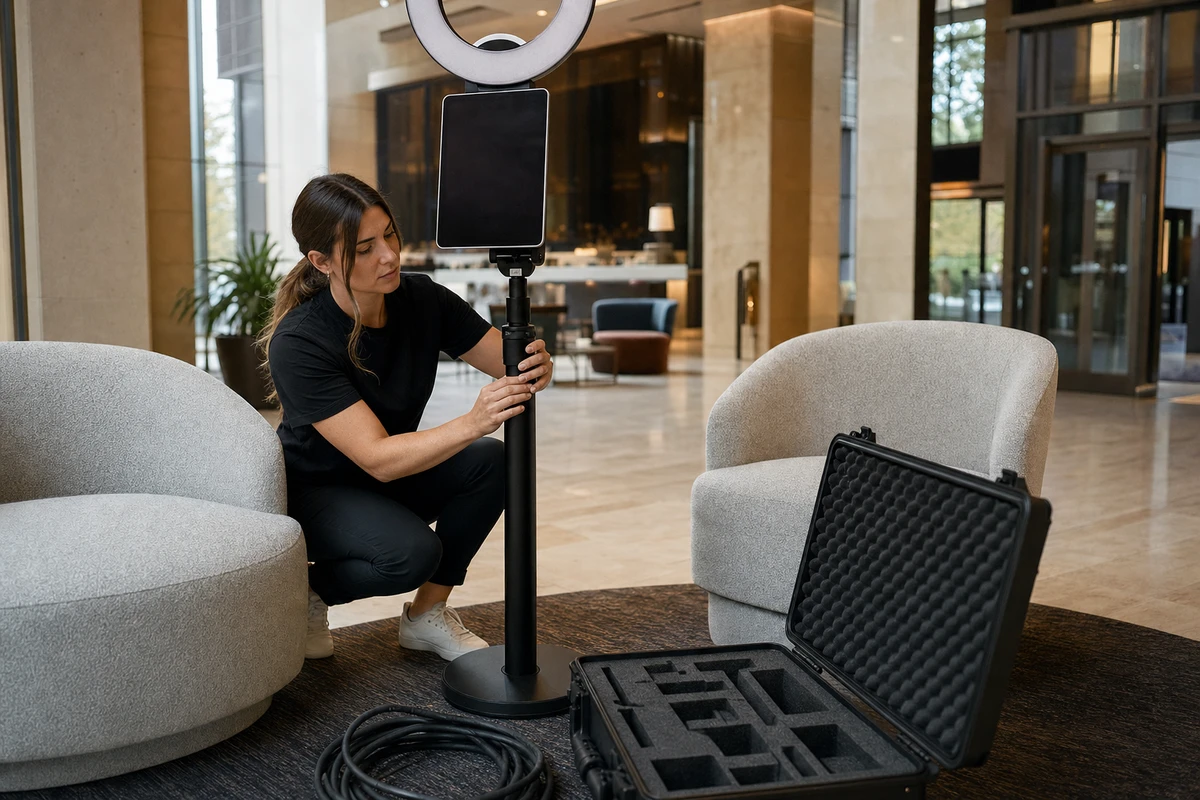
Vendor checkout financing is the option embedded on nearly every photo booth seller’s site: ClickLease, QuickSpark, Affirm, Klarna, branded as financing with a button promising approval in seconds. They are not all the same product (Affirm and Klarna are consumer installment plans, ClickLease is an equipment lease), but they share the pitch: convenience and a fast yes. ClickLease, the partner behind a large share of those buttons, is a lease, not a loan, and that distinction is where the money is lost.
A fifth path matters for multi-location operators: a business line of credit, or equipment line of credit, from the operator’s existing bank. A company equipping ten locations should not sign ten separate checkout contracts. One revolving facility funds the rollout at a single negotiated rate.
Why “instant approval, no credit pull” is a warning label
A buyer reaches the checkout page, sees “as low as $156 a month,” clicks the financing button, gets approved in under a minute with no credit check, and signs. Months later the buyer adds up the payments and finds the booth cost far more than its price. Nothing went wrong with the paperwork; the page simply never invited a closer look.
Start with the distinction the checkout page blurs
Start with the distinction the checkout page blurs. A loan ends with the borrower owning the asset and a clear payoff balance that shrinks each month. Many vendor checkout products are not loans. They are non-cancelable equipment leases. ClickLease, the partner embedded on a large share of photo booth checkout pages, says so plainly in its own FAQ: because it offers leases rather than loans, it has no interest rate. Its cost is described instead as a set surcharge, and the lease ends not at a zero balance but with a buyout, three additional monthly payments to actually own the equipment.
Run that through ClickLease’s own published example. The company markets $4,499 of equipment at “as low as $156 a month.” Thirty-six payments of $156 is $5,616. The buyout adds roughly $468. A documentation fee, listed at $79 to $499, adds at least $79 more. The total lands near $6,163 for $4,499 of equipment, about 37% above the purchase price. ClickLease’s FAQ is candid about this, comparing its cost to an expensive credit card.
The features advertised as kindness are the price tag. Instant approval, no hard credit pull, all credit profiles welcome: a lender offers those not from generosity but because it is not underwriting, and a lender that skips underwriting prices every borrower for risk. An independent review of ClickLease by UnitedCapitalSource documents the predictable result, a recurring pattern of buyers who believed they had taken out ordinary financing and later discovered a non-cancelable lease whose total ran well above the equipment’s value. The individual dollar figures in those complaints cannot be verified; the pattern is consistent enough to plan around.
The defense is three numbers, in writing, before signing anything: the total of all payments over the full term, the end-of-term buyout, and whether the contract can be canceled or early payoff earns a discount (a true lease usually offers neither). A salesperson who can quote the monthly payment but goes quiet on the total has answered the question.
The real numbers: a $4,000 photo booth financed three ways
Put a representative booth on the table: a commercial iPad kiosk at $4,000, financed over 36 months. Three paths, compared by what they actually cost.
| Path | Monthly payment | Total paid |
| Path | Monthly payment | Total paid | Cost of the money |
|---|---|---|---|
| Cash | None | $4,000 | $0 |
| Equipment loan (~8% APR, 36 months) | ~$125 | ~$4,510 | ~$510 |
| Vendor lease-to-own | ~$140 plus buyout | ~$5,500 | ~$1,500 |
The equipment loan figure uses a representative 8% rate for an established small business with reasonable credit. That sits comfortably below the SBA’s ceiling for small loans: the agency caps rates on 7(a) loans of $50,000 or less at the base rate plus 6.5%, which lands in the low-to-mid teens at recent base rates. Even at a steep 15%, total interest on a $4,000 loan over three years stays under $1,000. The lease-to-own figure scales ClickLease’s published example, which carries about 37% above the cash price once the buyout and fee are counted.
Two gaps matter here, and they are different sizes. The gap between paying cash and a sensible equipment loan is about $510 over three years, roughly $14 a month. The gap between that loan and the checkout lease is about $1,000. The first is small and often worth paying, because it keeps $4,000 of working capital in the business. The second is large and entirely avoidable, and it is the one a low monthly number is designed to hide.
Now set the financing cost beside what the booth is for. An operator does not buy a commercial booth for the hardware. Its job is to capture customer photos and, with permission, opted-in email and phone contacts at every event it runs. An iPad booth such as Simple Booth’s HALO kit does this by asking each guest for an email or phone number before it sends the photo, the same flow the entertainment-venue chain Treetop Golf used to build a list of 150,000 unique email addresses across its locations.
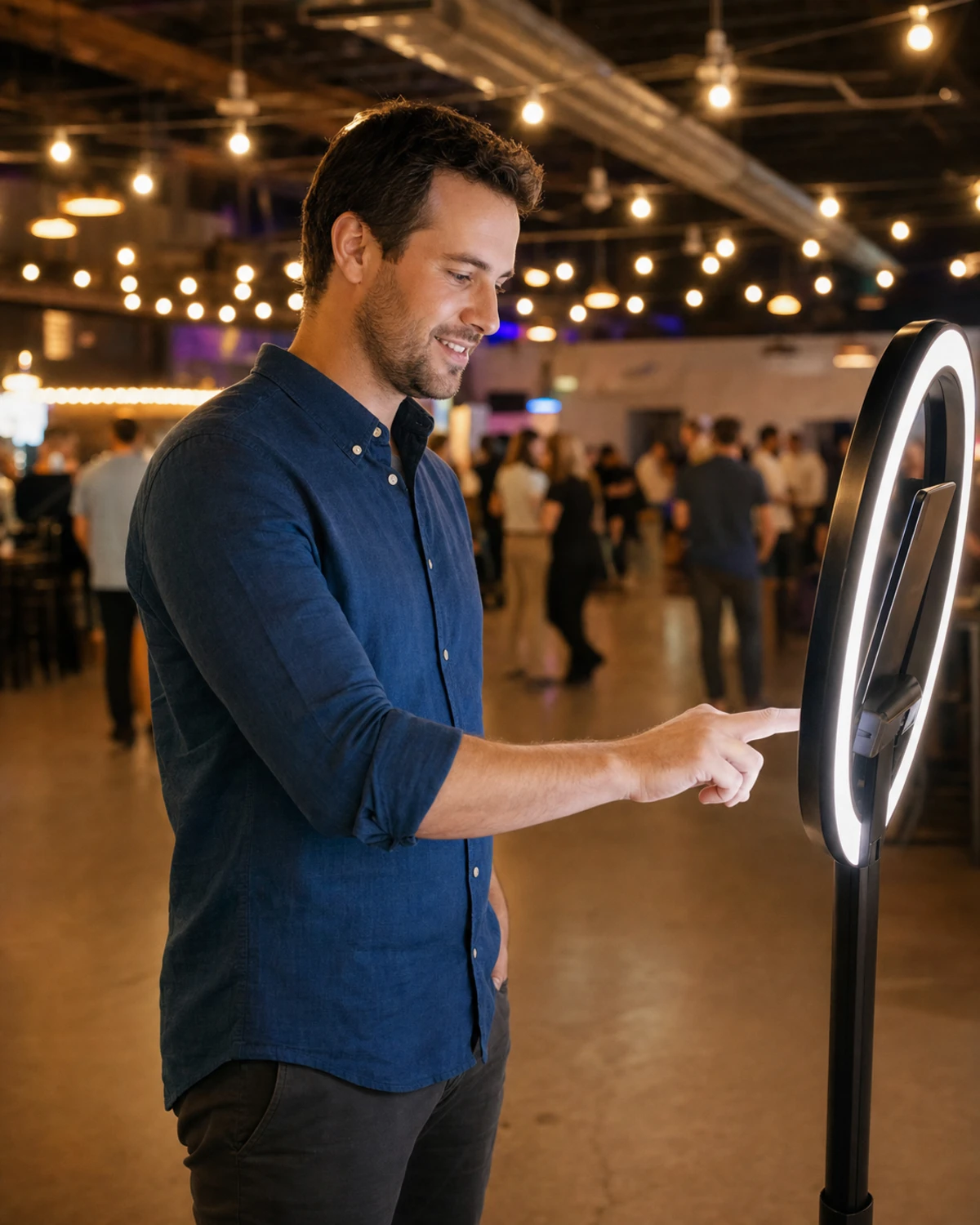
A venue that captures 40 contacts from a 100-guest event, twice a month, builds an email list in the hundreds within a quarter. (Forty of a hundred is an illustration, not a benchmark; operators should measure their own opt-in rate.) Email remains the highest-return channel marketers measure, with Litmus’s email ROI research putting the average at $36 returned for every $1 spent. Against a list that compounds like that, a $510 financing cost spread over three years is rounding error.
Financing cost is not irrelevant; it is second-order. Two things move the outcome: not overpaying for the money, and actually deploying the booth so it produces. An operator who fixates on the $510 and lets the purchase stall has optimized the wrong number. One who shrugs and signs the checkout lease has overpaid $1,000 for nothing.
Financing doesn’t cost the operator the tax deduction
Many operators believe a booth has to be bought with cash to be written off, that financing forfeits the deduction. It does not. How to pay and how to deduct are separate decisions.
Under Section 179 of the U.S
Under Section 179 of the U.S. tax code, a business can generally deduct the full cost of qualifying equipment in the year it is placed in service, whether bought with cash or financed. The deduction is figured on the asset’s price, not on the payments made during the year. A booth financed in December and put to work the same month can, in the right circumstances, be fully deducted that year on a single payment. For 2026, the IRS sets the Section 179 limit at $2,560,000, phasing out only above $4,090,000 of equipment placed in service, ceilings no photo booth buyer will trouble.
There is current news here that the older content ranking for this topic predates. Much competing advice was written in 2022 and 2023, when bonus depreciation was scheduled to phase down. P.L. 119-21, the law commonly called the One Big Beautiful Bill Act, reinstated 100% bonus depreciation for qualifying property acquired and placed in service after January 19, 2025. First-year expensing of the full hardware cost is more straightforward now than the older guides suggest.
Real conditions apply
Real conditions apply. The business needs taxable income to use a Section 179 deduction; it can reduce taxable income to zero but not create a loss, and any unused amount carries forward. The equipment must be used more than half the time for business. The deduction is claimed on IRS Form 4562. The instrument matters at the edges: a financed purchase and most $1-buyout (capital) leases let the operator treat the booth as an owned asset and depreciate it, while a true fair-market-value operating lease is handled differently, with the lease payments deducted as an expense instead. Loan interest is itself a deductible business expense. ClickLease-style leases with a multi-payment buyout sit in a gray area whose treatment depends on the specific contract.
This is a US-specific overview, not tax advice; the full mechanics belong with a CPA.
Matching the financing instrument to the operator
The right instrument depends less on the booth than on the operator’s cash position and credit.
When Cash Makes Sense
An operator with cash on hand, where spending $4,000 to $9,000 will not strain operations, should usually pay cash. It is simplest, carries no financing cost, and the Section 179 deduction is available anyway. The only reason to finance instead is a genuinely better use for that capital elsewhere.
An operator who wants to preserve working capital and has reasonable business credit should price an equipment financing loan, or draw on an existing business line of credit. The move is to compare: a credit union, the operator’s own bank, and one online equipment lender will quote three different rates, and ten minutes of comparison is worth more than the $510 in the scenario above.
An operator rolling booths out across multiple locations should talk to the bank about an equipment line of credit before signing anything at a vendor’s checkout. Per-location checkout financing does not scale. It multiplies paperwork, scatters the true cost across many small high-rate contracts, and makes the blended rate almost impossible to see.
An operator with thin or no business credit, for whom the checkout lease genuinely is the only approval available, should slow down rather than click. Get the total of payments and the buyout in writing. Compare it against a secured business credit card or a credit union equipment loan, both often reachable for a borrower who assumes they will be declined. If the lease is still the only option, treat it as a last resort and price it as one.
The thread through all four cases is the same. An operator who already runs a business almost always has a better option than the one bolted onto the vendor’s checkout page. The work is to choose the instrument deliberately, spend an afternoon on it, then put the real energy into deploying the booth, because that is where the return actually comes from.
Frequently Asked Questions
Can I finance a commercial photo booth with bad credit?
Yes. Instant-approval checkout leases approve most credit profiles, but they price that risk into a high cost rather than a stated interest rate. If credit is the obstacle, compare a secured business credit card or a credit union equipment loan first. Many borrowers who assume they will be declined are not, and those instruments cost far less than a subprime lease.
Is it better to lease or buy a photo booth?
For an operator using the booth as a long-term marketing asset, a financed purchase almost always beats a lease-to-own contract, because it ends with you owning the equipment outright at a known payoff. A lease-to-own ends with a buyout and a higher total cost. A genuine short-term need is a rental decision, not a financing one.
Can I write off a financed photo booth on my taxes?
Yes. Section 179 lets a U.S. business deduct the full cost of qualifying equipment in the year it is placed in service, whether the booth was bought with cash or financed. You deduct the asset’s price, not your monthly payments. The business needs taxable income to use the deduction. Confirm the specifics with a CPA.
How much does photo booth financing cost per month?
It depends on the instrument, not the booth. A $4,000 booth on a sensible equipment loan runs roughly $125 a month, with about $510 in total interest over three years. The same booth on a subprime checkout lease can cost roughly $1,000 more in total. Always ask for the total of payments, not just the monthly figure.
Does financing a photo booth hurt my credit?
A true equipment loan or line of credit involves a hard credit inquiry and appears on your business credit profile, which is normal and expected for a business purchase. “No credit pull” checkout leases skip the inquiry but typically charge much more, so avoiding one routine inquiry is not a free benefit.
Should a multi-location brand finance booths one at a time or together?
Together, through a single equipment line of credit with your bank. Financing each location separately through vendor checkout multiplies the paperwork, scatters the cost across many small high-rate contracts, and hides the blended rate. One facility funds the whole rollout at one negotiated rate.
Sources
- Equipment Leasing and Finance Association (2024). “Equipment Finance Industry Overview.” https://www.elfaonline.org/research/industry-overview
- Crestmont Capital (2026). “Photo Booth Financing and Leasing.” https://www.crestmontcapital.com/photo-booth-financing-leasing
- ClickLease (2026). “Equipment Financing FAQ.” https://www.clicklease.com/
- UnitedCapitalSource (2026). “ClickLease Review.” https://www.unitedcapitalsource.com/business-loans/lender-reviews/clicklease-review/
- U.S. Small Business Administration (2026). “7(a) Loans.” https://www.sba.gov/funding-programs/loans/7a-loans
- Internal Revenue Service (2025). “Publication 946: How To Depreciate Property.” https://www.irs.gov/publications/p946
- Litmus (2024). “Email Marketing ROI: What Leads to Better Returns?” https://www.litmus.com/email-marketing-roi/