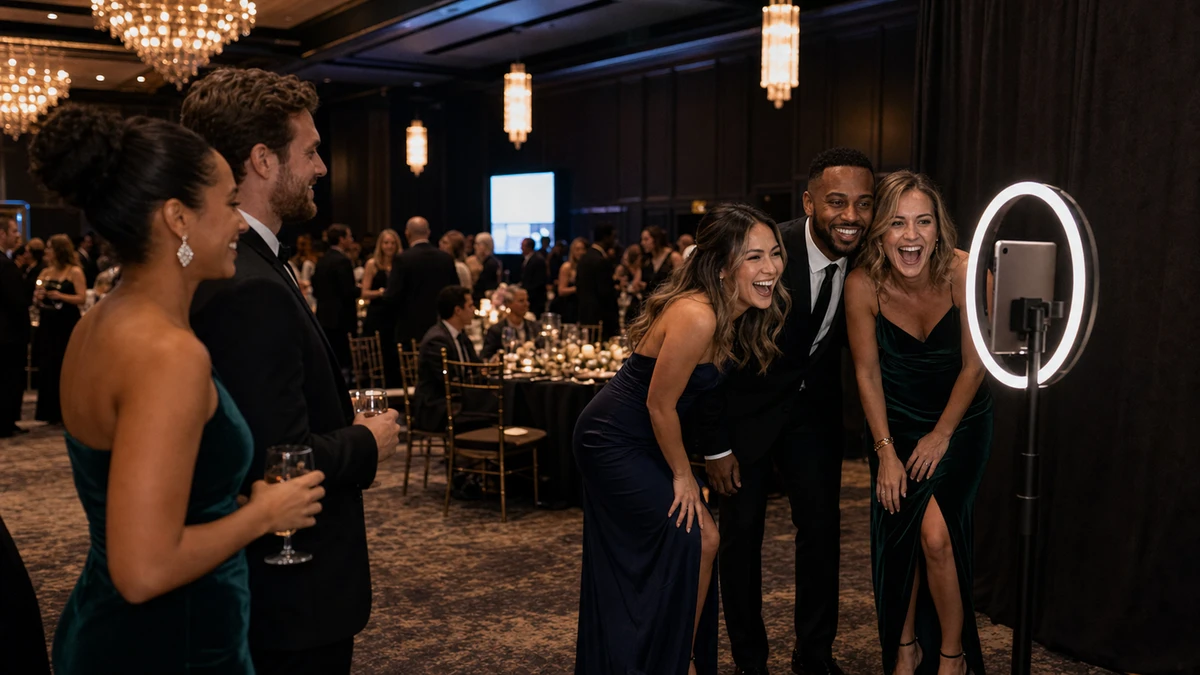
An hour before the doors open, a development director walks the ballroom floor. The tables are set, the silent auction is staged, and the program runs from 7:00 to 9:00. Near the bar, a square of carpet has been reserved for “entertainment,” and a rental company has quoted $1,400 for a photo booth to fill it. At the last board meeting, the treasurer asked a fair question: what does the booth bring back?
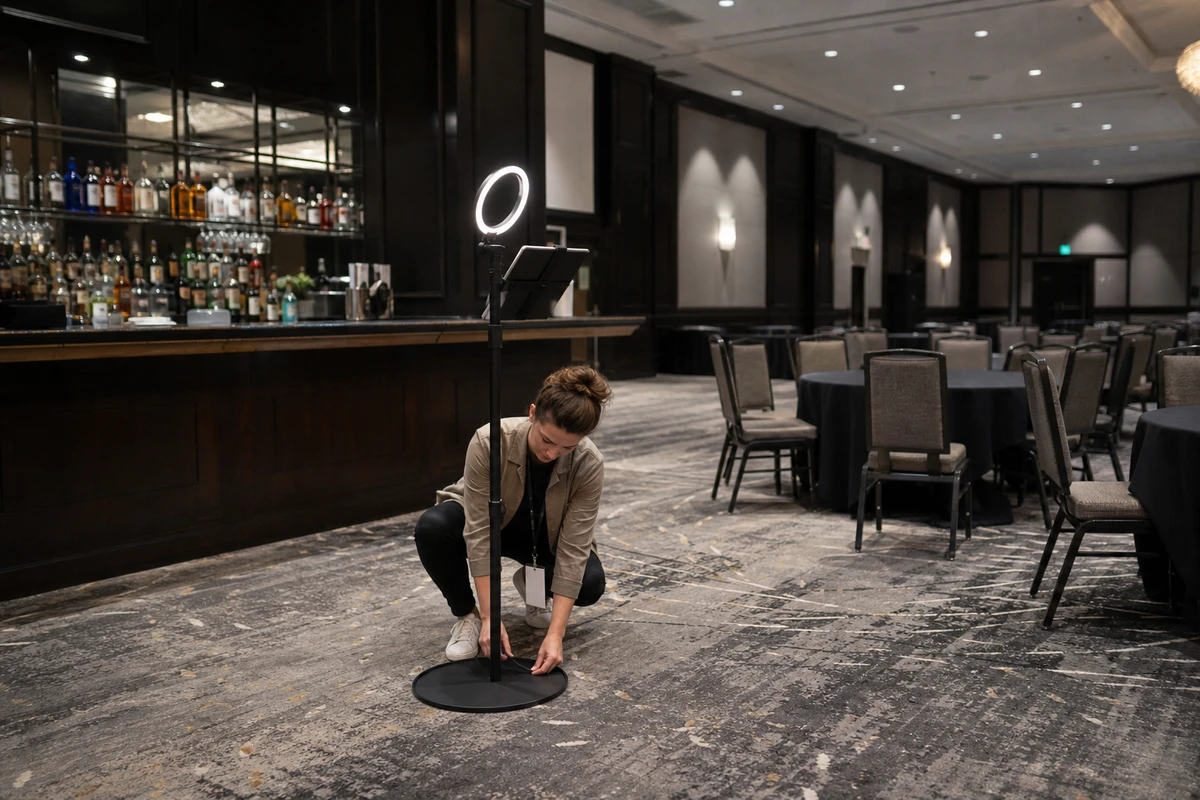
That question, not the props or the backdrop, decides which booth is the right one. The best photo booth for a non-profit is the one an organization can run as a net-zero or revenue-positive line item: branded on every photo it produces, reliable at capturing guest contact data, and in a format that fits the event actually being hosted. For most fundraising galas, that means an iPad-based digital booth underwritten by a sponsor. For a golf scramble or a 5K, it means something else. “Best” here is a procurement decision, not an entertainment one, and the rest of this guide works through the arithmetic, the event-type fit, and the questions to ask any vendor before signing.
What “Best” Means for a Non-Profit Photo Booth
A photo booth at a corporate holiday party is a discretionary expense, and nobody files a report on it afterward. A photo booth at a non-profit gala is a different object. Every line on a fundraising event budget is read by people, paid staff and volunteer board members alike, whose job is to ask whether the money was well spent.
That scrutiny is structural. The BBB Wise Giving Alliance’s Standards for Charity Accountability set the floor: a charity should spend at least 65% of total expenses on program activities, which caps administration and fundraising overhead at 35%. Charity Navigator’s ratings methodology rewards organizations that do better, generally favoring those that direct 75% or more of spending to programs. Neither figure is a legal threshold, but together they describe the ceiling a development director works under. A gala is a fundraising cost. The booth inside it is a fundraising cost inside a fundraising cost.
The pressure is not abstract
The pressure is not abstract. Giving USA and the Blackbaud Institute reported that the typical non-profit saw about 4.3% year-over-year growth in 2025, but the stronger gains landed at large organizations and in gifts of $1,000 and up, while lower-dollar giving declined. A small or mid-sized non-profit is raising money in a tighter room than the headline number suggests, which makes every event line worth defending.
This is where the standard sales pitch breaks down. Rental-company blogs repeat a claim that interactive elements or photo booths lift event donations by 20% to 30%. The figure has no traceable source: no academic database, trade publication, or industry survey carries an original study behind it, and the claim moves from one vendor blog to the next without a citation. The softer version surfaces in operator language: “the more fun guests have, the more they give.”
It does not hold up. A photo booth occupies guests during the gaps in a program, the stretch between dinner and the speeches, the lull before the live auction. It does not sit between a donor and the paddle. Same-night giving is decided by the ask itself: the case for support, the auctioneer, the matching gift, the social weather of the room. A booth in the corner changes none of that. Treating a direct donation lift as the booth’s payoff sets up a metric the booth cannot deliver, and a disappointed board the following year.
The return is real, but it sits elsewhere. A photo booth at a fundraising event does five concrete, measurable jobs. It holds energy and dwell time during program gaps so the room does not go flat. It functions as a sponsor deliverable the organization can sell. It captures current contact data from guests. It builds a library of content for stewardship, the annual report, and next year’s promotion. And it extends the event’s reach when guests share their branded photos. “Best,” then, means the booth that does those five jobs well while costing the organization as close to nothing as possible. The next section shows how to get the cost to zero.
The Sponsor-Underwriting Model: Making the Booth a Net-Zero Line Item
Most non-profit galas do not cover their costs on ticket sales. Bloomerang, a donor-management software company, puts it plainly in its guide to gala fundraising: the majority of event income comes from sponsors, not from the price of a seat. Development teams already know this, which is why they sell table sponsorships, bar sponsorships, and program-ad sponsorships. The photo booth is one more sellable line, and a good one, because the sponsor’s logo does not stay in the room.
The mechanism is simple
The mechanism is simple. Instead of paying a rental company out of the event budget, the organization sells a “Photo Lounge” or “Photo Experience” sponsorship to a local business, often a board member’s company or a vendor that already works with the cause. The sponsorship price covers the booth rental and adds a margin on top. The booth is funded, and usually profitable, before a single guest walks in.
What the sponsor receives is genuinely worth paying for. The logo goes on every digital photo, on any prints, in the delivery email or text message, and on the live gallery shown on a screen in the room. Ohh Snap Booth, a rental operator that pitches this model, draws the comparison well: unlike a banner on a wall, a branded photo leaves the building. It lands in the guest’s inbox and, often, on the guest’s social feed, where it carries the sponsor’s logo to people who were never at the event.
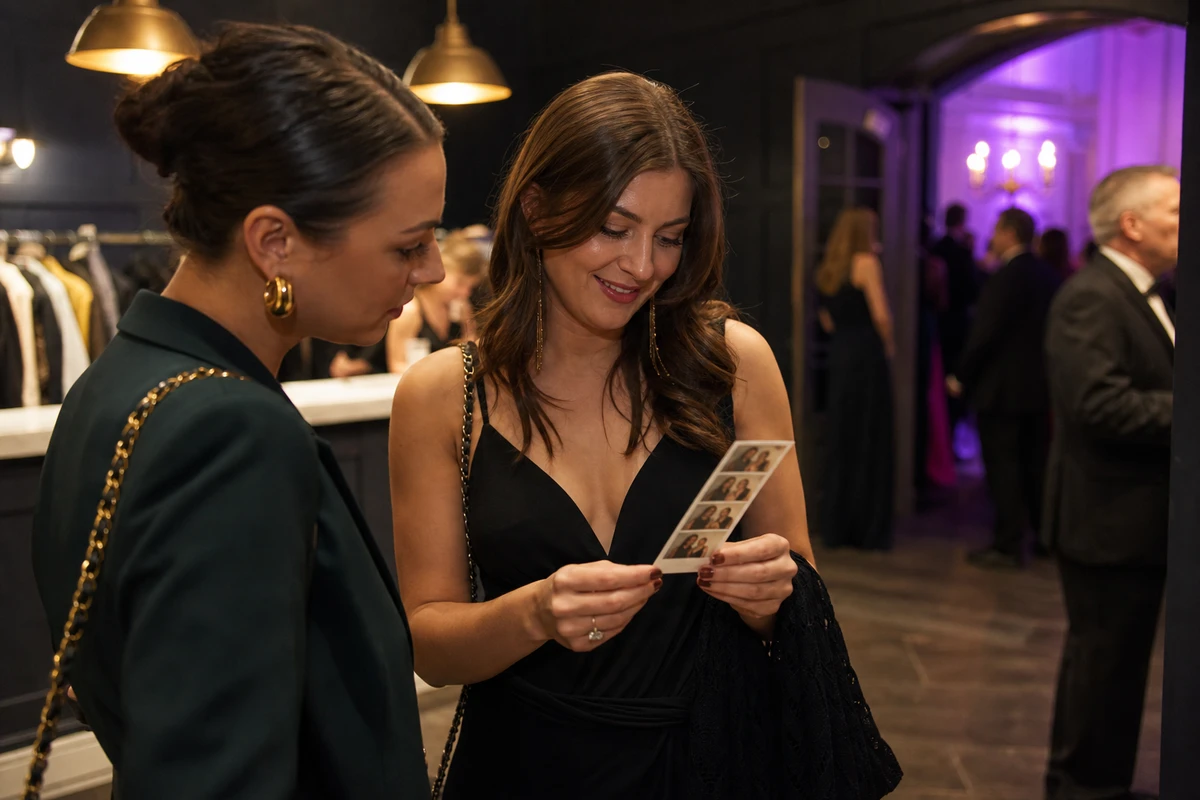
Here is the arithmetic competitors gesture at and never finish. Take a four-hour digital, iPad-based booth for a gala of 200 guests. National rental data compiled by Event Brothers Co., drawing on Thumbtack booking figures, puts an open-air or digital booth at $600 to $1,200 for three hours, with additional hours at $100 to $200 each. Call it $1,100 all-in for a four-hour booth with branded photo templates and a live gallery.
- Booth rental (4-hour digital booth): $1,100
- “Photo Lounge” sponsorship sold to a local business: $2,500
- Net to the cause before doors open: $1,400
The $2,500 is not an aggressive number; it is a modest mid-tier sponsorship at most galas. The booth is now a revenue line, not a cost line, and it has cleared the overhead test before the event begins. On top of the $1,400, the organization still gets the other four jobs from the previous section: dwell time, data capture, content, and reach. The sponsor gets a deliverable that travels. If 140 of the 200 guests use the booth and share their photos, the sponsor’s logo earns a count of impressions the non-profit can report back. A specific per-share reach number is not worth inventing, because reach varies too much by guest and platform. The vendor’s platform dashboard will show actual delivery and share counts, and those are the figures that belong in the sponsor’s recap.
Two honest caveats
Two honest caveats. The model needs a willing sponsor, and it needs a vendor whose outputs are fully brandable, not stamped with the rental company’s own watermark. If no sponsor materializes, the fallbacks are an in-kind donation request, where a vendor donates the service outright, or a budgeted line the development director can defend on the strength of the other four jobs. Treat an in-kind donation as a welcome surprise, not a plan, because it is too unreliable to build a budget around.
The small-revenue tactics other guides push deserve an honest look: charging guests per session, donate-to-vote photo contests, premium props unlocked by a donation. These raise modest sums and add friction at the booth, which works against the dwell-time and data-capture jobs. Sponsor underwriting is the cleaner play. It funds the booth without taxing the guest.
Match the Booth to the Event
A glam booth that looks right in a hotel ballroom is the wrong tool at the finish line of a 5K, and the reverse holds too. The format that fits depends on whether guests are seated or moving, indoors or outdoors, in formalwear or running shoes, and whether the event has sponsors to brand for. A non-profit calendar usually holds more than one event type, so the “best” booth is rarely a single answer.
| Event type | What the room is like | Format that fits |
|---|---|---|
| Black-tie gala or benefit dinner | Seated, formal, sponsor-rich | Branded digital or glam booth with a live gallery; sponsor logos and data capture matter most |
| Golf tournament | Players dispersed across a course, then a 19th-hole reception | QR-to-phone digital capture at registration and the reception; a fixed kiosk sits empty most of the day |
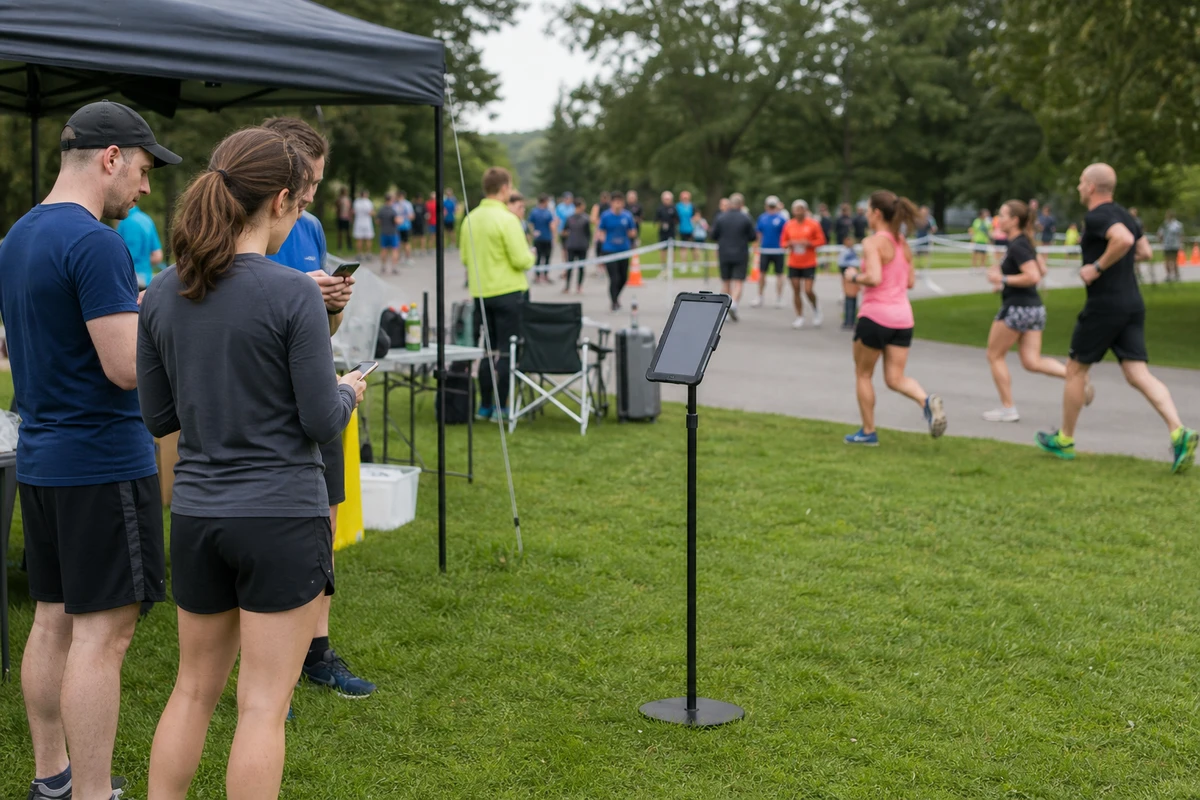
| Walk, run, or 5K | Outdoor, high volume, attendees in motion | Phone-based (QR) digital booth or a finish-line capture; enclosed booths underperform |
| Community festival or appreciation day | High foot traffic, low formality | Fast, lightly staffed digital booth; consent-light if there is no list-building goal |
| Donor cultivation dinner | Small, high-touch, major donors | A quiet branded portrait station; refresh contact data for stewardship |
| School or chapter auction night | Budget-sensitive, recurring | A low-cost digital booth; the recurring calendar is what tips toward owning |
The pattern under the table is movement and formality. A seated gala can support a stationary booth with a backdrop because guests come to it during the program gaps. A golf tournament and a 5K cannot; guests are spread across acres and on the move, so capture has to travel to the phone in their pocket through a QR code. A cultivation dinner for two dozen major donors is a different problem again. It is not a volume event, so the booth’s job is one good portrait per guest and a quiet, refreshed line of contact data for the stewardship file. Buying a gala-grade booth for a 5K spends money on a setup most attendees never reach.
Photo Booth Formats Compared
Ask three rental companies for a quote and the proposals will not line up. One sells an open-air digital booth, one a glam booth, one a 360 platform, and each describes its own format as the obvious choice. A buyer needs the category-level picture, separate from any single vendor’s pitch.
Non-Profit Booth Formats
| Format | What it is | Typical 2026 US price | Data capture | Non-profit fit |
|---|---|---|---|---|
| Digital / iPad-app booth | Tablet-based, instant sharing by text, email, or QR | ~$700–$1,400 for 4 hours; digital-only without prints runs lower | Strong, built-in | The workhorse for galas and most events |
| Glam / DSLR booth | Studio-quality retouched portraits, premium look, heavier setup | ~$1,200–$2,500 for 4 hours | Moderate | High-end galas where portrait quality is the point |
| 360 booth | Spinning video platform, high novelty | ~$1,000–$2,500 for 3 hours | Weak | An energy add-on, not a data tool |
| AI booth | Themed AI-generated portraits, very shareable | From ~$1,500 | Moderate | Stylized output can feel off at a formal donor event |
| Roaming capture | A photographer or staffer moving through the event | Varies by hourly rate | Weak, manual | Dispersed events such as golf and festivals |
These are vendor-published ranges, and an actual quote varies by market, vendor size, and package, so the working advice is to collect three quotes before booking. Major metros such as New York and Los Angeles run 20% to 30% higher across the board.
For a non-profit optimizing the five jobs from the first section, especially data capture and sponsor branding, the digital, iPad-based booth is the default. It carries branded photo templates, sends the image to the guest by text or email, captures contact data in the same step, and posts to a live gallery, all from a tablet that fits the modest footprint a venue gives to “entertainment.” Simple Booth’s HALO kit is one example in this category, an iPad-app booth whose lead-capture step Arizona Opera, a non-profit arts organization, used to add roughly 1,000 email addresses across a handful of events. Skipping printed photos lowers the price further. Event Brothers Co. notes that prints are a real cost for vendors, and a digital-only package often comes in well under the print-inclusive range.
A glam booth earns its higher price only when retouched, studio-quality portraits are the actual point, which a small number of high-end galas can justify. A 360 booth produces a striking spinning video and holds a crowd, but it captures little usable still imagery and weak contact data; it belongs in the energy column, not the asset column. An AI booth generates themed, highly shareable portraits, but the output is recognizably stylized rather than portrait-grade. Snapbar’s own guide concedes the point: an AI booth is not the right call when donors expect professional portrait quality. Roaming capture, a photographer or staffer working the crowd, is the practical answer for golf tournaments and festivals where guests never gather in one place, at the cost of self-serve branding and structured data capture.
Donor Data Capture and Consent: The Part Nobody Explains
At most fundraising events, asking a guest for a current email address is awkward. The development team works from a list that has gone a year stale, or sends a volunteer around with a clipboard. The booth solves this without the awkwardness, because the guest wants something in return: the photo. To receive it, the guest types in a current email address or phone number willingly. That is a clean exchange, and it is one of the few moments all night when contact data flows the right direction without anyone having to ask twice.
What makes that exchange worth engineering is the value of a good contact, and the cost of a bad one. M+R’s 2026 Benchmarks, drawn from 180 participating non-profits, put overall online one-time donor retention at 48%, and new-donor retention far lower, at 24%, meaning roughly three in four first-time donors do not give again the next year. A contact captured at a booth is usually a new or lapsed donor, which is exactly the fragile category. Whether it converts to a retained donor or goes nowhere is decided by how it gets captured and routed.

Done right has three parts
Done right has three parts. First, consent is explicit and specific at the point of capture: separate checkboxes to receive the photo, to receive marketing communications, and to allow public display of the image, not one bundled blanket tick. Snapbar’s published guest flow describes exactly this, a consent review with distinct ticks before the photo is taken, and it is a fair description of what proper consent design looks like. Second, every capture is source-tagged in the donor CRM so the development team can see the contacts came from the booth at a specific event. Third, the data fields are set per event: giving level, alumni status, employer-match eligibility, zip code, whatever the next appeal will segment on.
Done wrong is harvesting addresses with no clear consent and dropping them straight into the main appeal list. M+R’s email data shows non-profit email lists already lose about 16% of subscribers a year, 4% to bounces and 12% to unsubscribes, while online fundraising email is worth roughly $2.40 per subscriber annually. A batch of unconsented, half-typed addresses pushes the churn higher, drags down sender reputation, and quietly costs the organization the engaged subscribers it already had.
The compliance picture deserves a clear word. The U.S. CAN-SPAM Act, as the FTC’s compliance guide explains, turns on a message’s primary purpose. A pure photo-delivery email is transactional, since the guest asked for it. The moment that email carries a fundraising appeal or an event promotion, it becomes a commercial message and needs a working opt-out and a postal address. For events with EU or UK guests, GDPR and PECR require granular, opt-in consent before captured data is used for marketing, and the development team should run international events past counsel rather than guess. Handled this way, a booth capture list is mostly refreshed data on existing donors plus a slice of net-new prospects, the guests brought by other guests. Both are valuable when tagged and routed. Both are close to worthless dumped into a spreadsheet nobody segments.
Rent, Get It Underwritten, or Buy?
A non-profit that runs one gala a year and rents a booth for it owns nothing afterward, and that is the correct outcome. A booth bought for several thousand dollars and used once sits in a closet for 364 days, and on the expense ratio that whole purchase lands inside a single event’s budget. For an organization with one to three events a year, renting, ideally sponsor-underwritten as described above, is almost always right.
The exception is the organization with a crowded, recurring calendar: a gala, plus a golf tournament, plus a spring walk, plus quarterly chapter events, or a national body whose chapters each run their own. Repeated rentals add up. At some number of events per year, the per-event cost of owning or financing an iPad-based booth drops below the cost of renting each time, and the booth becomes a reusable asset that also serves volunteer appreciation, donor visits, and program photography between events.
The decision rule is straightforward, even if the exact threshold depends on local rental prices. Count the bookable events on next year’s calendar, multiply by a realistic rental quote, and compare that to the all-in cost of owning, which is hardware, the app subscription, staffing, and storage. Five rentals at the $1,100 figure from earlier come to $5,500 of recurring spend a year, every year, which is where the math stops being obvious. Below roughly four to six events a year, renting almost always wins. Above it, a purchase deserves a real model rather than a reflex.
What to Measure and Report After the Event
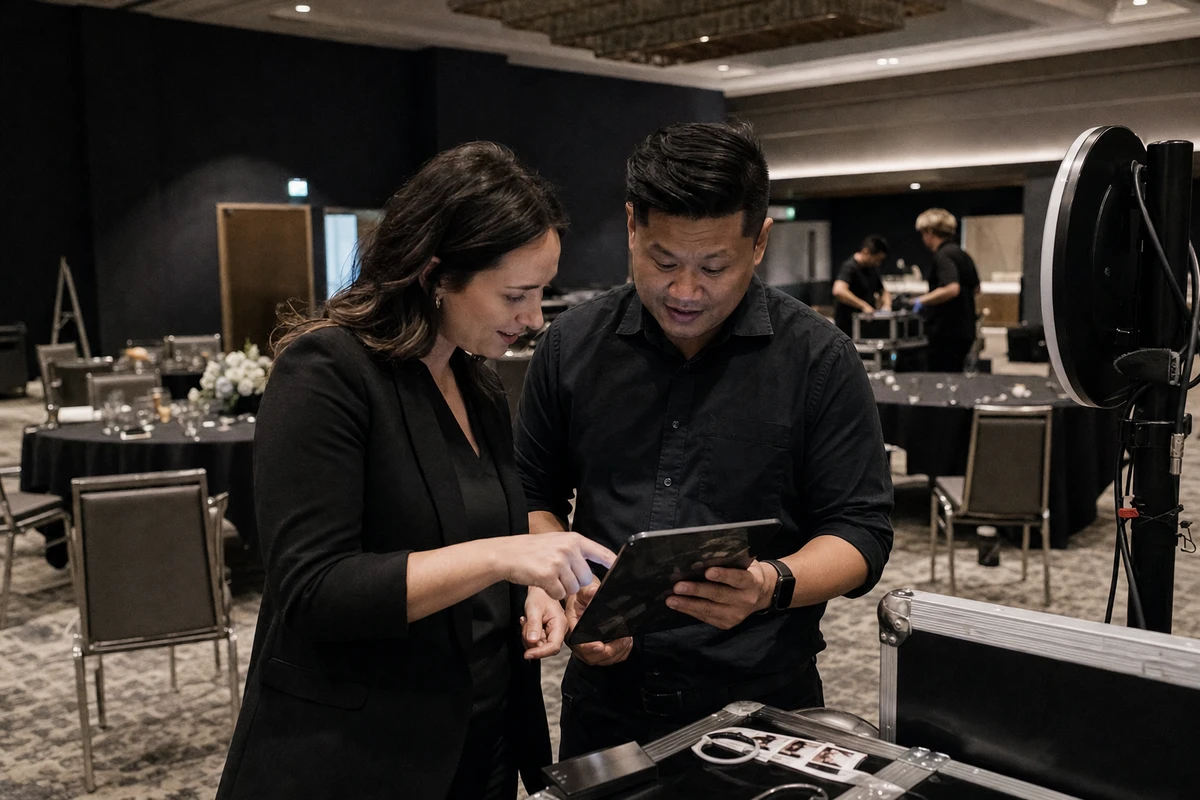
The Monday after the gala, the booth is back in the rental company’s van, and the question from the board meeting still stands: what did it bring back? A booth that produced no report is indistinguishable from a booth that produced no value. Three short reports make it defensible at the next budget cycle, and each goes to a different audience.
The board report is the net line
The board report is the net line. Booth cost against sponsorship raised, the $1,100 against the $2,500 from the earlier scenario, the number of guests who used it, the count of contacts captured, and the size of the content library it produced. One line, and it shows the booth paid for itself.
The sponsor report is impression counts: photos delivered, live-gallery views, and social shares carrying the sponsor’s logo, pulled from the vendor’s dashboard. A sponsor who receives a concrete recap with real numbers is a sponsor who renews, which turns a one-time sale into a recurring revenue line.
The development handoff is the contact data: every capture tagged by event and source, segmented, and scheduled into the next appeal while the event is still fresh. With new-donor retention at 24%, the follow-up window is narrow, and a list that sits untouched for two months has already lost most of its value. The content library is the quieter asset. The gallery feeds the annual report, the year-end appeal, social posts, and the promotion for next year’s event, including the plain fact that photos of a packed, lively room make next year’s tickets easier to sell.
The Non-Profit Photo Booth Buyer’s Checklist
Before signing with any vendor or platform, a development director can settle the decision with eight questions. A vendor that cannot answer the branding, consent, and data questions is selling entertainment, not the asset this guide has described.
- Are all outputs (digital photos, any prints, the delivery email or text) fully brandable with both the organization’s logo and a sponsor’s logo?
- Does the booth capture guest contact data, with a clear, configurable, opt-in consent step?
- Can captured data export cleanly into the organization’s donor CRM, with event and source tagging?
- Does capture and delivery still work if the venue wifi fails, meaning a real offline mode?
- Is there a live gallery or slideshow display for the room and for sponsor visibility?
- What is the all-in price, and is there verified 501(c)(3) or non-profit pricing? Captured Celebrations and other vendors confirm non-profit rates are commonly available on request.
- Does the format fit the event type, per the matching table above?
- What is the lead time from booking to event day?
Frequently Asked Questions
How much does a photo booth cost for a non-profit event?
For a four-hour event in 2026, expect roughly $700 to $1,400 for a digital, iPad-based booth, and $1,200 to $2,500 for a glam or DSLR booth, based on national rental data. Major metros run 20% to 30% higher, and digital-only packages without prints sit at the low end. Ask every vendor whether they offer verified 501(c)(3) pricing, because many do.
Can a photo booth actually make money for a non-profit, or is it just an expense?
It depends entirely on how you structure it. Rented and paid for out of the event budget, a booth is a straight expense. Sold to a sponsor as a branded “Photo Lounge” for more than the rental costs, it becomes a net-positive line: the sponsorship covers the rental and adds a margin to the cause before the event even opens.
Do photo booths really increase donations?
Not directly, and the widely repeated “20% to 30% donation lift” claim has no traceable source. A booth does not change what a guest pledges during the live ask. Its real return is sponsor underwriting margin, current donor contact data, sponsor impressions, and a library of stewardship content. Expect those, not a bump in same-night giving.
What kind of photo booth is best for a charity gala versus a 5K or a golf tournament?
A seated gala suits a stationary branded digital or glam booth with a live gallery. A 5K and a golf tournament spread guests across a wide outdoor space, so a QR-to-phone digital capture, placed at registration or the finish line, works far better than a fixed kiosk most guests never reach. Match the format to how much guests move.
Should a non-profit rent or buy a photo booth?
For one to three events a year, rent, ideally with a sponsor underwriting the cost. Owned hardware that sits idle most of the year fails the overhead test boards watch. Only an organization with a crowded recurring calendar, roughly four to six events or more, should model a purchase, where the per-event cost of owning can drop below repeated rentals.
How do non-profits get a photo booth sponsored or donated?
Sell it as a sponsorship. Package the booth as a “Photo Lounge” and offer a local business or board-member company logo placement on every photo, the delivery message, and the live gallery, priced at the rental cost plus a donation margin. A separate path is an in-kind ask, where a vendor donates the service, but treat that as a bonus rather than a plan.
Can we add the emails captured at the booth to our donor mailing list?
Only with explicit, specific consent collected at the booth, meaning a checkbox for marketing communications that is separate from the one to receive the photo. Adding unconsented addresses to an appeal list hurts deliverability and can trigger CAN-SPAM obligations. Tag every contact by event and source in your CRM so the development team knows where it came from. Sources
- M+R (2026). “Fundraising — M+R Benchmarks 2026.” https://mrbenchmarks.com/fundraising/
- M+R (2026). “Email Messaging — M+R Benchmarks 2026.” https://mrbenchmarks.com/email-messaging/
- BBB Wise Giving Alliance (2025). “BBB Standards for Charity Accountability.” https://give.org/bbb-standards-for-charity-accountability
- Charity Navigator (2026). “About Us: Our Methodology — Ratings.” https://www.charitynavigator.org/about-us/our-methodology/
- Giving USA / Blackbaud Institute (2026). “What the Early Trends in 2025 Giving Tell Us.” https://givingusa.org/what-the-early-trends-in-2025-giving-tell-us-and-what-nonprofit-leaders-can-do-next/
- Bloomerang (2026). “Nonprofit Gala Events Worth Everyone’s Money – Part 1.” https://bloomerang.com/blog/nonprofit-gala-events-worth-everyones-money-part-1/
- U.S. Federal Trade Commission. “CAN-SPAM Act: A Compliance Guide for Business.” https://www.ftc.gov/business-guidance/resources/can-spam-act-compliance-guide-business
- Event Brothers Co. (2026). “Photo Booth Rental Cost in 2026: Real Prices by Type.” https://eventbrothersco.com/photo-booth-rental-cost/
- Captured Celebrations (2026). “Photo Booth Experiences for Nonprofit Galas & Fundraising Events.” https://www.capturedcelebrations.com/photo-booth-for-nonprofits-galas
- Snapbar (2026). “Photo Booth Activations for Non-Profit Events: A Practical Guide.” https://snapbar.com/blog/10-ways-photo-booths-can-boost-your-non-profit-event
- Ohh Snap Booth. “Strategic Photo Booth Partnerships for Non-Profit Events.” https://ohhsnapbooth.com/ohh-snap-blog/beyond-the-ask-how-to-approach-in-kind-donations-sponsorships-strategic-photo-booth-partnerships-for-non-profit-events