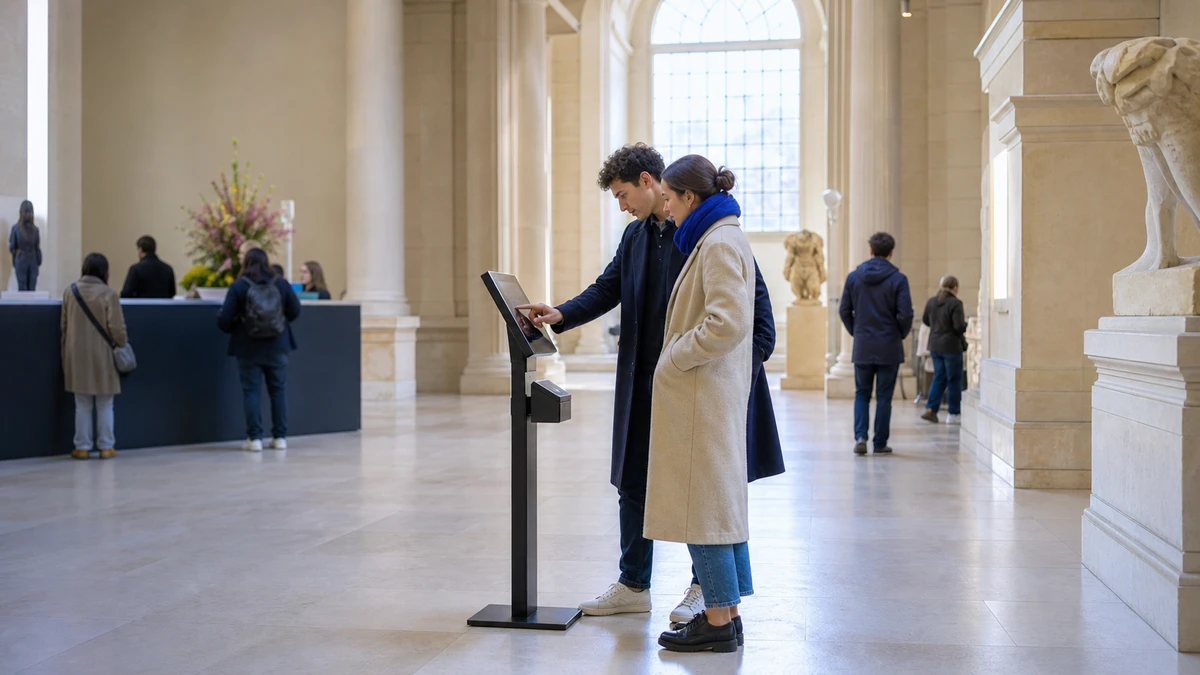
On a busy Saturday, a family reaches the admissions desk of a mid-size museum. The staffer scans their tickets and, with a line forming behind them, asks whether they would like to become members today. The parents trade a look, say “maybe next time,” and head for the galleries. That exchange happens a few hundred times a week, and it almost always ends the same way.
A self-service membership kiosk converts more of those visitors than the front desk does, for a reason worth stating plainly: it removes the discomfort of being sold to by a person. The conversion is worth chasing because a member is worth far more than a one-time guest.
Across 18 paid-admission cultural organizations tracked over a decade, IMPACTS Experience found the average member worth roughly four times the average visitor in a single year (Dilenschneider, 2019). That gap matters more now that crowds are thinner: the American Alliance of Museums reported in 2025 that 55% of U.S. museums still have not returned to pre-pandemic attendance (Wilkening, AAM, 2025).
Why a Screen Out-Converts a Staffed Membership Pitch
The front desk is the obvious place to sell membership, and the wrong one. It fails for three reasons, and a kiosk fixes all three.
The pitch depends on whoever is working that shift
Conor Hepp, writing for museum operators, treats onsite membership as a staffing problem from start to finish (Hepp, LinkedIn, 2018): hire passionate people, talk about sales targets several times a day, post a visible sales board, pay per-membership incentives, and train each staffer on “where to put the upsell push.” Every one of those prescriptions is a patch for the same flaw. A staffed pitch converts at the rate of the person delivering it, and that person’s training, mood, and competitive streak change from one shift to the next.
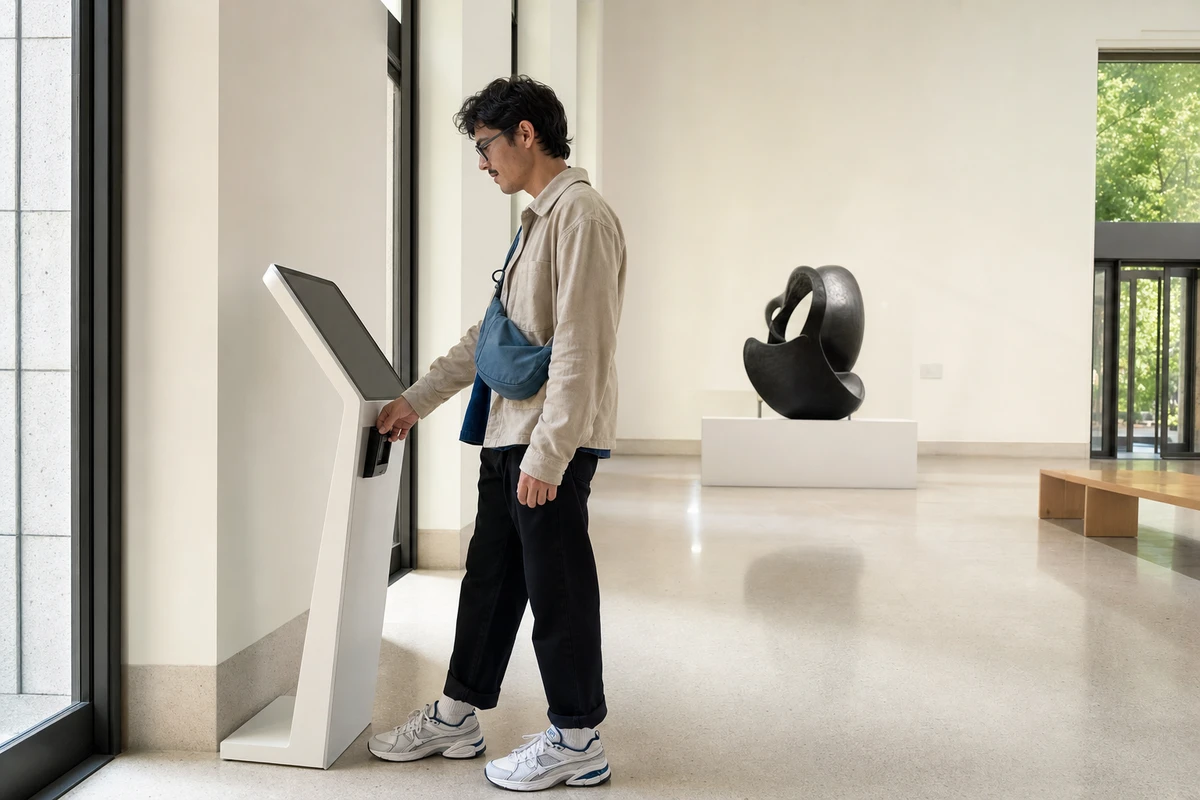
AAM’s annual survey of museum-goers also measures how visitors experience staff at all: only about a third say staff “always make me feel welcome,” and most do not register the interaction as either warm or cold. If a museum’s front-line staff land as merely neutral with most visitors, a membership pitch riding on those same interactions starts from a weak position. A museum running this play is not operating a membership channel. It is supervising one, daily.
A counter has no graceful exit, so visitors take the easy one
Picture the same family at the desk with a line behind them. A membership pitch from a person is a small social transaction, and the visitor’s fastest way out of it is “not today.” They are not weighing the offer. They are ending an interaction politely. A screen changes that math. With no salesperson to disappoint, the visitor evaluates the membership instead of managing a conversation.
The pattern is well documented outside museums. In fast-casual restaurants and retail, self-service ordering consistently lifts the average transaction value, and operators attribute much of the lift to the absence of social pressure when a customer considers an upgrade. A membership decision at a staffed counter has the same social texture.
The front desk catches visitors at their least interested moment
Even a flawless pitch at admissions is mistimed. A visitor arriving at the desk has one goal, which is to get inside. They have not seen the exhibit yet, felt the room, or watched their child stop in front of something. Asking them to commit to a year of return visits before they have had today’s visit is asking for a decision they have no information to make.
Two Moments to Make the Membership Offer
A membership offer lands or dies on timing, and a visit has exactly two moments worth building a kiosk around: the ticket purchase on the way in, and the walk out.
The entry kiosk: turn today’s admission into a credit
The strongest offer at the point of ticket purchase is not “buy a membership.” It is “apply what is being paid right now toward one.” Penn Museum runs a version of this: for up to one month after a visit, a guest can apply the cost of their tickets to a membership (Penn Museum, 2026). The catch is that Penn’s redemption is phone-only, on weekdays, 9 to 5. A visitor who felt the impulse on a Saturday has to remember to call on Monday, and deferred action is mostly lost action.

A kiosk presents that same credit at the moment of purchase, automatically, to every visitor. It reframes a sunk admission cost as a down payment, and it answers the most common objection with arithmetic the visitor can see. The top reason lapsed members and non-members give for not joining, according to AAM’s 2025 survey of museum-goers, is “we do not visit enough to make it worthwhile.” Fewer than 5% say membership simply is not worth it; the barrier is a visitor’s read on their own habits, not a verdict on the offer (Wilkening, AAM, 2025). A membership that pays for itself in two visits, with today’s ticket already counted as visit one, meets that objection head-on.
The exit kiosk: ask at the emotional peak
The second moment is the way out. A visitor leaving has just had the experience and is more invested in the place than at any earlier point in the day. AAM’s data sharpens why that matters: among parents, the curious ones are considerably more likely to cite the museum’s mission as a reason to join than the incurious ones (Wilkening, AAM, 2025). A gallery that genuinely catches a visitor’s attention may be doing the same work, nudging a transactional visitor toward the mission-motivated mindset most members share. An exit kiosk reaches that visitor while the impression is still fresh.
An exit kiosk earns its ask best when it gives the visitor something first. A take-home photo of the day, a digital souvenir, or a small memento of the visit creates a moment of reciprocity, so the membership question reads as a continuation of a good experience rather than an interruption of the way out.
Why both kiosks earn their place
The two placements catch different people. The entry kiosk converts the price-rational visitor, the one who responds to break-even math. The exit kiosk converts the visitor whose curiosity the galleries just lit. AAM’s motivations data shows both motives are real: over 80% of members cite the museum’s mission as why they join or renew, while fewer than half point to transactional benefits like free admission or discounts (Wilkening, AAM, 2025). One kiosk speaks to the math, the other to the mission. A museum that runs only one addresses just one of those motives.
What the Join Screen Should Actually Say
A kiosk is only as good as the screen a visitor actually reads. Most membership signage fails the same way: it leads with a price and a grid of tiers, which turns a quick decision into homework.
Lead with the break-even line, not the price
The first thing on the screen should be the math, not the cost. “Members get in free, so a family membership pays for itself in two visits” is a sentence a visitor can check against their own plans in a few seconds. A price shown first is just a number to flinch at. A price shown after the break-even framing is the answer to a question the visitor is already asking.
Speak to the deal and the mission on one screen
The screen has to address two different visitors at once. The transactional visitor needs the arithmetic. The curious visitor needs one honest line about what the museum is for and why a membership supports it. AAM’s data makes the split concrete: parents and guardians of minor children are about twice as likely as adults over 60 to join for free admission, while older adults lean toward the mission (Wilkening, AAM, 2025). The screen cannot pick one audience. It needs the break-even line and a single mission sentence, both visible without scrolling.
Name three benefits plainly and keep the form short
Some non-members, in the same AAM survey, simply do not know anything about membership. That is an awareness gap, not a value judgment, and it has a simple fix: state the top three benefits in plain words (free admission, member previews, guest passes) rather than in the museum’s internal program language. Show two or three tiers, not eight, with one tier visually set as the default.
Then keep the actual sign-up to what a payment needs: name, email, card. Everything optional, such as mailing preferences, interests, and household members, belongs in the follow-up email, not between the visitor and the join button.
The Follow-Up Play: Capturing Visitors Who Don’t Join Today
Most visitors will not join on the spot, however good the kiosk is. A kiosk that only sells membership treats every one of them as a loss. The fix is to give the kiosk two jobs.
Two jobs: sell a membership or capture an email
When a visitor is ready, the kiosk sells the membership. When they are not, it asks for one thing instead: an email address. That second outcome is not a consolation prize. It converts an anonymous admission into a contact the museum can reach again, which is the difference between a visitor the museum will never identify and a prospect it can follow up with.
Make the email an exchange, not a request
People hand over a contact when they get something for it. A blank “join our mailing list” field gets ignored. An email given in exchange for a take-home photo of the day, a digital souvenir, or a “first to know” list for upcoming exhibits gets filled in. This is zero-party data, information a visitor knowingly and willingly provides, and it is more reliable than anything scraped or guessed, because the visitor chose to give it.
The take-home photo is its own small piece of hardware. A dedicated photo station such as Simple Booth’s HALO kit handles it directly: it captures the picture, sends it to the visitor by email or text, and records the email address with an opt-in checkbox in the same step. Arizona Opera, a nonprofit arts organization, grew its email list by roughly 1,000 addresses across a few events using that kind of capture.

Let the post-visit sequence do the converting
The captured email feeds a sequence of post-visit emails, which is where deferred conversions actually land. A visitor who declined at the kiosk has not declined forever. They have declined today. A first-time visitor who gets a relevant follow-up email is reachable at the moment a return trip is being weighed, rather than when they were trying to get out the door. The kiosk’s real output, then, is not memberships alone. It is a marketable relationship with every visitor who used it, whether or not a membership sold that day.
Running a Membership Kiosk Nobody Has to Staff
A membership kiosk is simple hardware. What decides whether it earns anything is everything around the device: where it sits, whether it connects to the museum’s systems, and whether anyone notices when it stops working.
Placement: in the path, not in a corner
A museum membership kiosk converts at the rate of the traffic that passes it. The exit unit belongs in the natural outflow, near the gift shop or coat check, where every departing visitor walks anyway, not against a side wall a considerate visitor has to choose to approach. The entry unit belongs at or beside admissions, close enough to the ticket transaction that the upgrade offer reads as part of buying a ticket.
Hardware, payment, and the data handoff
The hardware is modest. A tablet on a stand with a card reader handles self-service membership sign-up, and this is not a capital project on the scale of an interactive exhibit build. It should not be budgeted like one.
The harder requirement is the data handoff. A new membership and every captured email have to land in the system the museum already runs, whether that is Blackbaud Altru, Tessitura, or ACME Ticketing. A kiosk that collects sign-ups into a list nobody reconciles creates work instead of removing it. Operators should confirm how a given kiosk writes into their specific platform before buying, rather than assuming the integration exists.
Keeping it running when nobody is watching
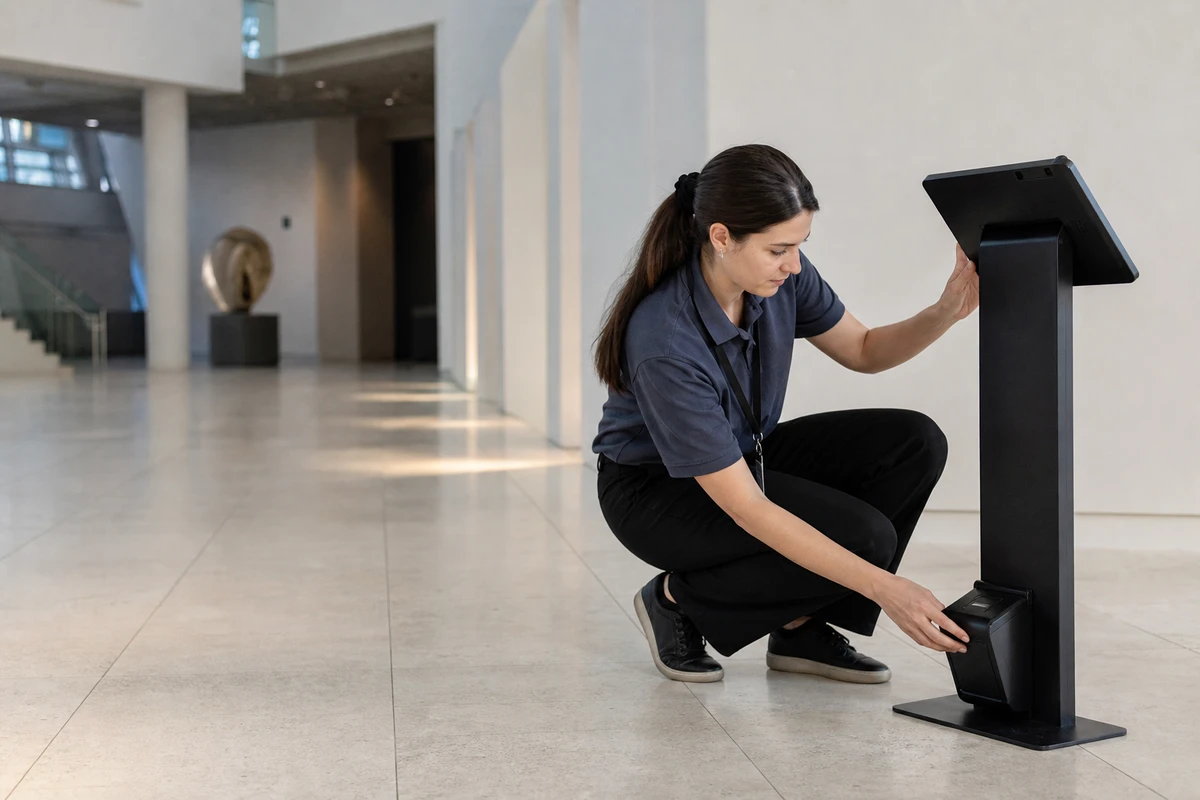
A kiosk only converts while it is actually working, and an unstaffed device fails quietly. Three safeguards keep it honest. Single-app or kiosk-mode lockdown stops a visitor, or a bored child, from exiting the join flow into the tablet’s home screen. Physical mounting and a secured enclosure handle theft. A brief daily uptime check catches the frozen screen that would otherwise convert nobody for a week. None of this is difficult, and all of it is the difference between a kiosk that earns and a prop.
What Kiosk-Driven Membership Is Worth, and How to Measure It
Membership is not a marginal program for U.S. museums; it generates over $350 million a year (Charr, MuseumNext, 2024). Yet the channel still runs on old rails. A 2024 MuseumNext survey of 242 museum professionals found fewer than half, 48.4%, count membership as an online revenue stream at all (Richardson, MuseumNext, 2024), and on-site, signing a visitor up still means a staff member asking at the desk. The question for any single museum is what a museum membership kiosk adds, and the arithmetic is straightforward enough to run before buying one.
A worked example
Take a museum with 120,000 annual visitors whose front desk converts 2% of them to memberships, which is 2,400 new members a year. (The 2% is an assumption, not a published benchmark. No reliable public figure for visitor-to-member conversion exists, a gap discussed below.) If a kiosk lifts conversion by half a percentage point, to 2.5%, that is 600 additional memberships a year.
What are 600 members worth? At the 2019 IMPACTS membership-fee average of $92.71, that is about $55,600 in first-year membership fees. Counting the food, retail, and added gifts members also spend, IMPACTS put the total annual value of a member at $135.25, which brings the 600 to roughly $81,000 a year. Over a full member lifecycle, IMPACTS measured an average ten-year member value near $727 (Dilenschneider, 2019), so 600 members represent about $436,000 in long-run revenue. Those figures come from a pre-pandemic sample and should be treated as illustrative, but the shape holds: a fraction of a percentage point, applied to a museum’s full visitor count, is a large number.

Everything a kiosk does is countable
The front desk cannot tell a manager its conversion rate. A kiosk can tell them all of it. Joins per 100 visitors, kiosk sign-ups against front-desk sign-ups, emails captured against memberships sold, which tier visitors pick, and which screen wording wins a head-to-head test are numbers the device produces on its own. A museum can run two versions of the break-even line for a month and keep the one that converts better. That kind of iteration is impossible with a human pitch, because the pitch is never the same twice.
Measure against the front desk, not an industry average
Operators reasonably want a benchmark. There is not a reliable public one. On AAM’s Museum Junction forum, a chief digital officer asked whether anyone had quantitative membership benchmarks by museum type, region, and visitor count, and the thread produced no agreed standard. The practical move is to stop waiting for an industry number and use the museum’s own front desk as the baseline. Run the kiosk beside it, compare joins per 100 visitors, and improve the screen from there. A kiosk’s most useful feature is not that it converts better than a person. It is that, unlike a person, it tells the museum exactly how well it is doing.
Sources
- American Alliance of Museums (2025). “Membership Motivations and Barriers: An Annual Survey of Museum-Goers Data Story.” https://www.aam-us.org/2025/08/15/membership-motivations-and-barriers-an-annual-survey-of-museum-goers-data-story/
- American Alliance of Museums (2025). “Visitation Recovery Trends from the Pandemic: A 2025 Annual Survey of Museum-Goers Data Story.” https://www.aam-us.org/2025/10/03/visitation-recovery-trends-from-the-pandemic-a-2025-annual-survey-of-museum-goers-data-story/
- IMPACTS Experience / Colleen Dilenschneider (2019). “Crunching The Numbers – Just How Valuable Are Your Members? (DATA).” https://www.colleendilen.com/2019/04/09/crunching-the-numbers-just-how-valuable-are-your-members-data/
- MuseumNext / Manuel Charr (2024). “Museum Membership Schemes: Strategies for Building Engagement and Revenue.” https://www.museumnext.com/article/museum-membership-schemes-strategies-for-building-engagement-and-revenue/
- MuseumNext / Jim Richardson (2024). “How Museums Are Boosting Online Revenue in 2024.” https://www.museumnext.com/article/how-museums-are-boosting-online-revenue-in-2024/
- LinkedIn / Conor Hepp (2018). “5 Ways to Increase Onsite Museum Membership Sales.” https://www.linkedin.com/pulse/increasing-museum-membership-sales-conor-c-hepp
- Penn Museum (2026). “Become a Member.” https://www.penn.museum/join-give/membership