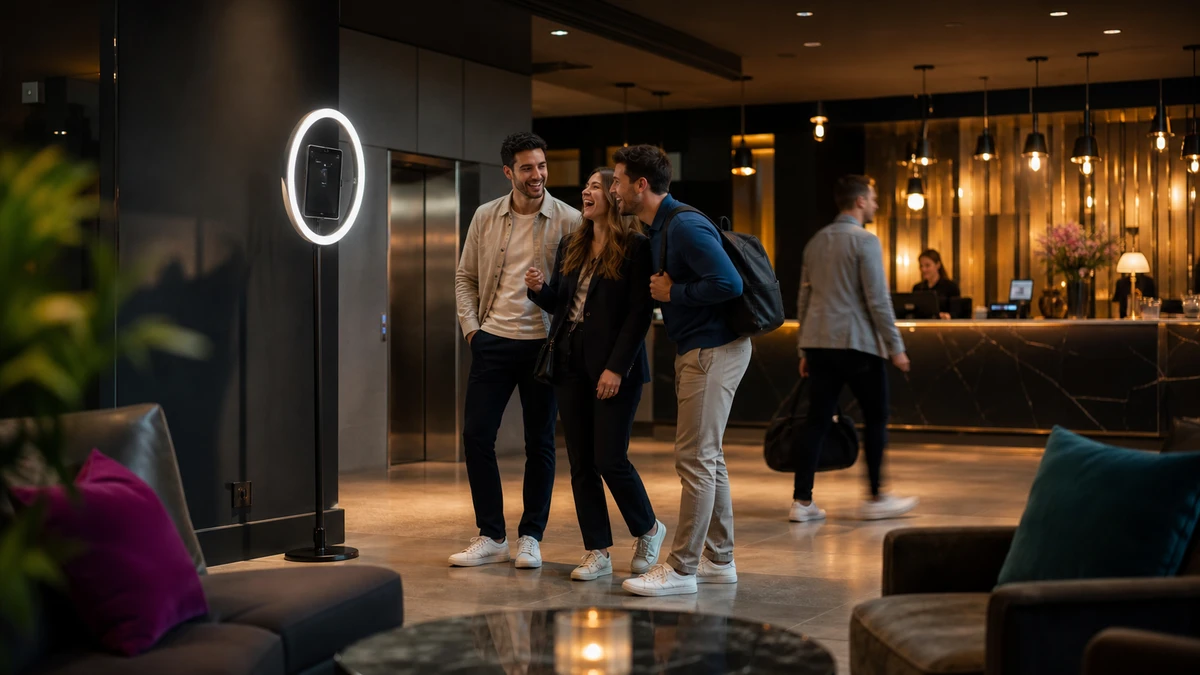
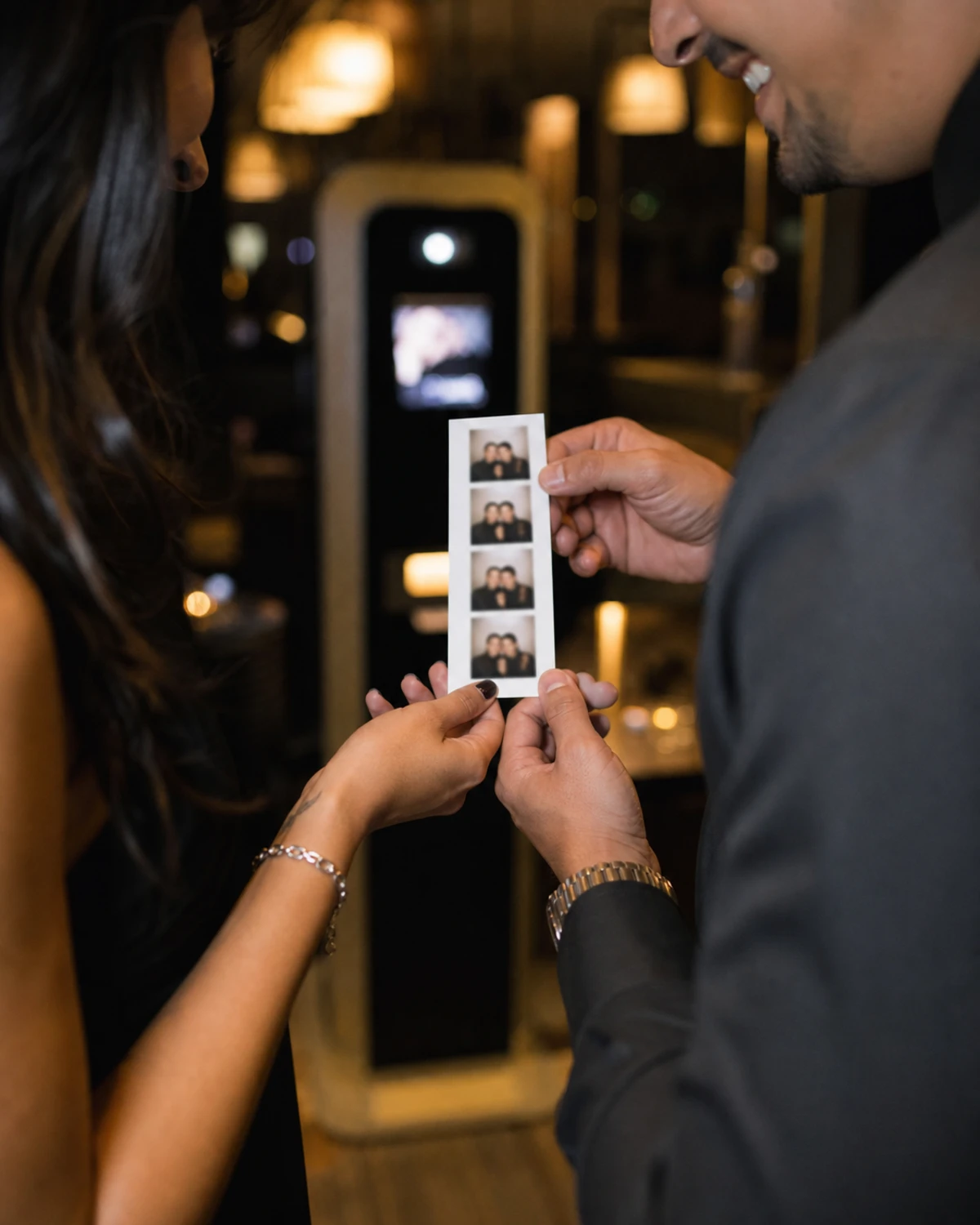
A photo booth sits near the elevators of a select-service hotel, a few steps from the front desk. On a busy Friday it runs all evening: a conference group on a night out, two friends at a reunion, a family waiting for a table at the restaurant. Each session ends with a printed photo and, often, a guest typing an email address to get the digital copy. The general manager who approved that booth had to do something the vendor’s brochure never mentioned. They had to put a number in next year’s budget and defend it.
That number is the subject here. A permanent photo booth is a procurement decision, not an event rental, and the all-in cost depends entirely on which of four acquisition routes a property picks. The spread is wide: from roughly $0 upfront on a revenue-share placement to anywhere from $8,000 to more than $30,000 to own a booth outright, plus the recurring costs every route carries. This is the line-item budget and the business case behind hotel photo booth procurement, for the general manager, owner, or director of operations who has to make that brochure number a defensible line in the capital plan.
How a Permanent Booth Lands in the Capital Plan
A general manager looking into a lobby booth usually starts with a search engine, and the first prices that come back read like a bargain: $550 to $1,100 for a three-hour booth. Those numbers describe a consumer event rental, wheeled in for one evening and out the next morning. They are the wrong mental model for a fixture that lives in the lobby for years. A buyer who anchors on them either dismisses the idea as trivial or budgets nowhere near what a permanent installation requires.
A permanent booth behaves like furniture, fixtures, and equipment
A permanent booth behaves like furniture, fixtures, and equipment (FF&E), the same category as the lobby televisions and the meeting-room audio-visual gear. The Stroud Group, a hospitality FF&E procurement firm, lists exactly those items as FF&E, including “computers, printers, projectors, audio-visual components, televisions, virtual concierges” (Stroud Group, 2024). A booth kiosk is not bolted into the building structure, so it is personal property and sits in the same bucket.
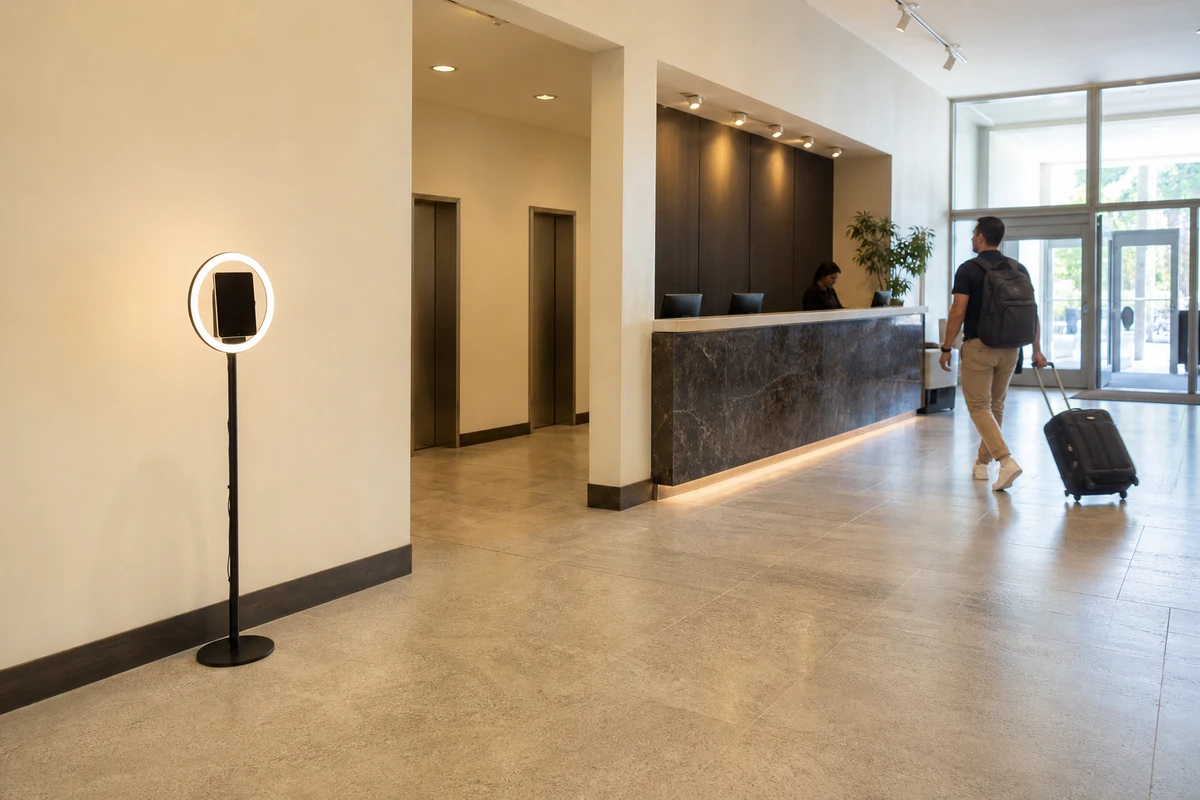
That classification carries a consequence. Once a purchase is large enough, the hotel records it as capital expenditure (CapEx) rather than an operating expense (OpEx). The hotel-finance firm Finoko explains the test: spending that maintains current condition is usually OpEx, while spending that improves or extends an asset’s life is usually CapEx, and the cutoff “depends on your capitalization policy, thresholds, and component rules” (Finoko, 2025). There is no industry-wide dollar figure; independent hotels commonly draw the line somewhere between $2,500 and $5,000. A booth bought outright clears almost any version of that threshold and lands in the capital plan. A booth rented month to month does not.
That decides who signs off. Finoko describes the standard gate as an Authorization for Expenditure process, with larger projects going to an investment committee and smaller ones falling inside a GM’s authority. ServiceChannel adds that hotel capital requests are defended by VPs of operations and finance before owner groups and asset managers, and each one must show how it protects operations, prevents lost revenue, or reduces future spend (ServiceChannel, 2026). A purchase needs an owner’s blessing and a business case. A monthly-fee route can often be approved by the GM, or by the department head whose budget absorbs it.
The Four Acquisition Routes and What Each Does to the Budget
A hotel researching photo booths runs into a fragmented market. One vendor sells booths outright, another offers a fixed monthly rental, a third pitches a placement deal with nothing to pay at all. Each page presents its own model as the obvious choice. There are four routes, and the real difference between them is not the booth. It is what each does to the budget.
Buy outright
The hotel purchases and owns the booth: one large number in Year 0, full control of its branding and the guest data it captures, and every recurring cost on the hotel’s books. A commercially installed, brand-grade booth runs roughly $8,000 to $30,000 or more depending on form factor. This route suits full-service and luxury properties that already run an events business.
Finance or lease-to-own
The same purchase, spread into monthly payments, with ownership transferring at term end. It keeps the asset without the full upfront hit, which suits properties that want to own the booth but cannot commit the capital in a single year.
Long-term rental
The hotel pays a fixed monthly fee and the vendor owns and maintains the booth: a pure operating expense, no asset, no capital approval. Reakt Photobooths markets this model to hotels with the line that “two bookings per month typically cover rental costs” (Reakt Photobooths, 2026). It suits select-service properties testing whether the amenity earns its keep.
Revenue-share placement
The hotel pays nothing upfront; the vendor installs, owns, and maintains the booth, and the hotel takes a percentage of per-session revenue. A&A Studios, which places booths in US bars and hotels, pays venues “based on a percentage of booth revenue” while handling installation, maintenance, permits, and taxes (A&A Studios, 2026). It suits independents and boutiques unwilling to tie up capital.
| Route | Upfront cost | Budget type | Who owns it | Who maintains it | Best-fit property |
|---|---|---|---|---|---|
| Buy outright | ~$8,000–$30,000+ | CapEx | Hotel | Hotel | Full-service / luxury with events business |
| Finance / lease-to-own | Low; monthly payments | CapEx (asset at term end) | Hotel at term end | Hotel | Wants the asset, not the upfront hit |
| Long-term rental | None; fixed monthly fee | OpEx | Vendor | Vendor | Select-service testing the amenity |
| Revenue-share placement | None | OpEx | Vendor | Vendor | Independents and boutiques avoiding capital |
The placement route deserves a second look. “Zero upfront cost” is the most repeated phrase on vendor pages, and hotels hear it as “free amenity.” It is not free. The hotel gives up three things for the $0: the larger share of the revenue the booth earns, control of its branding and the guest content it captures, and the asset itself, which stays the vendor’s property when the contract ends. Placement fits a property that genuinely does not want to own or manage a booth. It is the wrong call for one that wants the booth as a data-capture instrument, because the data is exactly what gets signed away.
Total Cost of Ownership: The Line Items Nobody Quotes
A vendor quote names one number: the hardware. That number is the smallest part of what the booth costs over its life in the lobby, and the lines that follow never appear on the quote.
Software comes first
Software comes first. A commercial booth runs on an app, and that app is a subscription. Snappic, one commercial photo-booth platform, publishes plans from $69 a month at its entry tier to $189 a month at its professional tier, with roughly 20% off for annual billing (Snappic, 2026). A year-round hotel booth needs a monthly or annual plan, not a per-event license, so this is a fixed line of about $800 to $2,300 a year.
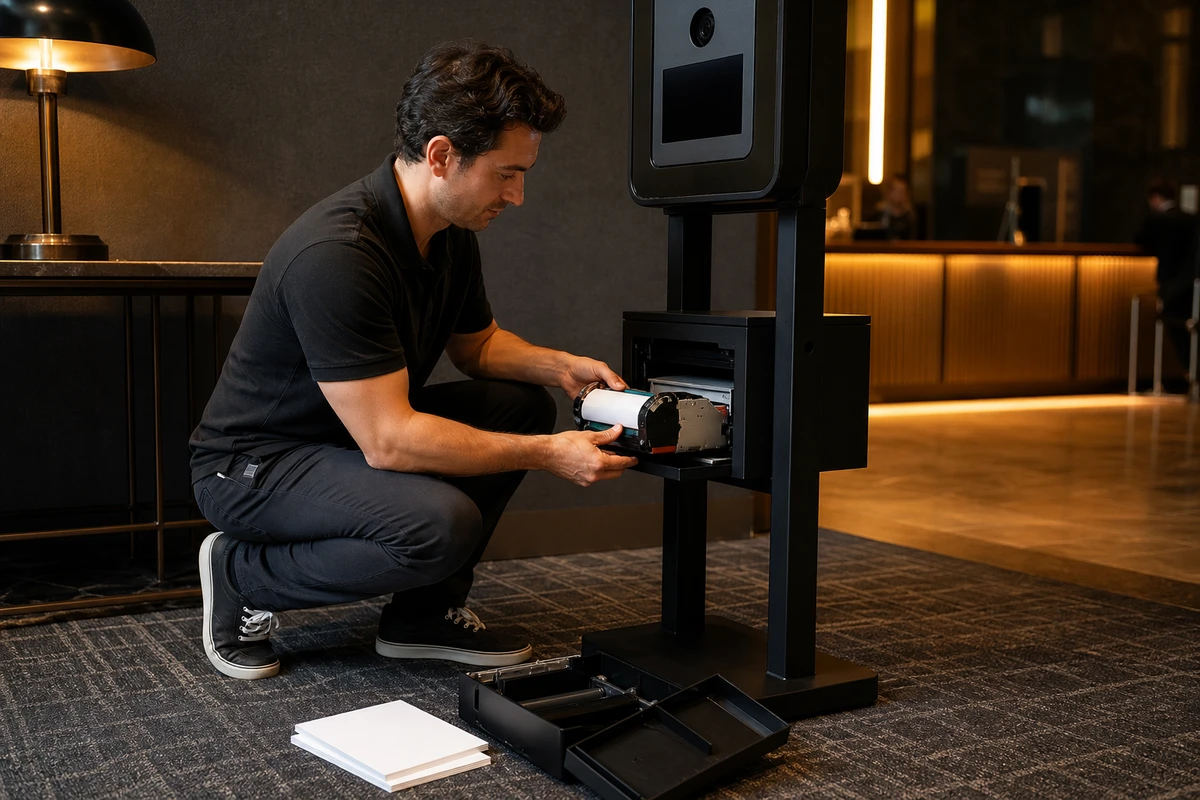
If the booth prints, consumables come next. Thermal dye-sublimation printing, the photo-booth standard, uses a combined paper-and-ribbon media kit. A DNP DS620A kit yields 800 four-by-six prints for about $179 at authorized resellers, roughly $0.22 per print in materials (Buffalo Imaging, 2026). With amortized maintenance and electricity, operators generally budget $0.20 to $0.50 per print all-in, so a booth printing 300 photos a month spends $720 to $1,800 a year on paper.
The smaller lines are still real
The smaller lines are still real. A booth that shares photos instantly needs its own reliable connection, dedicated wifi or cellular, because it cannot compete with guest traffic on the lobby network. It draws electricity continuously, and as a public-area fixture it belongs on the property’s insurance schedule. Its on-screen and printed designs need a refresh a few times a year. And it needs a maintenance path: a vendor support contract with a defined response time, or staff who can clear a paper jam and reboot a frozen app. Staffing is the swing variable. An attended booth costs labor hours every evening it runs, while an unattended booth, which most iPad-driven models support, removes that line entirely.
Which lines the hotel actually pays depends on the route. Outright purchase puts all of them on the hotel. Long-term rental and revenue-share placement typically fold maintenance, and often software, into the monthly fee or the revenue split. That bundling is not generosity; the vendor prices its own costs into the deal. But it does make a rental hotel’s operating budget simpler and more predictable than an owner’s.
Building the Number: A Three-Year Budget Scenario
Consider a select-service hotel adding a mid-range, iPad-driven booth to its lobby. The figures below are ranges drawn from the vendor pricing above; a property settles them with its own quotes and session counts, but the structure holds.
Start with the outright-purchase route
Start with the outright-purchase route. Hardware and a branded enclosure for a mid-range booth run about $8,000 to $15,000; call it $11,000. Delivery, installation, and the fabrication that makes the booth look like part of the lobby add $1,000 to $2,000, so Year 0 lands near $12,500. Then the recurring lines, every year: software, $800 to $2,300; consumables at 300 prints a month, $720 to $1,800; connectivity, $400 to $800; insurance and electricity, a few hundred dollars; a maintenance contract, $800 to $1,500; content refresh, $300 to $600. The recurring total runs roughly $3,400 to $7,300 a year, with a mid-point near $5,000. Three years of ownership therefore total about $12,500 plus three years at $5,000, or roughly $27,500 all-in. The hardware, the part the vendor quoted, is under half of it.
The long-term-rental route reshapes those three years. There is no Year 0 capital spike and no capital approval, and the vendor folds maintenance and usually software into a flat monthly fee, so the hotel’s separate line items shrink to mostly connectivity and consumables. Rental vendors do not publish their hotel rates, and each is negotiated per property. The mechanism worth understanding: a rental has to recover the same hardware cost, plus the vendor’s bundled services, plus its margin and financing cost, across the contract. Over a full three years, a rental that bundles everything generally totals more than the $27,500 ownership figure, not less. The premium buys a predictable flat line, no capital approval, and a booth the hotel can hand back. It gives up the asset.
The revenue-share placement route is the simplest to budget and the easiest to misread. The three-year spend is close to zero: no hardware, software, or maintenance line. But the booth still earns money from guests, and the hotel collects only its negotiated slice while the vendor keeps the rest. The real cost of placement is the share of three years of booth revenue the hotel signs over. For a quiet lobby that figure is small and placement is close to free money. For a busy lobby it can exceed what owning the booth outright would have cost.
Where the Money Comes Back: Modeling the Return
An owner reviewing a budget request asks one question of any new lobby fixture: does it earn back its line? A photo booth produces two kinds of return, and they are not equally easy to count.
Direct revenue
The first is direct revenue. A pay-per-play booth charges per session, commonly around $5. The same booth becomes a paid add-on or an included feature in the hotel’s events and banquet packages, where a conference, a gala, or a corporate celebration books the lobby booth as part of the event. Direct revenue is fully measurable: the software reports session counts and the hotel sets the price.
Marketing value, and it splits into a countable part
The second is marketing value, and it splits into a countable part and an uncountable one. The countable part is data. A booth that emails or texts the photo to the guest captures contact details and, with a consent checkbox, marketing permission. The Flash Pack, which runs revenue-share booths across more than 100 venues, publishes operating data from two named sites: its BrewDog Waterloo booth averaged 612 captures a month at an 18% marketing opt-in rate, and its Toca Social booth averaged 1,740 captures a month at 22% (The Flash Pack, 2026). Those are entertainment venues, not hotels, and the figures are vendor-reported, but they are real numbers from named locations. A hotel-specific figure sits in the same vendor-reported category: Simple Booth reports that its HALO kit, an iPad booth built for permanent installs, drew 31,730 participants and 92,579 gallery views from one ongoing deployment at the W Hotel Austin.
Take a hotel booth running 400 sessions a month. Operator reports put the email-capture rate at 60% to 80% when an email is required to receive the digital photo. Active marketing opt-in, the narrower share who also agree to receive marketing, runs lower: operators report an 18% to 40% band depending on how plainly the booth asks, and the Flash Pack’s high-volume venues sit at the bottom of it, at 18% to 22%. At 400 sessions and a 25% opt-in, the booth adds about 100 permissioned contacts a month, or 1,200 a year. The value of each contact is the hotel’s own number, set by what a permissioned guest is worth in repeat bookings and on-property spend. At a conservative $20 per contact, that is $24,000 a year in marketing pipeline; at $40, it is $48,000. Either way it is a measurable line, which is what an owner reviewing the request wants to see.
The uncountable part is exposure
The uncountable part is exposure. The Flash Pack’s venues saw 71% to 80% of guests share their booth content to social media, each post carrying the venue’s branding (The Flash Pack, 2026). That reach is real but cannot be banked the way an opt-in can. Event Marketer’s EventTrack survey, its annual study of marketers and consumers, reports that a majority of consumers become more likely to buy after interacting with a brand experience (Event Marketer, 2025), which supports the case that lobby content has value without letting a hotel put a precise dollar on it. An honest business case counts the per-play revenue and the opt-ins, and treats social reach as upside.
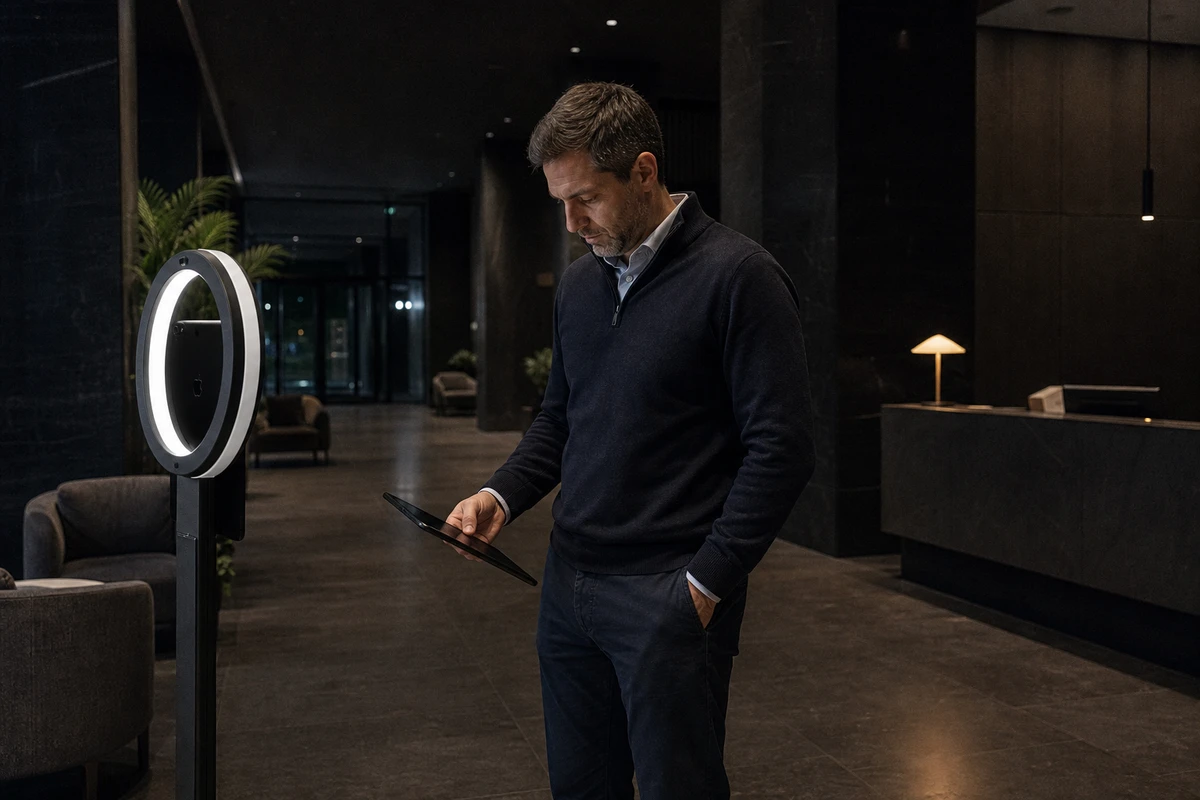
That sets up a payback period. Three years of ownership cost roughly $27,500 in the scenario above. A booth charging $5 a session and running 400 paid sessions a month generates $24,000 a year in pay-per-play revenue alone, before events bookings and before the marketing pipeline. That clears the full three-year cost inside the second year. The figure rests on two assumptions worth stating plainly: that the hotel charges guests rather than running the booth as a free amenity, and that the lobby stays busy. A quieter lobby at 100 sessions a month, or a booth offered free to guests, changes the arithmetic and may point toward the rental or placement route instead.
Approvals, Brand Standards, and the Procurement Gotchas
A hotel can have the budget approved and the route chosen and still see the booth blocked by something that never appeared in the financial model. Four items are worth clearing before signing.
Brand standards
A franchised hotel does not have a free hand with its lobby. The Plasencia Group, a hospitality investment and advisory firm, describes the Property Improvement Plan as a brand’s primary tool for enforcing physical standards, and notes that any change affecting brand presentation can trigger brand-representative review (The Plasencia Group, 2023). A booth near the front desk changes the guest arrival experience. For a flagged property the chain is layered: the GM, the owner or asset manager for a capital item, and the franchisor for anything touching the lobby’s look. Independent and boutique hotels skip the last layer, one reason placement deals concentrate among independents.
Accessibility
A guest-facing booth is a self-service kiosk in a place of public accommodation. The Kiosk Manufacturers Association notes that the U.S. Access Board is still in early rulemaking on kiosk-specific ADA standards, so no final kiosk rule exists yet, but the 2010 ADA Design Standards already govern the installation: reach ranges for operable controls, clear floor space, and no protruding objects in the path of travel (Kiosk Industry, 2024). Screen height and the clearance around the booth are decisions to settle before installation. The booth also needs floor space clear of the travel path and a dedicated outlet, which a lobby that looks spacious can still lack.
Guest data privacy
A booth that captures a guest’s photo and links it to an email address is processing personal data. GDPR Local notes that under GDPR a plain photograph with consent-based email delivery sits in an ordinary-data zone, while a booth using facial recognition to identify guests crosses into special-category biometric data under Article 9 (GDPR Local, 2025). Either way, consent must be “freely given, specific, informed, and unambiguous,” and a pre-ticked box does not count. Under California’s CPRA, biometric information is sensitive personal information that also requires explicit consent. The practical requirement is a clear privacy notice and a genuine opt-in at the booth.
Contract terms
On rental and placement deals, this is where operators most often report being surprised after signing. Before agreeing, the hotel should pin down six terms: the revenue-split percentage (never posted publicly, always negotiated), the contract length (commonly 12 to 36 months), whether the vendor demands exclusivity in the property, who handles maintenance and how fast, who carries liability if equipment is damaged or a guest is hurt, and the removal and end-of-term terms, including what happens to the captured guest data when the booth leaves. A booth that collects two years of guest data and then departs with it is a data-governance problem to solve in the contract, not at removal.
A hotel that picks the route first, runs the three-year number second, and clears brand standards, accessibility, and the contract terms third can put a defensible figure in front of an owner in a single pass. The mistake is starting from the sticker price, because that answers a question the property was never actually asking.
Frequently Asked Questions
How much does a permanent photo booth cost for a hotel?
It depends on the route. Buying a commercial-grade booth outright runs roughly $8,000 to $30,000 or more depending on form factor. A long-term rental or finance deal converts that into a fixed monthly fee, and a revenue-share placement costs close to nothing upfront in exchange for giving the vendor a share of booth revenue. Every route also carries recurring costs for software, consumables, connectivity, and maintenance.
Is a hotel photo booth a capital expense or an operating expense?
A booth bought outright, or financed toward ownership, is normally a capital expense and competes for the FF&E or capital reserve. A long-term rental or revenue-share placement is an operating expense that sits in a department budget. The split depends on the property’s capitalization threshold, often between $2,500 and $5,000, and it decides which budget and which approval path apply.
Should a hotel buy or rent a photo booth?
Buy if you want the asset, full control of guest data and branding, and all of the revenue, and you can absorb the capital approval. Rent or take a placement deal if your priority is minimal commitment, a predictable monthly cost, and the option to hand the booth back. Full-service and luxury hotels with an events business tend to buy; select-service and independent properties tend to rent or place.
Do hotels actually make money from a lobby photo booth?
Yes, through per-session pay-per-play revenue and as a paid add-on in events and banquet packages, plus the marketing value of opt-in guest contacts. Whether it clears its cost depends on session volume: a busy lobby can pay back an outright purchase within a couple of years, while a quiet one may only justify a low-commitment route.
What ongoing costs come with a permanent photo booth?
Software subscription, print consumables, connectivity, electricity, insurance, maintenance or a support contract, periodic content refresh, and staffing if the booth is attended. Outright ownership puts all of these on the hotel; rental and placement deals typically fold maintenance and software into the monthly fee or revenue split.
Who has to approve a photo booth purchase at a franchised hotel?
For a capital purchase, the general manager and the owner or asset manager. At a franchised property, the brand or franchisor also has a say, because a lobby fixture affects brand presentation and can fall under brand-standard review. Independent hotels skip the franchisor layer.
Sources
- Stroud Group (2024). “Hotel FF&E Budgeting: Expert Tips on How Much Money to Allocate.” https://www.stroudgroup.com/hotel-ffe-budgeting-expert-tips-on-how-much-money-to-allocate/
- Finoko (2025). “CAPEX in Hotels: How to Plan, Control, and Report Investments.” https://www.finoko.info/capex-in-hotels
- ServiceChannel (2026). “Hotel CapEx Budgeting Tips for 2026: From Guesswork to Confidence.” https://servicechannel.com/blog/hotel-capex-budgeting/
- Reakt Photobooths (2026). “Photobooth Rental for Hotels.” https://reaktphotobooths.com/photobooth-rental-for-hotels/
- A&A Studios (2026). “Photobooth Profit Share Vending.” https://www.aastudiosinc.com/photobooth-vending
- Snappic (2026). “Photo Booth Software Pricing Plans.” https://www.snappic.com/pricing
- Buffalo Imaging (2026). “DNP DS620A 4×6 Media Kit, 800 Prints.” https://www.buffalous.com/product/dnp-ds6204x6-media-kit-ds620a/
- The Flash Pack (2026). “Revenue Share Photo Booths.” https://itstheflashpack.com/rev-share/
- Event Marketer (2025). “EventTrack 2025.” https://www.eventmarketer.com/article/eventtrack25/
- The Plasencia Group (2023). “Slaying the PIP Dragon: Navigating Brand Mandates While Selling A Hotel.” https://tpghotels.com/slaying-the-pip-dragon-navigating-brand-mandates-while-selling-a-hotel/
- Kiosk Industry / Kiosk Manufacturers Association (2024). “ADA Kiosk Accessibility Multi-Point Checklist – Draft 2024.” https://kioskindustry.org/ada-kiosk-accessibility-multi-point-checklist-draft-2024/
- GDPR Local (2025). “Biometric Data GDPR Compliance Made Simple.” https://gdprlocal.com/biometric-data-gdpr-compliance-made-simple/