
On debond day, a teenager who has worn braces for two years watches the orthodontist lift off the last bracket. The patient runs a tongue over smooth teeth, smiles into the hand mirror, and the parent already has a phone out. In a pediatric or family practice, a smaller version of that ceremony happens a dozen times a week: a nervous child who survived a cleaning, a teen halfway through aligners, a parent who wants proof the visit went well. Those are the moments a dental office can turn into something measurable, and most of them end as a hallway selfie the practice never sees again.
The best photo booth for a dental or orthodontic office is the one that is safe to operate inside a HIPAA-covered practice, captures written photo authorization as part of the session, and routes patient enthusiasm into reviews and referrals rather than generic social posts. That single sentence rules out most of what a search for “best photo booth for dental offices” returns. The phrase hides two different purchases and one constraint that no competing guide mentions. This guide sorts all three, for the practice owner choosing the device, the office manager who will run it, and whoever handles the practice’s marketing.
Two Different Jobs People Call a “Dental Photo Booth”
A search for a dental photo booth returns two products that have almost nothing in common. One is a twenty-dollar box of cardstock props (oversized toothbrushes, speech-bubble signs) and a printable backdrop sold on Etsy or Amazon. The other is a freestanding kiosk that can cost a few thousand dollars and runs its own software. Both get filed under “photo booth.” A practice that orders the first when it needed the second has spent a purchase order and a corner of the waiting room on decoration.
The way to tell them apart is to name the job. The first job is patient experience. A booth or photo wall makes a visit feel lighter, which matters more in dentistry than in almost any other business. The American Dental Association’s JADA published the first nationally representative U.S. study of dental fear in September 2025, and it found that 72.6% of adults report being afraid of going to the dentist, with 26.8% describing that fear as severe. A playful, low-stakes activity in the waiting room gives a child or a nervous teen something to focus on besides the chair, and a reason to associate the office with a good feeling rather than a clinical one. This job is strongest in pediatric and family practices, and in orthodontics it peaks on debond day.
The second job is practice growth
The second job is practice growth. Here the booth is not amusement, it is an instrument. A session ends with a contact the patient has chosen to share, a prompt to leave a review, a referral link in the patient’s hand, and a branded photo that travels to a social feed with the practice’s name on it.
Most practices want both jobs done
Most practices want both jobs done. The booth they should actually buy is decided by which job leads, because the patient-experience job can be satisfied by a ring light and a frame, and the growth job cannot. Katy ClearChoice Orthodontics in Texas documented its own photo station in 2021: a ring light, a magnetic picture frame, and word magnets. Patients love it. It also captures no contact, sends no photo to anyone’s phone, and prompts no review. Castle Orthodontics in California runs a more polished version with a dedicated photo-booth gallery page. Both are patient-experience plays. Neither is a growth engine, and a practice that wants the second outcome should not buy hardware built only for the first.
The Constraint No Other Guide Mentions: A Dental Office Is a HIPAA-Covered Practice
A restaurant can stand a photo booth by the door, let a guest text themselves a picture, and the worst thing that happens is an unflattering photo. A dental office cannot treat the device that casually. The moment a camera points at a patient inside a clinic, the practice is operating a compliance surface, and every guide currently ranking for this keyword is silent on it.
A dental or orthodontic practice is a covered entity under HIPAA. The HIPAA Privacy Rule (45 CFR § 164.508) requires a covered entity to obtain valid written authorization before using or disclosing a patient’s protected health information for marketing. An identifiable patient photo used in a social post, on the website, or in the practice’s own feed is exactly that kind of use. The authorization has to be in writing, signed and dated, and it has to name what is being used, who may use it, and the purpose. The patient keeps the right to revoke it. A practice also cannot make treatment conditional on signing it, so the consent step has to be genuinely optional.
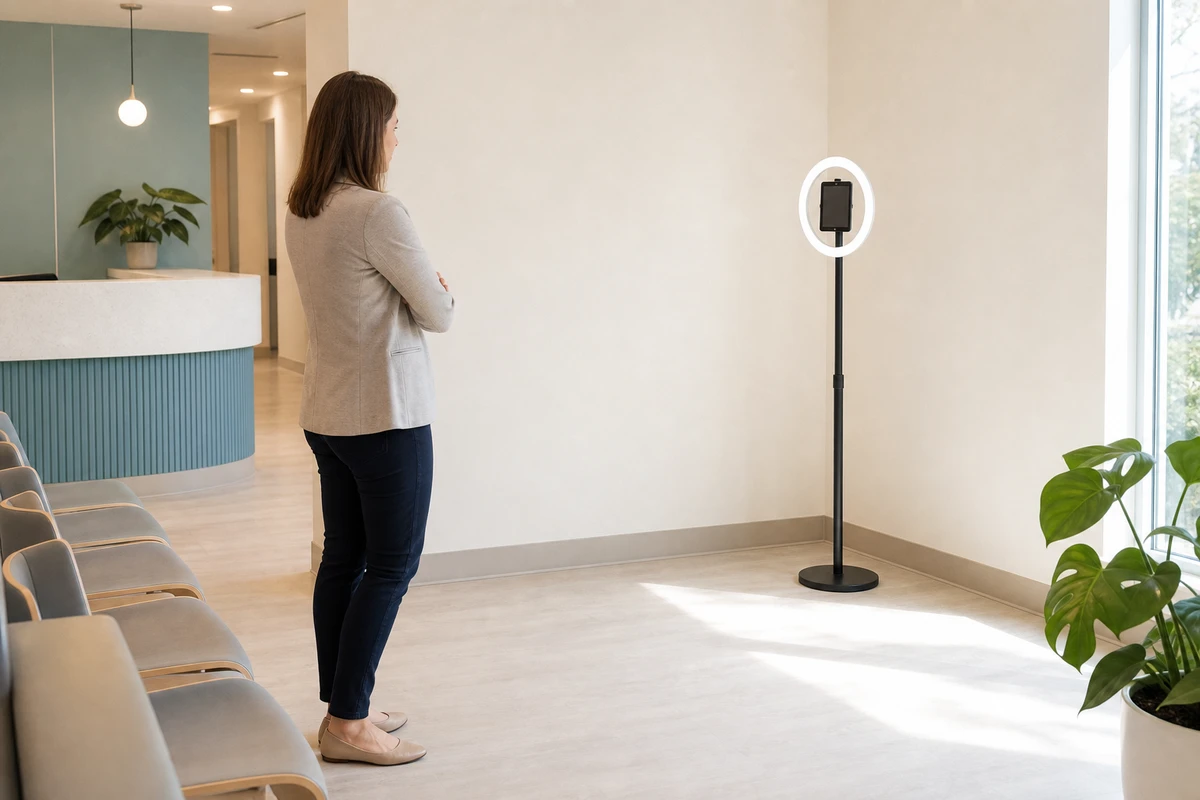
Two parts of this rule reshape the buying decision. The first is the background. A photo is a disclosure of whatever sits in the frame, not only the patient who posed for it. If a monitor showing a schedule, a sign-in sheet, or another patient’s face appears behind the subject, the practice has disclosed that information too. RevenueWell’s guidance for dental teams puts it plainly: practices should designate a specific area for any patient photography so protected information never lands in the background. A booth’s placement is therefore a compliance decision, not an interior-design one.
The second part is minors
The second part is minors. An orthodontic lobby is full of teenagers, and a minor generally cannot authorize the marketing use of their own image. A parent or guardian has to sign. A booth that lets a photo leave the building with one tap, with no checkpoint for who is standing in front of it, cannot tell a 15-year-old patient from an adult. The Florida Dental Association’s best-practice guidance on patient images, published in 2025, reinforces the same point from the state-association side: a signed media consent form is required before any image is shared, and the patient must be able to revoke that consent easily.
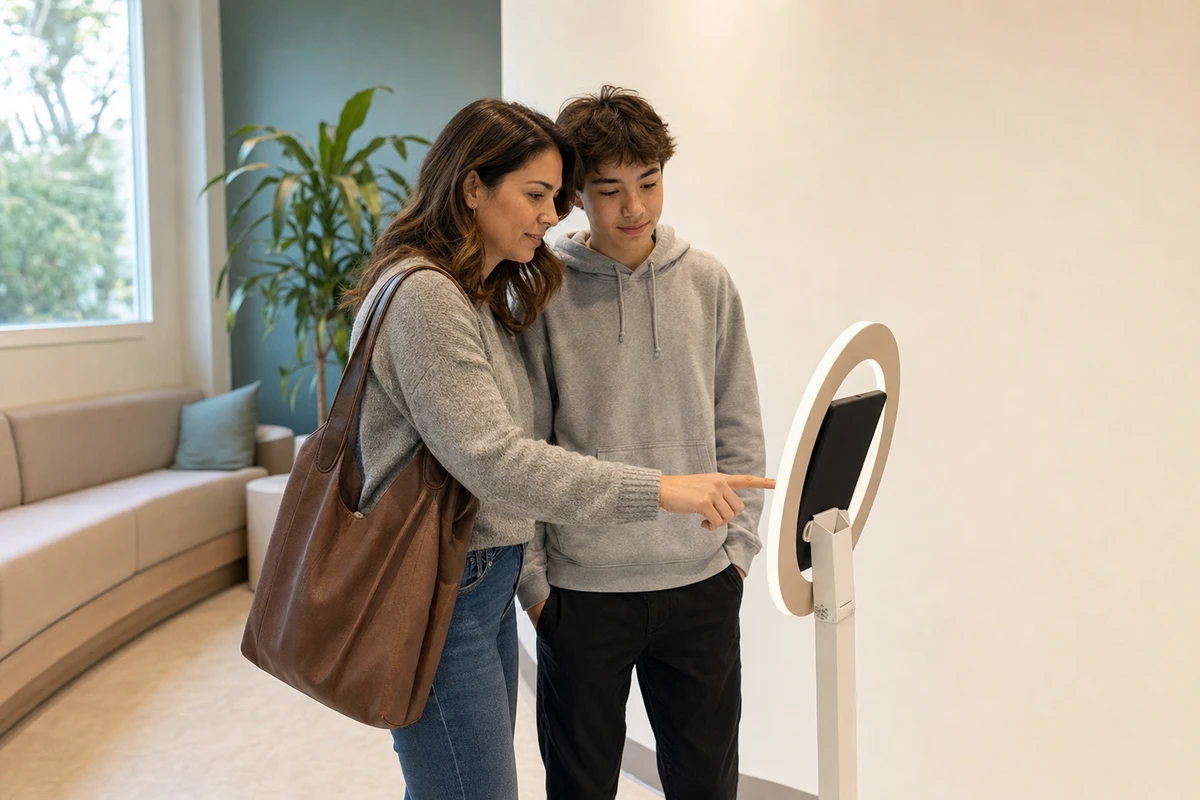
This is why “best” means something different in dentistry. The best booth for a dental office builds the consent step into the session itself, a clear, logged opt-in that has to happen before a photo can be shared, so compliance is designed in rather than bolted on by a front desk that is already busy. A booth that is excellent in a retail store or a hotel lobby can be disqualified here for one reason: it shares first and asks later.
What “Best” Actually Means Here: The Buying Criteria
A practice owner sitting through a booth demo is shown filters, a touchscreen, and a slideshow of happy patients. None of that answers whether the device belongs in a dental office. The two jobs and the one constraint turn into a checklist that does, and any booth can be held against it line by line.
Built-in consent capture
- Built-in consent capture. The session has to include an explicit, logged photo-authorization step before any image can be shared. For this vertical it is the first filter, not a nice-to-have. A product that cannot show, in its own records, who authorized what does not belong in a clinic.
- Unattended, reliable operation. The device sits in a reception area for a full day with no staff babysitting it. That means a locked-down tablet or kiosk, automatic recovery after a crash, and simple delivery of the photo by QR code, text, or email. An event-rental unit that needs an attendant fails this test.
- Practice branding. Every photo that leaves the building should carry the practice name and handle. The patient’s phone then becomes distribution. A brand-neutral amusement kiosk spends the same patient goodwill and keeps none of the credit.
- Review routing. The session should be able to invite a Google review at the right moment, after a visit that went well. Reviews are this audience’s scoreboard, and a booth that cannot connect to them leaves its main payoff on the table.
- Referral hook. The booth should put a referral offer or link in the patient’s hand while the visit still feels good, not days later in an email that competes with everything else in the inbox.
- Before-and-after capability. Orthodontics runs on visible change. A booth that can capture a treatment-start image and pair it with a debond-day image gives the practice a branded before-and-after asset, usable later with written consent.
- Kid-safe and durable. A pediatric lobby is hard on hardware. The device has to be physically secured and simple enough for an unsupervised eight-year-old to operate without help.
- Data ownership. The opt-in contacts and the media library should belong to the practice, with clear records of every authorization. If the vendor holds the data, the practice has rented an audience instead of building one.
- Event portability. Practices market at school screenings, health fairs, and community days. A booth that converts to a portable stand does the same job off-site and captures contacts from prospective families.
The category’s dominant niche product, BuzzyBooth (a vendor-published dental and orthodontic kiosk), advertises most of this list: review-request automation, referral software, an analytics dashboard, and a convertible event stand. That a single-product vendor has built toward these features is useful confirmation of what the category should deliver. It is not a reason to skip the checklist. The same checklist applies to general-purpose commercial booths, not only dental-niche kiosks. Simple Booth’s HALO kit is built for venues rather than clinics, but its session can carry custom data fields and an opt-in checkbox, so an office manager can build the practice’s own photo-authorization step into the session itself and keep the exportable opt-in records under the practice’s control. The point of the criteria is to let a practice evaluate any product, including the one a sales rep is currently demonstrating.
The Growth Mechanism: How a Booth Becomes Reviews and Referrals
A patient finishes a cleaning, tells the hygienist it was the easiest visit in years, pays at the front desk, and leaves. Nobody asked for a review. Nobody asked who else in the family needs a dentist. The goodwill walks out the door with the patient. That is the gap a booth closes, and the reason it works is timing, not loyalty.
The gap is measurable
The gap is measurable. Compiled healthcare-referral data from GrowSurf, drawing on a Software Advice survey, reports that 65% of patients say they would refer their provider if asked, while only 12% are actually asked. The problem operators describe is not a satisfaction problem, it is a prompting problem. A booth placed at the exit is a prompt that fires every time, at the one moment the visit is freshest. It converts a feeling that would otherwise fade into three things that last: a review, a referral, and a branded photo in someone’s feed.
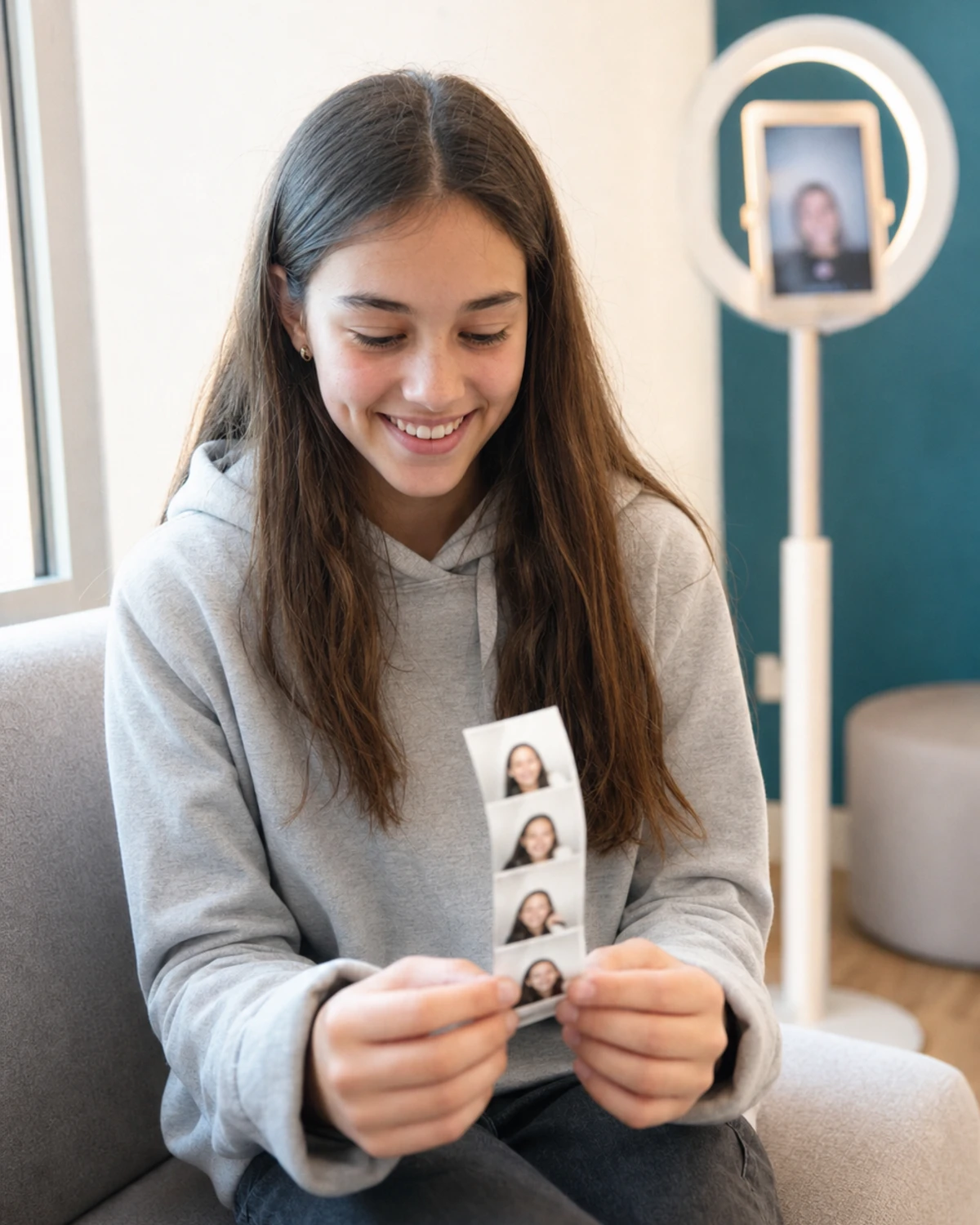
Reviews are worth isolating because they compound. BrightLocal’s Local Consumer Review Survey 2026 found that 97% of consumers read reviews for local businesses, and that the share who “always” read them rose to 41%. A prospective patient comparing two practices is reading reviews before booking. Count and recency are not vanity metrics: Whitespark’s annual Local Search Ranking Factors report and BrightLocal’s ranking-factors work both place review signals among the strongest influences on Google’s local pack, and an orthodontic-specific analysis from Nexunom puts review-related factors at roughly a 16% impact on local-pack ranking.
A booth that lifts review velocity from one or two a month to ten can move where the practice appears when a parent searches for an orthodontist nearby. Curogram’s practice-facing review guide makes the same point from the operator side: review frequency, not just star rating, is what Google rewards.
Referrals carry the larger dollar figure
Referrals carry the larger dollar figure. The Medical Group Management Association, cited in GrowSurf’s compiled data, attributes 40% to 65% of new-patient acquisition in healthcare practices to referrals, and PatientPop’s figure puts word-of-mouth at 38% of new patients for the average practice. Accenture Health data, in the same compilation, reports that referred patients carry roughly 30% higher lifetime value and a 25% higher retention rate than patients from other channels. A referred patient is not just one more case, it is a longer, more complete one. The booth’s job in this mechanism is narrow and specific: be the thing that asks.
Running the Numbers Before Buying a Booth
The case for a booth should survive contact with arithmetic. Take a practice that sees 300 patient visits a month, and label every figure below as the assumption it is.
Assume a quarter of those patients stop at a lobby booth on the way out, which is 75 sessions a month. Assume 40% of those users accept a review prompt after a visit that went well, and that a third of the people who accept actually post a Google review. That chain produces about 10 new reviews a month (75 × 0.40 × 0.33 ≈ 10). For a practice that was earning one or two reviews a month, that is a different local-search profile within a single quarter, with the kind of review volume and recency that the Whitespark and BrightLocal evidence above ties to local-pack ranking.
Now the referral line
Now the referral line. Assume 5% of booth users actually hand a referral link to someone, roughly 4 referrals a month, or about 48 a year. Assume one in four of those referred people books a consultation, and one in two consultations becomes a case. That is about 6 new cases a year. The American Association of Orthodontists, in its guidance on the cost of braces, declines to publish a single national average and stresses how widely treatment cost varies, but independent dental-cost sources consistently place comprehensive orthodontic treatment in the $3,000 to $7,000-plus range. Using a deliberately conservative $5,000 per case, those 6 referred cases represent about $30,000 in new case value a year.
Every number in that chain is a dial. A pediatric practice with lower case values and higher visit volume produces a different shape than a single-doctor orthodontic office with a $6,000 average case and a slow lobby. The figures are illustrative, and a practice should rebuild the chain with its own visit count, its own opt-in rates, and its own case value. What does not change is the structure: a booth that costs a few thousand dollars is measured against a review line and a referral line, and in most practices the referral line alone clears the device cost well inside the first year. A product that cannot be connected to either line cannot be evaluated this way at all, which is the real reason the buying criteria matter.
Where to Put It and How to Run It
Placement is the first operational decision, and in a dental office it is also the compliance decision from the earlier section. The default spot is the reception or waiting area, but only where the camera’s field of view contains no monitor, no schedule board, no sign-in sheet, and no other patient. Walk the room, sit where the booth will sit, and look at what the lens sees. If protected information is in the frame, the booth moves.
The highest-yield trigger in orthodontics is debond day
The highest-yield trigger in orthodontics is debond day. A patient who has just had braces removed is at a peak the practice will not see again in that treatment, and a booth positioned near the debond chair captures it while it is happening. The treatment-start photo is its pair: taken on bonding day, it becomes half of a before-and-after set the practice can use later with written authorization. In a general or pediatric practice, the equivalent moments are a child’s first cleaning without tears and the end of a long restorative visit.
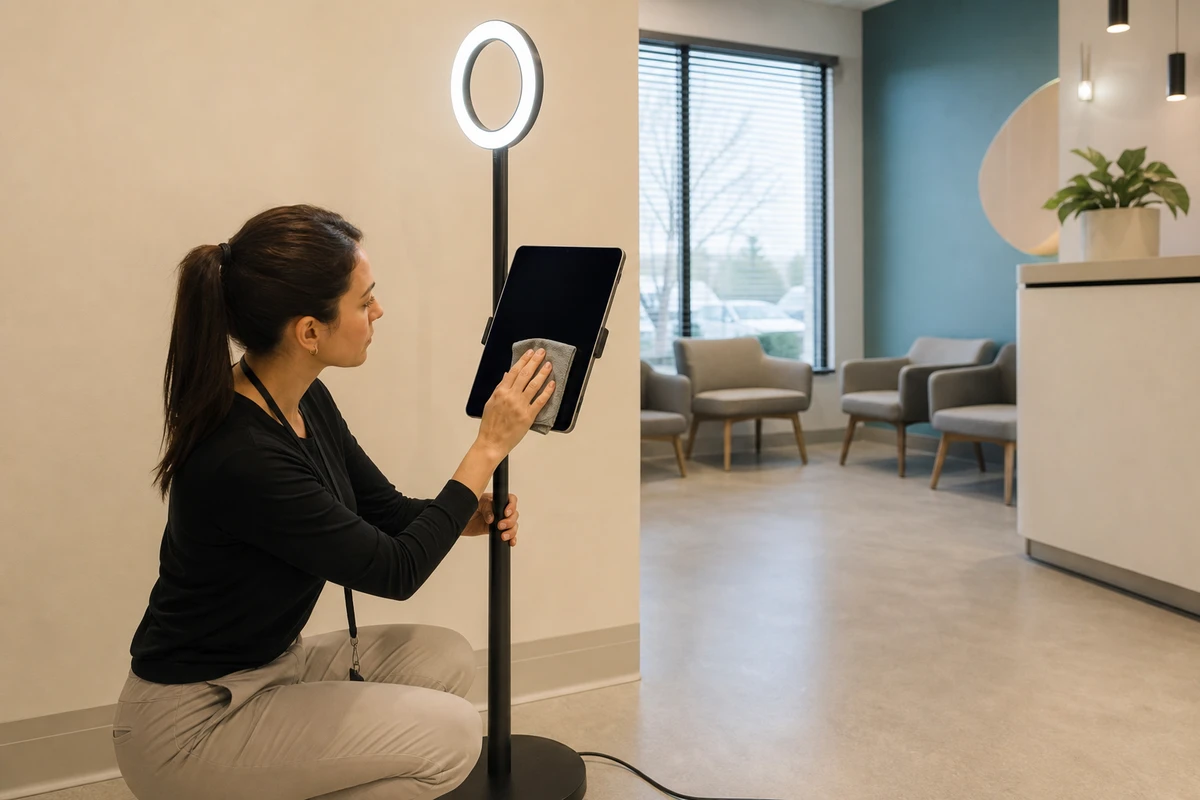
The staff workflow has to be almost nothing. A booth that requires the front desk to operate it will be skipped on a busy morning. The device should run itself, and the team’s only task is a single spoken line as the patient leaves, something close to “grab a photo on the way out.” For pediatric lobbies, add the physical considerations: mount it at a child’s height, secure it against a determined eight-year-old, and place it within a staff sightline so an unsupervised child stays visible.
The booth also does not have to stay in the building. School screenings, career days, health fairs, and community sponsorships put the practice in front of prospective families, and a booth that converts to a portable stand captures opt-in contacts at those events the same way it does in the lobby. One framing matters more than any placement detail: a dental photo booth is a permanent fixture, not a one-day event rental. Its value comes from running every day the practice is open, which is also why an attended rental unit is the wrong tool for the job.
Common Mistakes Dental Offices Make
The same errors show up across practices, and each one has a short fix.
- Buying props instead of an instrument. A backdrop and a box of cardstock teeth photograph well and measure nothing. If the goal is growth, the prop kit is the wrong purchase, regardless of how good it looks on opening day.
- Treating the booth as decor. A booth no patient is prompted to use, whose sessions end without a review prompt or a captured contact, is furniture. The fix is a session flow that ends in an action and a one-line staff prompt that sends patients to it.
- Ignoring consent until a photo is already public. A media authorization that lives in a binder at the front desk, or nowhere, is not consent the practice can prove. The authorization step has to live inside the session, before the photo can move.
- Placing the camera where PHI is in the frame. A monitor, a whiteboard schedule, or a sign-in sheet behind the subject turns a marketing asset into a disclosure. This is a placement audit, and it takes ten minutes.
- Buying an event-rental booth that needs an attendant. A staffed rental unit cannot sit unattended in a lobby for office hours. The practice needs a fixture, not a rental.
- Letting the vendor keep the data. If the opt-in contacts and the media library belong to the vendor’s platform, the practice has rented an audience. Ownership of the contact list and the authorization records should sit with the practice.
- Forgetting parental consent for minors. An orthodontic lobby is mostly teenagers. A booth flow that assumes an adult is authorizing the image will, sooner or later, share a minor’s photo without a guardian’s signature.
How to Decide in One Pass
A practice can settle this purchase by running five checks in order.
Name the lead job
First, name the lead job. If the booth exists mainly to make visits feel lighter, a simple photo station satisfies that and the budget can stay small. If it exists to grow the practice, only an instrument with capture and routing qualifies.
Verify Logged Authorization
Second, confirm the product captures written, logged authorization inside the session. If it cannot show who authorized what, stop there.
Confirm it runs unattended through a full office day
Third, confirm it runs unattended through a full office day and that every photo it sends carries the practice’s branding.
Route Reviews and Referrals
Fourth, confirm it routes to reviews and referrals, and that the practice, not the vendor, owns the resulting contacts and media.
Confirm the booth can be placed where no protected
Fifth, confirm the booth can be placed where no protected information enters the frame.
A product can be attractive, well-reviewed, and popular in other industries and still fail check two or check five. In a dental office, either failure is disqualifying, because the cost of getting consent or background PHI wrong is not a bad photo, it is a regulatory event. The deeper questions (hardware form factors, the buy-versus-rent decision, and the longer-run economics of a permanent booth) are worth working through before signing. But the order above is what separates a device a dental practice can actually run from one that merely looks good in a showroom: decide the job, prove the booth is safe to operate inside a clinic, and only then judge how well it sells.
Sources
- Electronic Code of Federal Regulations (2026). “Title 45, § 164.508 — Uses and disclosures for which an authorization is required.” https://www.ecfr.gov/current/title-45/subtitle-A/subchapter-C/part-164/subpart-E/section-164.508
- Florida Dental Association (2025). “How to Safeguard Patient Images: HIPAA Best Practices.” https://blog.floridadental.org/2025/10/23/how-to-safeguard-patient-images-hipaa-best-practices/
- RevenueWell (2018). “How to Stay HIPAA Compliant on Social Media.” https://www.revenuewell.com/article/hipaa-compliance-dental-social-media
- ADA News / Journal of the American Dental Association (2025). “September JADA finds dental fear still prevalent in US.” https://adanews.ada.org/ada-news/2025/september/september-jada-finds-dental-fear-still-prevalent-in-us/
- BrightLocal (2026). “Local Consumer Review Survey 2026.” https://www.brightlocal.com/research/local-consumer-review-survey/
- Whitespark (2025). “Local Search Ranking Factors 2026.” https://whitespark.ca/local-search-ranking-factors/
- Nexunom (2024). “The Importance of Patient Reviews: Why Google Reviews are Vital for Orthodontists.” https://nexunom.com/digital-marketing-guides/importance-of-patient-reviews-for-orthodontic-practices/
- Curogram (2025). “How to Get Reviews for Orthodontists in 2025.” https://curogram.com/blog/how-to-get-reviews-for-orthodontists-in-2025
- GrowSurf (2026). “35+ Healthcare Referral Statistics and Patient Acquisition Data for 2026.” https://growsurf.com/statistics/health-referral-statistics/
- American Association of Orthodontists (2025). “How Much Do Braces Cost? Financing Options for Orthodontic Treatment.” https://aaoinfo.org/whats-trending/how-much-do-braces-cost/
- Castle Orthodontics (2026). “Photo Booth.” https://www.castle-orthodontics.com/photo-booth
- KCC Orthodontics (2021). “KCC Orthodontics has a Photo Station!” https://kccortho.com/kcc-orthodontics-has-a-photo-station/